New studies on Francisco de Vitoria in the 21st century: legacy, debates and current events
Introduction: why Vitoria matters today
Francisco de Vitoria continues to be a central figure for understanding the history of legal and political thought in Europe in the 16th and 17th centuries. However, its relevance is not limited to historical reconstruction. In the 21st century, studies on Vitoria have experienced a new interpretive wave that revalues its teaching from multiple perspectives: legal, moral, political and geohistorical. This renewed attention responds to an interest in recovering theoretical frameworks capable of illuminating contemporary problems such as sovereignty, collective rights, the legitimacy of intervention and the relationships between political powers and universal norms.
In this article I offer a critical overview of the main axes of recent research on Vitoria. The intention is twofold: to present historiographical advances and, at the same time, show how these readings can contribute to current debates. Beyond erudition, it is about understanding Vitoria as an interlocutor of the present, capable of providing conceptual resources to think about global justice, international law and public ethics.
My approach combines a close reading of the classical sources of the Salamanca School with the discussion of contemporary bibliography. I will not compete here with critical editions or specialized works in philology; Instead, I will try to synthesize the most relevant findings and show their practical and theoretical projection. In doing so, I will maintain accessible language for university students and professors interested in the intersection of legal history, political philosophy, and moral economy.
New approaches to Francisco de Vitoria
New historiographical perspectives
One of the most notable transformations in studies on Vitoria is the methodological change. Recent research incorporates tools from global history, the history of intellectual networks, and microhistory. This allows rereadings of Vitoria to be situated in broader contexts: not only as a teacher of theology and law in Salamanca, but as a node in a network of intellectual exchanges that spanned Europe and the Atlantic. These approaches emphasize the circulation of ideas, manuscripts, and students, and how these circulations influenced local readings and concrete political practices.
Another important shift is the attention to the material and archival dimensions. Contemporary studies have reopened archives and have examined administrative documents, letters and university records that allow us to reconstruct the teaching practice and internal debates of the University of Salamanca. From this perspective, Vitoria appears less like a timeless author and more like a professor immersed in concrete disputes about jurisdiction, property, and just war. This approach forces us to qualify anachronistic readings and to better understand the flexibility and limitations of their arguments.
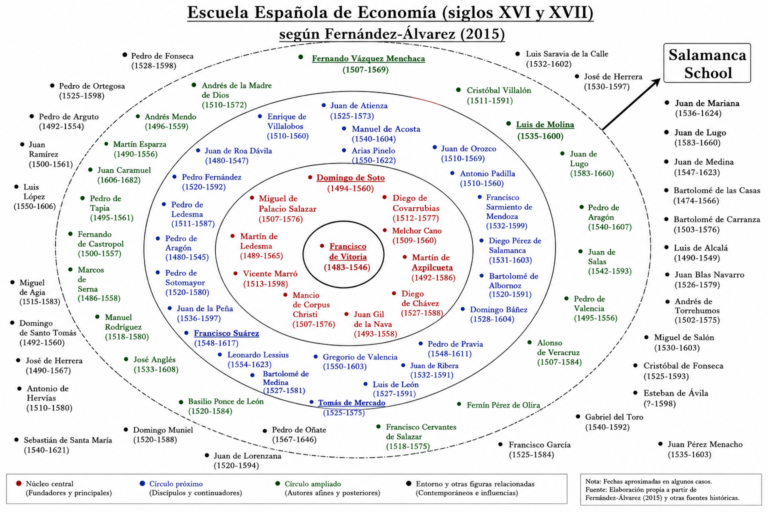
Finally, comparative intellectual history has favored readings that link Vitoria with other contemporary authors of the Salamanca School, such as Domingo de Soto, Martín de Azpilcueta, Luis de Molina and, in later stages, Francisco Suárez. These comparisons help to draw a map of affinities and internal tensions that enrich the interpretation of Vitorean work. Altogether, the new methodologies allow the figure of Vitoria to be moved from a monolithic pedestal towards a plural and dialogic presence.
Vitoria and global history
The global history category has been particularly fruitful for rethinking Vitoria. Instead of studying his ideas in isolation, we investigate how his lessons interacted with specific problems of the Spanish empire, evangelization and Atlantic trade. This perspective shows that many of their concerns—legitimacy of dominion, rights of indigenous peoples, limits on war—arose in dialogue with very specific historical events.
By incorporating American and administrative sources, contemporary researchers recover the practical dimension of Vitoria’s “relections.” His classes responded, to a large extent, to questions posed by the imperial government and by agents involved in the conquest and administration of the new lands. This dialogue between theory and practice is one of the keys to understanding why his approaches have continued to be relevant.
Furthermore, global history allows us to place Vitoria’s reception outside of Spain. His ideas circulated through European religious, diplomatic and academic networks; They influenced debates about trade, sovereignty and legitimacy that transcended the Hispanic context. Recognizing this breadth of reception questions a nationalist or provincial reading of the Salamancan thinker.
International law and the Vitorean heritage
One of the reasons why Vitoria remains at the center of contemporary reflection is its contribution to the foundations of international law. His lessons on the law of nations and the nature of rights have been interpreted, from different angles, as precursors of concepts that today form part of public international law. However, modern readings differ: some highlight its moral universalism; others highlight its limitations in terms of practical applicability and its dependence on religious frameworks.
Vitoria articulated a distinction between natural law, divine law, and positive law that allowed him to address issues such as the legitimacy of conquest and the sovereignty of peoples. For him, certain rights—such as the right to property for use and the freedom of people—had a rational foundation that must be respected. This rational basis opened a way to argue against abuses committed in the name of conversion or discovery. In contemporary terms, we can see in these arguments an early invitation to normativize intersubjective relations between diverse political communities.
However, the translation of Vitorean reflections into the corpus of modern international law requires caution. Its categories were embedded in a theological and scholastic framework that does not coincide with current secular and procedural assumptions. Current research works, therefore, on two fronts: on the one hand, recovering Vitoria’s normative intuition; on the other, to delimit what can be transferred to contemporary legal language without forcing anachronistic analogies.
Francisco de Vitoria in contemporary research
From the law of people to collective rights
A relevant contribution today is the reinterpretation of Vitore’s “law of people” as a precursor to the idea of collective rights. Contemporary studies show that Vitoria not only thought about individual rights, but also recognized communities’ own reality and rights in the face of invasions and external provisions. This opens a useful reading path for debates about indigenous peoples, collective rights and their fit into modern constitutional frameworks.
From this interpretation, Vitoria offers a framework to argue in favor of the recognition of cultural and territorial autonomy without the need to resort to purely ethnographic or identity concepts. His argument is based on rational dignity and principles of justice that, although formulated in scholastic terms, can dialogue with contemporary human rights.
This rereading contributes to deactivating simplistic versions that presented the Salamanca School as an apologist for colonization. Although the colonial context in which these authors worked cannot be annulled, it is possible to recognize critical resources in their texts that served as a basis for questioning abusive legitimacies.
Just war, intervention and international order
Vitoria’s reflections on the just war have attracted much recent interest. In a world marked by interventions, occupations, and disputes over the legitimacy of the use of force, the questions Vitoria raised about just causes, proportionality, and legitimate authority seem surprisingly contemporary. However, doctrinal developments of the 21st century show that the conditions of self-defense, the responsibility to protect and humanitarian intervention differ essentially from the assumptions of the 16th century.
Vitoria maintained that only legitimate authority could declare war and that war must conform to strict moral conditions. He also stated that just cause could not be invoked to justify enslavement or unjust expropriation. These statements were used, at times, to criticize colonial excesses. However, the concrete applications of his criteria were not always easy or consistent in imperial practice.
Currently, discussions about the legality of interventions benefit from a critical reading of the Vitorean tradition. For example, his insistence on placing moral limits on hostility and on protecting non-combatants speaks directly to debates about international humanitarian law and the responsibility to protect. However, the leap from scholastic argumentation to the formulation of contemporary international norms requires a process of theoretical reconstruction that preserves the principles while adapting the procedural rules.
Authority, legitimacy and non-state actors
One aspect that recent studies highlight is the Vitorean conception of authority. For Vitoria, the legitimacy of collective actions depends on the authority that promotes them and their conformity with justice. This vision presents a tension with the emergence in the 21st century of powerful non-state actors: transnational companies, NGOs, supranational organizations. How to incorporate these actors into a framework that privileges traditional political authority?
Contemporary research proposes reading Vitoria as a starting point to discuss the accountability and legitimacy of public action, not just state ones. His emphasis on justice as a criterion for judging authority can be extended to forms of global governance if interpreted dynamically. This approach requires, however, introducing control procedures and equity principles that Vitoria did not develop in detail.
In short, the Vitorean heritage provides moral criteria to evaluate the exercise of power, but its adaptation to the plurality of contemporary actors requires a theoretical and legal reformatting. The new studies work precisely on this reformatting, seeking bridges between historical principles and contemporary rules.
Moral economy: Vitoria and the economic issues of its time
Another field of interest is the relationship between Vitoria and the moral economy. Although he is not an economist in the modern sense, his reflections on fair prices, credit, and treatment of indigenous people open dialogues with current problems of political economy and economic ethics. The Salamanca School, in general, developed concepts that anticipate discussions about usury, contracts and the market that we consider fundamental today.
Vitoria, together with authors such as Martín de Azpilcueta and Domingo de Soto, contributed to a vocabulary and analytical criteria that allow economic practices to be judged in the light of justice. Its insistence on the notion of the common good and the limitation of power for the sake of equity offers resources to discuss structural inequalities and the legitimacy of certain economic policies.
In the 21st century, these contributions are useful for reflecting on social responsibility, financial regulation and economic rights. Although institutional frameworks have changed radically, the question of what makes an economic transaction fair remains relevant. Recent studies critically rescue Salamancan intuitions to illuminate contemporary debates without falling into anachronisms.
Property, commerce and ethics of exchange
Vitoria discussed the property based on criteria of use and justice. He did not accept a purely absolutist conception of property rights; Ethical limits linked to the common good appear in his lessons. These perspectives have been reexamined to think about current problems: rights over common resources, sovereignty over natural goods and distributive justice.
Regarding trade, the Salamanca School developed reflections that anticipate notions of market and contract based on trust and equity. Vitoria and his contemporaries criticized abusive practices and offered arguments in favor of fair contracts and the moral control of usury. Such arguments today allow us to rethink financial regulation and the ethical principles that should guide transnational exchange.
Current studies contrast these ideas with neoliberal acceleration and market globalization. In this contrast, the power of an economic ethic is discovered that does not reduce justice to efficiency but rather incorporates human and community purposes in the evaluation of economic policies.
Receptions and controversies: myth and criticism
Vitoria’s intellectual biography cannot be understood without attending to the receptions that have shaped his image. For centuries, his figure was the object of contradictory readings: hagiographies that showed him as a pioneer of human rights and criticism that branded him a theoretical accomplice of the colonial order. The 21st century has brought a more nuanced attitude that recognizes ambivalences and tensions in his work.
A recurring criticism points out that, despite his arguments in favor of the indigenous people, Vitoria did not propose a radical program of decolonization nor did he question the imperial system in its entirety. Contemporary studies accept this reproach, but contextualize it: Vitoria acted within institutional and methodological limits that conditioned its scope. Recognizing these limits does not invalidate its normative contributions; places them in their complexity.
Another focus of controversy is the use of Vitoria in contemporary political debates. His figure has been invoked by both progressive and conservative discourses. Recent research warns about the anachronistic and rhetorical use of his name. Instead of instrumentalizing it, they propose a critical reading that allows us to extract useful theoretical resources for today without distorting its intellectual history.
Myths and demystifications
Among the most widespread myths is the idea that Vitoria was the “inventor” of international law. This formulation simplifies: Vitoria was decisive in the articulation of arguments about the “law of people”, but the historical construction of international law implies multiple subsequent contributions and material conditions that were only consolidated much later.
By demystifying this figure we do not seek to diminish its relevance. Rather, it is about placing it in a complex genealogy where its contributions constituted an initial impulse that other authors and institutional processes transformed over time. Contemporary historiographical criticism therefore seeks to avoid heroic readings and replace them with more precise interpretive maps.
This demystification also allows us to open the space to recognize other thinkers and cultures that influenced the formation of international thought. Thus, Vitoria’s work becomes a piece within a plural concert of legal ideas and practices.
Implications for the contemporary debate on human rights
Studies on Vitoria have contributed to rethinking the genealogy of human rights. It is not about affirming an unbroken line from scholasticism to the Universal Declaration; rather, there is a continuum of normative concerns: human dignity, limits on violence, and recognition of basic rights. Vitoria is a key figure in that early history.
In the 21st century, where the universality of rights is contrasted with cultural and collective demands, the Vitorean categories offer resources to harmonize universalism and pluralism. Its emphasis on rationality and minimum principles of justice can operate as a bridge between demands for cultural recognition and demands for universally applicable legal rules.
However, the transposition of these principles requires conceptual translation work: converting scholastic intuitions into procedural norms and institutions that guarantee compliance and protection. Recent studies on Vitoria contribute to this work of translation, offering a critical repertoire to rethink the foundation of human rights in a plural world.
Vitoria in university teaching: challenges and opportunities
Incorporating Vitoria into university education implies pedagogical challenges and didactic opportunities. On the one hand, its scholastic language and its historical context require mediations that facilitate access to non-specialized students. On the other hand, its problems offer transversal themes of enormous relevance, from the legitimacy of war to economic justice.
An effective pedagogical strategy consists of articulating readings of their texts with contemporary case studies. For example, confronting “relections” on the law of nations with current debates on the exploitation of natural resources or the protection of indigenous peoples allows students to understand the continuity and transformation of essential problems.
Another opportunity is the use of interdisciplinary seminars that integrate law, history, and philosophy. Vitoria works well as a meeting point between disciplines. His work invites learning that combines conceptual analysis with historical sensitivity and ethical commitment.
Tools for the classroom
To facilitate teaching work, it is necessary to resort to translated critical editions and teaching materials that explain historical contexts and scholastic concepts. Likewise, it is useful to use active methodologies: debates, simulations and research projects that allow students to apply Vitorean criteria to contemporary problems.
The use of primary sources in translation helps to develop critical skills. Students learn to compare arguments, detect assumptions, and evaluate the applicability of ancient principles to modern situations. These skills are valuable for both legal and philosophical and historical training.
Finally, promoting critical readings that recognize both the value and limitations of Vitoria fosters an academic culture that values complexity and avoids reductionism.
Conclusion: lessons for our times
The new studies on Francisco de Vitoria offer a richer and more complex panorama than traditional readings. Far from turning him into a univocal archetype, contemporary research presents him as a plural author: at the same time critical, alien to radicalism and deeply committed to the practical dilemmas of his time. This plurality is precisely what makes it possible to draw useful lessons for the present.
Among the most valuable lessons is the insistence on the moral evaluation of authority, the normative status of justice in international relations, and attention to the rights of collective communities. These concerns are relevant to contemporary issues such as the protection of indigenous peoples, the regulation of the use of force, and the ethics of global trade. Without leaving aside historical differences, the Vitorean tradition offers conceptual resources that, correctly translated, can enrich contemporary theory and practice.
In short, Vitoria continues to be a fruitful interlocutor. Twenty-first century studies do not idolize him or dismiss him; They insert it into historical networks and subject it to criticism. That combination of historical respect and academic demand is the best way to make tradition a living tool for thinking and acting in the present.
References
– Vitoria, F. (1991). Political Writings (A. Pagden, Ed.). Cambridge University Press.
– Pagden, A. (1982). The Fall of Natural Man: The American Indian and the Origins of Comparative Ethnology. Cambridge University Press.
– Noonan, J. T., Jr. (1957). The Scholastic Analysis of Usury. Harvard University Press.
– Suárez, F. (1612). De legibus ac Deo legislatore.
– Works and lessons from the Salamanca School: texts by Domingo de Soto, Martín de Azpilcueta and Luis de Molina, in critical editions and contemporary translations, for academic consultation.