The Council of Trent and the Salamanca influence: Law, theology and contemporary legacy
Introduction: why the dialogue between Trento and Salamanca matters today
The Council of Trent (1545-1563) marked a turning point in the history of the Catholic Church and in the configuration of theology and ecclesiastical discipline in the Modern Age. At the same time, an intellectual nucleus developed at the University of Salamanca—the so-called School of Salamanca—that developed reflections on law, economics and morals based on Thomist sources and the concrete experience of the Atlantic world. Understanding the crossing between Trento and Salamanca is not a sterile scholarly exercise. It allows us to see how fundamental notions were negotiated – authority, conscience, justice, just war, people’s rights and limits of power – that are still present in today’s legal, political and ethical debates.
This article proposes to read this intersection from a double perspective: on the one hand, the direct and indirect influence that Salamanca thinkers exerted in the Tridentine discussions and in the subsequent reception of their decrees; on the other, the contribution of the School of Salamanca to problems that Trento dealt with from a doctrinal and pastoral perspective. To achieve this, key ideas from authors such as Francisco de Vitoria, Domingo de Soto, Luis de Molina, Francisco Suárez and Martín de Azpilcueta will be presented, and it will be shown how their arguments dialogue, converge or disagree with the conciliar pronouncements.
The intention is didactic but rigorous: it is not about imposing a simplistic narrative that turns Trent into an echo of Salamanca or Salamanca into a mere branch of the Counter-Reformation. Rather, it is about explaining how a university school and an ecumenical council met in the field of the urgent questions of their time, and how that encounter continues to offer conceptual resources for thinking about the legitimacy of power, the protection of rights, and economic responsibility in the contemporary world.
The Council of Trent and the School of Salamanca
Historical and academic context: Salamanca and Trento in perspective
The central decades of the 16th century were turbulent. The Protestant Reformation, Atlantic expansion, and the consolidation of modern monarchies created a scenario in which the Church sought to reaffirm doctrine and discipline. The Council of Trent was born as a response to the Protestant emergency and as an attempt to renew ecclesial life through doctrinal clarity and institutional reform. Its sessions addressed the doctrine of the sacraments, justification, the authority of Scripture and Tradition, as well as disciplinary issues.
At the same time, the University of Salamanca became a center of reflection whose influence transcended the peninsula. Professors and Dominicans, theologians and jurists discussed new problems: the rights of the indigenous peoples of America, the legitimacy of war and occupation, international trade and the nature of the just price. These concerns were not abstract; They were born from practice and the need to interpret moral and legal regulations in the face of unprecedented realities for the medieval tradition.
It is important to emphasize that the link between Trento and Salamanca was not one of automatic subordination. Salamanca offered a critical theoretical heritage that fueled broad Catholic discussions. Some people from Salamanca sympathized with the Tridentine objectives of reform; others maintained critical distance in specific aspects. But the school provided analytical tools—natural law, ius gentium, theory of law, and reflections on conscience—that were useful both for the reception of conciliar decrees and for their practical application in local governments and confessions.
Actors and works: who were the Salamancan interlocutors
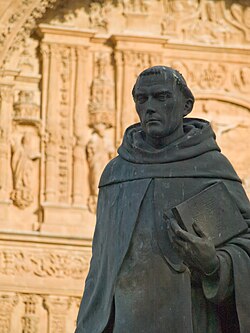
Francisco de Vitoria is, perhaps, the most emblematic figure in the relationship between Salamanca and the global issues of the 16th century. His lessons on the Indians and international law, collected in what is traditionally called Relectio de Indis, posed moral limits to the conquest and defended the rights of the American peoples in terms of natural law and ius gentium. Vitoria did not write with Trent specifically in mind, but his arguments offered an ethical and legal framework that was relevant to Catholic discussions about legitimacy of power and treatment of subjects.
Domingo de Soto, disciple and colleague of Vitoria, contributed in his work De iustitia et jure reflections on distributive and commutative justice, the nature of consent and the relationship between natural and positive law. His analyzes on the justice of price and causality in human acts were inserted into theological and pastoral debates that Trento also touched upon, especially around sacramental morality and the conduct of the clergy and the faithful.
Luis de Molina, representative of the so-called Molinism, rigorously faced the problem of grace, human freedom and divine foreknowledge. His Concordia liberi arbitrii sought to reconcile the freedom of man with the efficacy of grace; That concern about the reconciliation between freedom and salvation became a central theme in post-Tridentine theology. Molina taught at the University of Salamanca and his work would be a mandatory reference in debates on justification, graces and human cooperation.
Francisco Suárez, in his vast production, particularly in De legibus ac Deo Legislatore, systematized the theory of natural and positive law integrating it with matters of political theology. Suárez not only inherited the Salamanca tradition but elevated it to an articulation that would influence modern theorizing on sovereignty and international law. For his part, Martín de Azpilcueta, known as Doctor Navarrus, stood out in moral economy and in the analysis of currency and price, contributing ideas that, although not explicitly addressed by Trento, affect the social ethics that the Counter-Reformation sought to affirm.
Trent and the great theological themes: justification, sacraments and authority
The Council of Trent clearly addressed the doctrine of justification, in open dispute with Protestant theses. His definition insisted on the cooperation between grace and human freedom, on the necessity of the sacraments and on the continuity between faith and works as signs of a vivified faith. These theological questions connected with Salamanca’s concerns as professors and theologians sought to balance doctrinal rigor and understanding of individual conscience.
Salamanca provided conceptual tools to understand the ethical dimension of justification. Luis de Molina, for example, offered nuances about freedom that helped articulate human cooperation without denying divine efficacy. Domingo de Soto worked on moral interiority, intention and guilt in human acts, elements that enrich the pastoral reading of the Tridentine definitions of sacraments and penance.
The influence of the Salamancans on the Council of Trent
Authority in the Church was another Tridentine axis. Trent reaffirmed the importance of hierarchy, councils and tradition in the interpretation of Scripture. From Salamanca the need for a rational and natural foundation for law and morality was defended, which made it possible to articulate a vision of the teaching profession that dialogued with practical reason. In other words, the School offered a theoretical toolbox that made a solid ecclesial restoration compatible with rational arguments that could sustain that restoration before educated readers and rulers.
Natural law, ius gentium and the American question
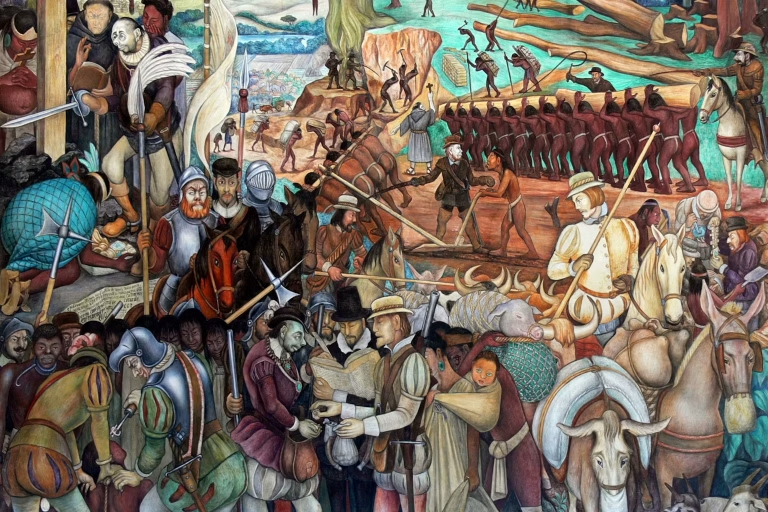
One of the most notable contributions of the Salamanca School was its formulation of principles of natural law applicable to human coexistence beyond cultural borders. Vitoria, based on natural law and ius gentium, maintained that indigenous peoples had rights over their lands and were free from arbitrary domination. He rejected the idea that technological superiority alone justified the usurpation of indigenous sovereignty or unjust trafficking.
Trento, for his part, did not speak at the same length on colonial issues; Its focus was doctrinal and pastoral. However, the post-conciliar intellectual climate allowed Salamanca’s arguments about human dignity and natural law to find support in pastoral practices more respectful of evangelization. That is to say, although Trent did not issue specific decrees on the conquest, the moral and legal articulation of the School helped shape modes of action and debate within Christianity that transformed, slowly and with limitations, some colonial practices.
The contemporary relevance here is clear: debates about sovereignty, peoples’ rights, and historical reparation have intellectual antecedents in the same tradition that elaborated universal legal concepts. The Salamanca discussion shows that already in the 16th century there were resources to defend the dignity of subordinate groups with arguments of natural law and moral authority that transcend merely religious appeals.
Moral theology and sacramental discipline: practical contributions from Salamanca
Trent reinforced sacramental discipline by regulating the administration of the sacraments and the training of the clergy. In the field of practical morality, the concern was also pastoral: how to form responsible consciences and how to articulate penance, conscience and forgiveness in a time of great changes. Here the Salamanca School provided analytical criteria on guilt, intention, the link between act and circumstance, and the mitigation of responsibility according to knowledge and coercion.
Domingo de Soto and other people from Salamanca worked in detail on the imputability of acts, moral causality and the role of conscience. Such contributions were useful for confessors and for the preparation of pastoral manuals that sought to apply the Tridentine decrees to specific contexts. This practical harmony between the council and the university contributed to the ecclesiastical reform having effects on the daily lives of the faithful.
The contemporary dimension of these issues is evident in current debates on autonomy of conscience, bioethics and moral responsibility in plural contexts. The conceptual instruments of the School allow us to sustain an ethic of personal responsibility that does not renounce objective criteria of justice, something very pertinent for religious and secular societies that seek to combine respect for plurality with shared ethical norms.
Moral economy: prices, currency and justice in Salamanca, and its echo in Tridentine praxis
Although Trent did not deal with economics in a technical sense, the Catholic reform aspired to a more orderly and just society. In this framework, Salamanca’s reflection on the fair price, the merit of work, usury and the nature of money gained social relevance. Martín de Azpilcueta analyzed the causes of the value of coins and anticipated notions that would later be associated with the quantitative theory of money. Other people from Salamanca discussed equity in transactions and how to situate moral intervention in the economy.
The School did not offer homogeneous state recipes, but it did offer an ethical reflection on the production of wealth and its distribution. These considerations were functional to the Tridentine agenda to the extent that a reformed Church sought to articulate a public ethic consistent with its moral teaching: trained clergy, less predatory business practices, and greater attention to the poor.
Today, in the face of problems such as inequality, financial bubbles or ethics in global markets, Salamanca’s contributions remain useful. Its emphasis on commutative and distributive justice, together with an empirical look at currency and price, becomes a heritage that can illuminate economic policies with ethical anchoring and sensitivity to the social effects of economic decisions.
The Council of Trent and modern moral theology
International justice and just war: the practical legacy of Vitoria and Suárez
Reflections on the just war are another area where the Salamanca School left a lasting mark. Vitoria, in his lessons on the Indians, and Suárez, in his systematization of natural law, contributed to formulating criteria for the legitimacy of war and the limits to state power. These formulations constitute antecedents of modern international law, as they claim rational and universal norms that regulate the conduct of States.
Trent was not a foreign policy council, but the new Catholic sensitivity to violence and justice supported the dissemination of moral norms that conditioned war and the treatment of prisoners and civilians. Salamanca’s arguments also allowed us to think about an international order based on rights and reciprocal obligations, beyond simple dynastic or religious interests.
Today, when discussing humanitarian interventions, the responsibility to protect and international legislation on armed conflict, it is worth remembering that the Western tradition has had moral and legal resources since the 16th century to delimit the legitimate use of force. Recovering these resources with a critical spirit can enrich the contemporary discussion about the legitimacy of intervention and the protection of civilians.
Convergences and tensions: where Salamanca agrees and where it disagrees with Trento
It is not advisable to idealize the relationship between Trento and Salamanca. There were important convergences: a shared concern for doctrinal rectitude, the need to train a more competent clergy, and the will to defend a social ethic consistent with the faith. However, there were also tensions. Salamanca, due to its academic nature and rational vocation, introduced nuances in doctrinal issues that in the Tridentine climate could be perceived as too open.
For example, Salamanca’s insistence on the use of natural reason to justify norms may have clashed with positions that, in the Counter-Reformation, prioritized doctrinal unity and ecclesiastical authority. Likewise, innovation in topics such as indigenous law or monetary theory could be uncomfortable for political and economic interests that sought to justify expansion and profit.
However, these frictions do not invalidate the value of dialogue. On the contrary: they show that the Catholic tradition has an internal plurality capable of renewing its thinking through the university and the teaching profession. This dynamic of creative tension is a valuable legacy for contemporary societies that navigate between authority, innovation and moral pluralism.
Contemporary projection: human rights, sovereignty and ethical economy
Looking at Trento and Salamanca today is not doing intellectual archaeology. Questions about how to reconcile moral authority with individual freedom, or how to integrate ethical values into public policies and markets, are at the center of the contemporary agenda. The Salamanca School, due to its attention to natural law and social reality, provides arguments to base universal human rights on the rational dignity of the human being, without depending exclusively on religious confession.
In international politics, the tradition that goes from Vitoria to Suárez is a precedent of public international law. His arguments on the equality of sovereignties, the moral limitations of war, and the protection of non-combatants contain useful theoretical resources for contemporary problems such as humanitarian intervention, refugee status, and the international regulation of conflicts.
In economics, Salamanca’s reflections on justice in exchange and the nature of value offer a bridge between ethics and economic policy. Faced with current debates on financial regulation, business ethics and social responsibility, the school remembers that the economy is not an autonomous system without moral obligations. Recovering that sensitivity helps formulate policies that weigh efficiency and justice.
Teaching and public science: pedagogical uses of the Salamanca legacy
For teachers and students, Trento and Salamanca offer an ideal case study of how institutions and academia interact in the production of social norms and practices. Comparative analysis allows students to be taught to read primary sources, identify arguments, and evaluate their practical consequences. Furthermore, intellectual history reveals how ideas travel and transform when applied in specific contexts.
In public science, the example of Salamanca suggests the importance of a university committed to public problems. The dialogue between theory and practice, between research and application, is essential to address complex issues such as global governance, technological ethics or social justice.
Finally, in a world where polarization makes rational deliberation difficult, the Salamancan method—firm in principles, attentive to reality and respectful of argumentation—can inspire more reflective and less closed modes of public discussion.
Conclusion: Lasting Lessons and Unresolved Questions
The Council of Trent and the School of Salamanca represent two complementary forces of the Catholic Modern Age. Trent brought the urgency of reform and doctrinal clarity; Salamanca offered analytical resources to think about law, morality and society. Together, although not without friction, they helped shape an ethical and legal tradition that still illuminates debates about rights, sovereignty, war, economics, and conscience today.
The lessons are plural. First, public reason and religious tradition can collaborate in the defense of universal rights without giving up critical rationality. Second, the study of historical cases such as the American conquest shows the possibility of articulating moral limits to political and economic expansion. Third, Salamanca’s moral economic reflection reminds us that economic institutions require ethical foundations to guarantee the common good.
Open questions remain: how to translate Salamancan principles into plural and secular international law today? How to integrate the Tridentine sensitivity for moral formation with deeply diverse societies? These questions invite us to return to tradition with a critical and creative spirit, recognizing its potential to enrich contemporary deliberation on justice and collective responsibility.
References
• Vitoria, F. (1991). Political Writings. Cambridge: Cambridge University Press.
• Pagden, A. (1982). The Fall of Natural Man: The American Indian and the Origins of Comparative Ethnology. Cambridge: Cambridge University Press.
• Noonan, J. T. (1957). The Scholastic Analysis of Usury. Cambridge, MA: Harvard University Press.
• Molina, L. (1588). Concordia liberi arbitrii cum gratiae donis. Historical edition of his complete works.
• Suárez, F. (1612/1999). De legibus ac Deo Legislatore. In modern editions on his legal and theological work.
• Soto, D. (1556). De iustitia et jure. Texts on justice and law at the time of the Salamanca School.
• Azpilcueta, M. de (1548). Writings on currency and fair price. Contemporary studies collect their analyzes of the nature of currency.