The University of Salamanca in the Golden Age: knowledge, speeches and legacy
The School of Salamanca and the Spanish Golden Age
Introduction: why the University of Salamanca matters today
The University of Salamanca was much more than a center of higher education in the Golden Age. It was a crossroads of knowledge where theology, law, philosophy and emerging subjects that today we would recognize as economics and political science converged. To understand its history is to understand the intellectual keys that shaped debates about justice, war, sovereignty and the market in modern Europe and in the transoceanic relations of the Hispanic empire.
This article invites us to explore the role of Salamanca between the 16th and 17th centuries with critical thinking and a contemporary perspective. This is not a hagiography: we will analyze internal tensions, academic debates and the limitations of their responses. At the same time, we will show how many of Salamanca’s concerns resonate in our current dilemmas about human rights, international trade, and public ethics.
The intention is didactic, but profound. We direct the text to readers with university training interested in the history of thought, political philosophy, law and economics. We will avoid unnecessary technicalities and seek clear historical examples and connections with contemporary problems.
We will begin with a brief institutional overview and continue through the debates and figures that made Salamanca an intellectual laboratory. We will close with a reflection on the legacy and its usefulness in current public discussion.
The influence of the Salamanca School in Europe
Institutional situation and academic transformation
The University of Salamanca, founded in 1218 and consolidated in the 14th and 15th centuries, reached the Golden Age as an already veteran institution. During the 16th and 17th centuries it experienced intense academic activity, fueled by the arrival of students and professors from different kingdoms of the Hispanic monarchy and by the need to respond to new problems: the governance of overseas territories, the regulation of markets and the articulation of a theology capable of addressing unprecedented moral questions.
The university structure combined traditional faculties—theology, law, arts and medicine—with a faculty that simultaneously taught, preached and advised public authorities. This confluence contributed to making classrooms spaces of deliberation with effects beyond the cloister. Lectures, public disputes and rereadings of ancient sources formed a demanding and deeply contextual mode of intellectual production.
In practice, the University acted as a provider of intellectual legitimacy. Its doctors and lawyers advised courts, the Crown and municipalities. This function makes explicit the ambivalence of academic knowledge: on the one hand, it sought the truth in dialogue with the scholastic tradition; On the other hand, he participated in the construction of policies and practices that affected millions of people in Europe and America.
The disciplinary corpus: theology, law and arts in dialogue
The centrality of theology should not be surprising. The Faculty of Theology was the normative heart of university knowledge. However, Salamanca theology was distinguished by its interest in applying moral principles to concrete problems. It was within this framework that arguments were made about the legitimacy of the war, the treatment of indigenous peoples, and the morality of economic contracts.
The Law School, for its part, did not only teach rules and procedures. Professors such as Francisco de Vitoria and other jurists from the scholastic tradition renewed the study of natural law, articulating it with the emerging political reality. The nature of sovereignty, the limits of real power and the legal status of subjects until then invisible in European codes were discussed.
Finally, the arts—in their classical sense—included logic, physics, and moral philosophy. They formed the methodological substrate that allowed students to rigorously address practical problems. This logical and rhetorical training was decisive for the University to produce complex and nuanced arguments, capable of dialogue with enlightened readers from different fields.
Teaching, method and way of arguing
Salamanca teaching preserved the medieval structure of readings and disputes, but the way of arguing evolved. Greater attention was paid to the critical use of sources, the distinction between authority and reason, and the contextual application of principles. This combination of respect for tradition and analytical openness allowed innovative solutions to be formulated without breaking with the scholastic framework.
Public disputes and rereadings of the Sentences and canons of classical authors made visible the virtues and limits of the method. Teachers taught how to construct solid syllogisms, weigh premises, and anticipate objections. This intellectual workshop gave rise to a culture of argumentation that today we can identify as the antecedent of certain modern academic practices.
The result was a style of reasoning that integrated universal principles with attention to concrete circumstances. This intellectual prudence allowed issues such as the legitimacy of war or justice in trade to be resolved not by dogmatic appeals, but by arguments that combined ethics, law, and empirical considerations.
Key figures of the Salamanca School
To talk about Salamanca is to name figures who condensed the work of the University. Francisco de Vitoria is the obligatory reference in matters of human rights and discussion of the rights of indigenous Americans. His lessons on the law of nations questioned dominant positions and paved the way for a discourse on universality and limits of power.
Domingo de Soto deserves attention for his methodological and moral contribution. His interest in second causes, causality, and the application of theological principles to specific cases influenced the way in which the problems of time were addressed. Martín de Azpilcueta, known for his studies on commerce and usury, anticipated reflections that today we would describe as moral economy.
Francisco Suárez, although his relationship with Salamanca is more complex, as he worked in different universities, shares with the Salamanca tradition the concern for natural law and the relationship between law and the political community. Juan de Mariana also contributed a critical perspective on monarchy and the legitimacy of power, with implications that later resonated in theories about social contract and resistance to the tyrant.
Law of nations and international ethics: Vitoria and the American question
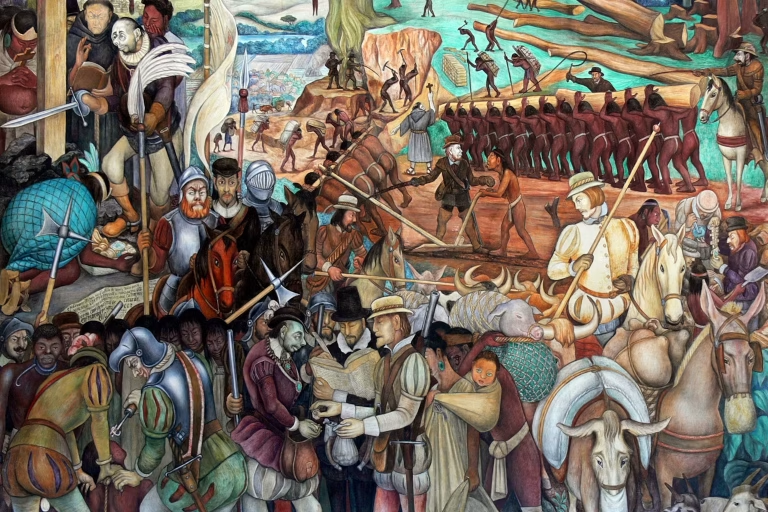
Francisco de Vitoria is frequently presented as a precursor of modern international law. In his lessons on Indians and war, he reflected on the ontological condition of the indigenous people and the legitimacy of the conquest. He rejected the idea that simple cultural difference justified expropriation or arbitrary domination. His analysis was legal and moral: it started from the recognition of a natural law shared by all men.
Vitoria maintained that the Spanish Crown did not have an absolute right to subjugate towns just for the sake of finding them. He defended, however, reasons that could justify the use of force when there was a real injury to justice or rights that affected the universal community. That distinction did not exonerate the Crown from abusive practices, but it did provide a critical framework that inspired later debates about the universality of rights.
Today, reading Vitoria forces us to think about how ideas about sovereignty and rights were forged in colonial settings. Their lessons show that, even in contexts of extreme asymmetry, arguments pointing to an early international ethics were visualized. This genealogy is fruitful for rethinking current debates about intervention, self-determination and state responsibility in the international system.
Moral economy: Azpilcueta, Soto and reflections on market and usury
In Salamanca of the Golden Age, the ethical limits of commerce were intensely discussed. Martín de Azpilcueta addressed practical issues such as determining the fair price and the morality of credit. Based on scholastic logic, Azpilcueta developed arguments that distinguished between legitimate benefit and exploitation, taking into account market circumstances and conventions.
Domingo de Soto also worked on utility and justice in contracts. His reflection on prices and intermediation anticipates modern notions about competition and market signals. Instead of condemning trade as such, the Salamancan discussion sought criteria to identify when a transaction could be considered unfair.
These discussions are not only the heritage of economic history. They offer conceptual resources to think about market ethics, financial regulation and responsibility in transnational operations today. The notion of fair price, far from being a medieval relic, reappears in contemporary debates about transparency, competition and protection of vulnerable consumers.
Moral theology and the care of consciences
Moral theology in Salamanca was marked by an interest in the practical application of ethical principles. The manuals for confessors and casuistry moral texts sought to guide decisions in specific situations. This attention to context evidenced a sensitivity to human complexity that great theoretical abstraction does not always capture.
The casuistic approach does not imply laxity; On the contrary, it was a demanding discipline that articulated principles, circumstances and degrees of moral responsibility. Salamanca theologians discussed, for example, guilt in acts carried out under duress, the proportionality of penalties and the moral evaluation of economic behavior.
Today moral philosophy and bioethics find a valuable antecedent in that tradition. The Salamancan casuistry shows how to move from general principles to specific decisions without abandoning rigor. This skill is especially relevant in current debates that require applied ethical responses, from the regulation of new technologies to health governance.
The University and the Empire: tensions and mediations
The relationship between the University and the Crown was complex. Salamanca was not an organ of the monarchy, but its members served as advisors and legitimizers. This closeness generated tensions: the university defended academic autonomy and the integrity of knowledge, but at the same time it participated in the administration of an empire with policies that often required practical and justifying responses.
The university functioned as a space of mediation between central power and local realities. Their decrees and academic decisions influenced administrative, fiscal and legal practices. At the same time, the demands of the empire—control of territories, taxation, regulation of overseas trade—incentivized the production of applied knowledge.
Understanding this relationship helps to understand how institutions of knowledge contribute to the power structure and its limits. The Salamanca experience shows that academic autonomy is a fragile construction that is sustained by institutions, practices and principles that must be defended so that knowledge fulfills its critical function in the face of power.
Internal criticism and limits of the Salamancan project
Not everything in Salamanca was coherence and intellectual progress. There were internal debates and criticisms about the scope of natural law, the interpretation of sources, and the practical application of principles. Some teachers were conservative and resisted innovations; others were exposed to political or ecclesiastical pressures that conditioned their academic freedom.
Furthermore, the universality of Salamanca’s discourse had real limits. Although many arguments defended rights and human dignity, they did not always translate into effective policies against colonial abuses or real improvements for indigenous people. The distance between theory and practice is a lesson we must remember as we look to the past for inspiration for the present.
Recognizing these limits does not invalidate the intellectual value of Salamanca. On the contrary, it allows a critical and nuanced reading: the university was a space of significant intellectual production, but subject to contradictions and limitations typical of its time and institutional environment.
Contemporary projection: human rights, international law and economic ethics
The Salamanca legacy is relevant to contemporary debates. In the field of human rights, reflections on the dignity and universality of the human being allow us to trace an intellectual genealogy that predates modern codification. Vitoria and his contemporaries did not formulate a modern catalog of rights, but they did offer arguments that challenged the idea of absolute legitimacy based on force.
In international law, the notion of the law of nations and the argument about moral limits to war and conquest find echo in current discussions about humanitarian intervention, sovereignty and the responsibility to protect. The University of Salamanca showed the possibility of formulating ethical standards with practical projection in an expanding world.
In economic matters, discussions of fair pricing, usury, and contractual justice illuminate contemporary debates on financial regulation, consumer protection, and cross-border contracts. The Salamanca School offers a vocabulary and a methodology to combine theoretical exercise and attention to concrete consequences.
Methodological teachings for researchers and teachers
For those who investigate or teach, the Salamanca case suggests several lessons. First, the importance of integrating historical analysis with conceptual reflection. The specific problems of the time demanded theory and vice versa. Second, the usefulness of teaching that does not sacralize authorities, but rather promotes critical argumentation. Third, the value of interdisciplinarity: solving complex problems requires legal, theological and economic resources.
Applying these lessons today requires promoting spaces where students and teachers discuss real cases, compare sources and evaluate social consequences of theories. The University of Salamanca reminds us that academia is not only the production of texts, but the formation of public criteria capable of influencing social life.
In a contemporary university context, these teachings invite us to rethink curricula, assessment of teaching and links to public problems. The history of thought is, in this sense, a living resource to improve professional and civic training.
Conclusion: Ideas to remember and open questions
The University of Salamanca in the Golden Age was a creative space where problems that are still current were worked on. His contributions to the law of nations, moral economy and applied theology show a remarkable ability to combine principles and circumstances. At the same time, the limitations of its practical projection remind us of the distance between good arguments and just policies.
Remembering Salamanca is not adopting his responses without criticism. It is, instead, valuing a working method: conceptual rigor, attention to specific cases and willingness to dialogue with authorities and facts. This combination produces useful knowledge for public life and for confronting contemporary dilemmas.
Finally, open questions persist. How to translate better arguments into fairer institutions? What lessons learned from casuistry can be applied in bioethics or contemporary financial regulation? The answer requires dialogue between historians, philosophers, jurists and economists. Salamanca shows us the value of that dialogue.
References
• De Vitoria, F. (1539). Reflections: De Indis et de iure belli. Works and lessons cited in tradition; consult modern editions and compilations of his lessons.
• Suárez, F. (1612). De Legibus ac Deo Legislatore. Fundamental texts for understanding the theory of natural law in the late scholastic tradition.
• Azpilcueta, M. (16th century). Writings on fair price and usury. Consult compilations of his opuscula and studies on early moral economy.
• Domingo de Soto. Works and lessons on morality and causality; relevant to understanding the practical application of ethical principles.
• Mariana, J. (1599). De rege et regis institutione. Central text in debates on sovereignty and political criticism in Spain during the Golden Age.
• Noonan, J. T. Jr. (1957). The Scholastic Analysis of Usury. Classic study on the medieval and Renaissance discussion of usury.
• Pagden, A. (1982). The Fall of Natural Man: The American Indian and the Origins of Comparative Ethnology. Key research to contextualize discussions about indigenous people and universality in modern Europe.
• Elliott, J.H. (1963). Imperial Spain. Recommended text to understand the political and cultural articulation of the empire in which the University of Salamanca operated.