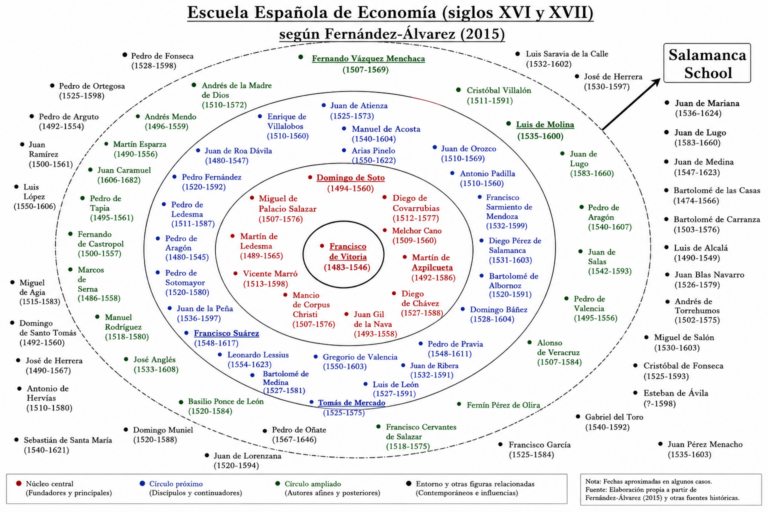
The School of Salamanca and the discovery of America: law, economics and universal conscience
Introduction: why Salamanca’s reflection matters today
The encounter between Europe and America in the 16th century was not just a clash of cultures and resources. It was an intellectual challenge that forced thinkers, theologians and jurists to rethink basic notions about the person, sovereignty, war and property. The School of Salamanca responded with a forceful reflection that combined scholasticism, humanism and empirical observation.
Today, when we debate universal human rights, indigenous sovereignty, ethics of globalization and transnational corporate responsibility, the questions that were asked in Salamanca remain fully relevant. It is not about looking for facsimile solutions, but rather about recovering principles and conceptual resources that contribute to a more rigorous and morally informed debate.
In the following pages we will address the central contributions of the School of Salamanca to the American problem: its arguments on the legitimacy of dominion, just war, the dignity of native peoples and the economic implications of conquest. We will proceed by citing relevant authors and works and relating their thoughts to contemporary problems of international law, distributive justice and historical memory.
The School of Salamanca and the foundations of international law
Historical and academic context: Salamanca as a forum for questions
The University of Salamanca in the 16th century was a node where traditions converged: Thomism, Roman law and canon law, Renaissance humanism and practical experiences derived from the imperial administration. This confluence made it possible for questions about the legitimacy of discovery and colonization to be treated not as abstract speculations but as concrete legal and moral problems.
The immediate impact of the discovery of America led to urgent questions. Can Christian law be coercively imposed on a people who do not know the gospel? What limits does the right of conquest have? Under what conditions does expropriation, evangelization or the use of force proceed? The teachers of Salamanca responded to these problems with arguments based on natural law, practical reason and positive norms, trying not to lose sight of the empirical experience reported by missionaries and administrators.
It is essential to understand that the Salamanca School was not a monolith. There were internal debates, nuances and confrontations. Some authors defended more restrictive positions regarding war and colonization; others, more permissive. This internal pluralism is precisely what makes their contributions relevant: they do not offer univocal solutions, but rather a catalog of theoretical and practical criteria that allow rights and obligations to be evaluated in contexts of encounter between civilizations.
Francisco de Vitoria and the invention of the law of nations
Francisco de Vitoria is frequently presented as the central figure of the Salamanca School in relation to America. His lectures on the Indians, known collectively as Relectio de Indis, are a pioneering intervention in what we would today call international law. Vitoria defended that the American populations had the full status of subjects of law and not simple objects of domination.
For Vitoria, justice is based on natural law and the law of nations, understood as a set of rational norms that regulate relations between peoples. From that perspective, he questioned claims to sovereignty based solely on discovery or on papal claims that had no moral support. He also maintained that evangelization does not legitimize violence; Preaching must be free and persuasive, not imposed by force.
The implications of Vitoria transcend the 16th century. Its defense of the indigenous person as a subject of rights anticipates, although imperfectly and conditioned by its intellectual framework, principles that today we consider essential in human rights and international law. It also offers useful criteria for evaluating contemporary claims about sovereignty, minority protection, and limits to intervention.
Vitoria in its main works
The Relectio of Indis are the direct source for understanding his position on the legitimacy of the domain. In them, Vitoria discusses the admissible causes of war, the validity of property titles and the notion of usurpation. Their arguments are based on the reciprocity between legal theory and concrete experience sent by missionaries and chroniclers.
It is important to read Vitoria considering his method: it is not about abstracting universal principles without reference to fact. His work is a balance between moral theory and attention to colonial reality. This combination makes it especially valuable for those who today seek to establish international standards with sensitivity to the material and cultural conditions of the affected subjects.
By affirming the status of subject of law of the American peoples, Vitoria did not resolve all the tensions of its time. However, he placed at the center of the discussion the idea of human dignity as a limiting criterion of political violence and as a basis for a right between nations that is not reduced to the will of the strongest.
Principles of international law in Salamanca
Domingo de Soto and the richness of legal-systematic thought
Domingo de Soto, a contemporary of Vitoria, contributed from legal exegesis and moral theology. Its analytical rigor offered tools to systematize notions related to property, fair price and the legitimacy of contracts in colonial contexts. He especially addressed the practical dimension of distributive justice in exchanges between different communities.
Soto highlighted the importance of intention and consent in legal acts. In colonial contexts, this requires analyzing whether the agreements between Europeans and indigenous people were truly voluntary, informed and made under conditions of relative equality. Its perspective protects against appropriations that rely on coercion or blatant asymmetries of power.
Domingo de Soto’s contribution is not only historiographical; Their concerns raise current questions about consent in situations of inequality, contracts between multinational companies and local communities, and the moral validity of transactions in contexts of structural asymmetry.
Martín de Azpilcueta: economy, currency and ethics of exchange
Martín de Azpilcueta, also known as Navarro, is a central figure in the early history of economic thought. His reflections on currency, price and exchange anticipate important insights into the theory of value and the function of markets. In the American context, these issues take on a practical dimension: the circulation of metals, forced exchange, and the configuration of colonial markets required normative criteria on equity and regulation.
Azpilcueta analyzed how prices are formed in real markets, introducing subjective and psychological elements in the valuation of goods. Although he did not develop a modern market economy, his observations on the importance of supply and demand and on the role of trust in transactions are notable for their time.
Applied to the American context, his ideas help understand problems such as the exploitation of resources, the extraction of precious metals and distortions in local economies. They also offer a starting point for thinking about moral responsibilities in international trade and contemporary extractive exploitation.
Francisco Suárez and the theory of law and authority
Francisco Suárez, although belonging to a later generation, took up and expanded key issues to think about political authority and law within the framework of colonial expansion. His treatment of natural law and positive law offers an instrument to evaluate the justice of the institutions that are established in conquered territories.
Suárez emphasized the distinction between the moral legitimacy of a norm and its factual existence as positive law. This distinction allows us to analyze cases in which a rule imposed by force retains imperfect legal effectiveness if a minimum moral basis is missing. In colonial contexts, this reflection requires a critique of colonial norms that pursued economic or confessional goals without guaranteeing justice for the original inhabitants.
Suárez also provided the debate with criteria to delimit the competence of sovereign power. Their arguments serve to question claims of absolute authority and to point out ethical limits to the exercise of dominance, an issue of enormous relevance when international jurisdictions and the rights of indigenous peoples are discussed today.
Practical controversies: the Requirement and the Valladolid debate
The Requerimiento, a document through which colonial authorities demanded the subjection of the American peoples, constitutes a paradigmatic example of the tension between formal norms and moral legitimacy. Authors from Salamanca, with different positions, criticized the use of the Requirement when it functioned as a mere pretext to legitimize violence.
The legacy of international law of the School of Salamanca
The debate in Valladolid, which faced Bartolomé de las Casas and Juan Ginés de Sepúlveda, although it was not held solely in Salamanca, raised many of the issues that interested Salamanca residents. Las Casas defended the full humanity and rights of the indigenous people, their capacity for government and the illegality of their enslavement. Sepúlveda, on the contrary, justified war and subordination in Aristotelian-Telluric terms of culture and nature.
The Salamanca discussions offered criteria to qualify and, in many cases, reprove the most extreme positions. They reaffirmed the requirement that any use of force have a just cause, proportionality and a legitimate objective. These criteria are precursors of the current standards of international humanitarian law.
Property, dominion and indigenous rights: a nuanced reading
The Salamanca School contributed to unraveling complex notions about property. He rejected, in general terms, the idea that discovery alone generated absolute and automatic title to the domain. Legitimate ownership requires valid titles, effective occupation, legitimate agreement or concession and, ultimately, respect for the possession and traditional uses of the communities.
Furthermore, the people of Salamanca followed forms of use and possession that were different from the European conception. They recognized the validity of customary systems and communal uses, which implies that expropriation needs not only legal justification but also reparation and compensation. These ideas anticipate contemporary debates about land restitution, territorial rights, and indigenous autonomy.
However, it is not advisable to idealize their positions. Despite its novelty and its humanist limits, some people from Salamanca operated within Eurocentric and religious assumptions that conditioned their reach. The critical reading of his texts allows us to rescue useful principles without forgetting the tensions and contradictions of their context.
Economy, extraction and ethics of treasure: material consequences of reflection
The arrival of enormous quantities of precious metals from America transformed the European economy. Authors from Salamanca analyzed the monetary and social implications of this influx. They warned about inflationary distortions, the distributional consequences and the moral responsibility of the agents involved in extraction and trade.
The debate over the fairness of price and the role of intermediaries in transatlantic trade was not only technical. It had direct consequences on poverty, dispossession and the colonial productive structure. From Salamanca’s perspective, the economy had to meet criteria of justice, avoid fraud and respect the dignity of the agents involved.
Today, these questions resonate in discussions about corporate social responsibility, ecological debt, and justice in global value chains. The combination of market analysis and practical morality that the people of Salamanca offered is fruitful for thinking about ethical regulations for international trade.
From norm to praxis: missionaries, judges and governors
The academic reflections did not remain in the texts. Missionaries, judges, and administrators applied and clashed with these ideas on the ground. There is a continuous tension between normative theory and colonial praxis, where political and economic interests limited the application of principles of justice.
At the same time, the circulation of Salamancan arguments fueled concrete practices of defense of indigenous people, protection initiatives and, in some cases, administrative reforms. The work of defenders like Las Casas, supported by theological and legal arguments, is part of this web of theory and praxis. Evaluating the effectiveness of Salamanca’s thought requires recognizing both dimensions.
Teaching in Salamanca contributed to training officials and clerics who played relevant roles in the overseas government. This training adds another dimension to the Salamanca influence: not only ideas, but operators equipped with a conceptual framework to legislate and administer.
Dialogue with modernity: legacy and limits
The legacy of the Salamanca School is visible in the development of international law, state contractual theory, reflection on human rights and in early contributions to moral economy. His insistence on rationality, natural law and human dignity found echo in later developments in Western legal thought.
However, its modern projection should not be simplified. The heterogeneity of positions and contextual limitations (religious, Eurocentric and social) show that the legacy is complex. Recovering it requires reading it critically, distinguishing between universalizable intuitions and period prejudices.
As a bridge between scholastic tradition and modernity, the School of Salamanca offers conceptual resources that continue to be useful for thinking about global justice, international law, and ethical economics. Their contribution is not the definitive solution, but it is a valuable instrument to enrich contemporary debates.
Connections with current debates: historical memory, reparation and global law
The questions that the people of Salamanca asked regarding the legitimacy of the conquest and the dignity of the native peoples connect directly with debates on historical memory and reparations that are alive today. Rereading Salamanca’s arguments can inform processes of recognition, truth and reparation, offering criteria of justice that link norms to concrete situations.
In contemporary international law, Salamanca’s notions related to just war, proportionality and protection of civilians are precursors of norms that regulate armed conflicts. Likewise, its insistence on the person as a subject of rights helps justify the expansion of legal categories that today include collective and cultural rights.
In economic matters, Salamanca’s criticism of exploitation and its attention to equity in exchanges refer to current demands on corporate responsibility, fair trade and reparations for ecological or social damage. Intellectual history can thus contribute to nurturing more just normative frameworks that are sensitive to cultural plurality.
Conclusion: lessons and tensions to think about a shared present
The School of Salamanca offered, faced with the impact of the discovery of America, a reflective body in which law, ethics and economics converged. Its authors defended the legal subject status of the American peoples, questioned dominion titles based on mere force, and proposed criteria to evaluate the legitimacy of war, property, and exchange.
His legacy is ambivalent: on the one hand, he advanced notions that today we consider essential for the protection of human dignity and the regulation of relations between states. On the other hand, it operated within assumptions typical of its time that limit its universality. The contemporary task is to recover its critical contributions without idealizing its context.
Ultimately, reading the School of Salamanca in a contemporary key forces us to combine historical memory with normative reflection. It urges us to pay attention to both rights and material conditions, to demand criteria of legitimacy in the face of force and to articulate an ethics of exchange that protects the most vulnerable. It is an invitation to think about a law and an economy that are not content with efficiency, but aspire to justice.
References
• Vitoria Francisco. (1539). Relectio of Indis. Works and lessons on the law of nations and the conduct of Spain in the discovered territories.
• Suárez Francisco. (1612). De legibus ac Deo legislatore. Treatise on natural law and political authority.
• Molina Luis de. (1593). De iustitia et iure. Legal reflections on justice and law.
• Azpilcueta Martín de. (1549). Manual for confessors and penitents. Moral contributions and reflections on practical economics.
• Domingo de Soto. Works on law and practical morality. Studies on justice, contract and fair price.
• Bartolomé de las Casas. History of the Indies. Testimony and defense of the rights of the American peoples.
• Pagden Anthony. (1982). The Fall of Natural Man: The American Indian and the origins of comparative ethnology. Princeton University Press.
• Noonan John T. Jr. (1957). The Scholastic Analysis of Usury. Harvard University Press.
• Hanke Lewis. (1949). The Spanish Struggle for Justice in the Conquest of America. University of Pennsylvania Press.
• For contemporary and accessible readings about the School of Salamanca, compilations and historiographic studies that contrast primary sources with modern interpretations are recommended.