The law of nations: precursor of international law
The law of nations in the School of Salamanca
Introduction: why remember the law of nations today
The concept of the law of nations appears in the Modern Age as an intellectual response to a world that expanded its material and moral boundaries. From the Iberian Peninsula, thinkers linked to the universities of Salamanca and Alcalá began to question the legitimacy of the domains, the limits of sovereignty and the rights of those who until then had been considered subjects outside of European Christian law.
Today, when we talk about shared sovereignty, humanitarian interventions, mass migrations and the governance of global commons, we once again come across issues that were already part of the Salamanca agenda. His reflections on just war, international trade, legitimate property, and the protection of persons are strikingly relevant to contemporary debates on public international law.
This article offers a patient and critical reading of that body of thought. It is not a question of invoking the School of Salamanca as the exclusive origin of all modern institutions. Rather, it aims to show how certain conceptual instruments and normative criteria developed then fed the tradition that leads to modern international law.
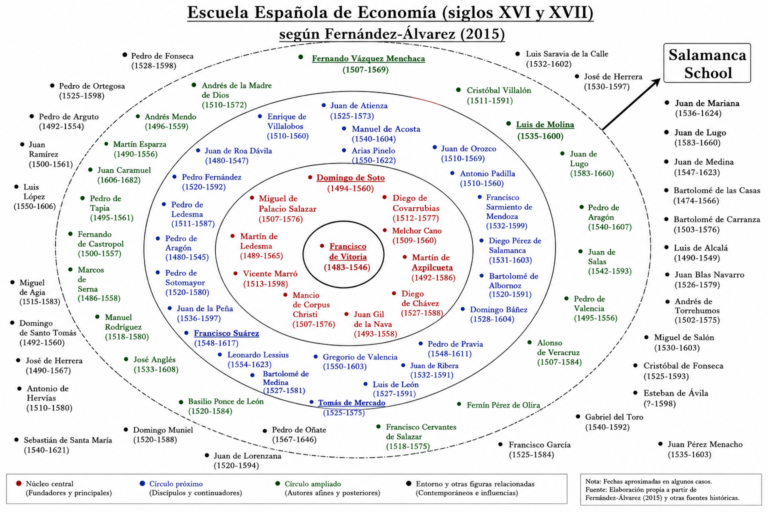
The aim is didactic and reflective. I will question classic texts and authors, such as Francisco de Vitoria, Francisco Suárez, Luis de Molina or Tomás de Mercado, and I will confront them with current problems. The goal is for the reader to see intellectual continuity and learn to use these tools to think about global justice.
Foundations and projection of the law of nations
Historical and academic context of the School of Salamanca
The School of Salamanca was not a formal school in the institutional sense. It was a group of professors and students who, from the end of the 15th century to the 17th century, developed an interdisciplinary reflection on theology, natural law, moral economy and political ethics. The University of Salamanca, due to its prestige, facilitated the circulation of ideas and debates among canonists, moralists and jurists.
The 16th century is a time of encounters and clashes: Atlantic expansion, colonization, new trade routes, monetary crisis and religious wars. Faced with this reality, Salamancan scholars tried to apply classical and Christian principles to unprecedented situations. They did so with notable conceptual care, seeking rational criteria that justified rights and obligations beyond the mere positive disposition of power.
Unlike a myth of uniformity, in Salamanca there were intense debates and diverse positions. Some argued for strict limits on royal power, others emphasized papal authority, and among them there were nuances about property, usury, trade, and the legitimacy of war. This plurality is a strength: it shows that the law of nations was not a dogma but a project under construction.
Theoretical foundations of the law of nations
The law of nations, as the people of Salamanca thought about it, comes from two intertwined sources: natural law and practical reason. Natural law offered universal norms derived from human nature and divine law. Practical reason completed this base by converting general principles into rules applicable to specific cases, including the relationship between peoples and States.
A key notion is that of person and moral community. For the people of Salamanca, the indigenous Americans were not subhuman beings or lacking reason. They were people with natural rights, capable of owning property and being subject to obligations. That statement opened the door to recognizing moral limits to the power of conquest and to demanding a legal basis for occupation and evangelization.
Another pillar is the idea that the positive law of a prince is not enough to legitimize actions that violate natural justice. The law of nations, therefore, acts as an intersubjective order that regulates relations between political communities, independently of the arbitrary will of a sovereign. This anticipates the modern distinction between internal law and international law.
Finally, the figure of distributive iustitia and commutative iustitia allows Salamancans to evaluate treaties, contracts and reparations between political parties. His attention to equity and consent as conditions of contractual validity is one of the most direct bridges to the modern theory of international covenants.
Francisco de Vitoria: the genesis of a legal vocabulary
Francisco de Vitoria is often the name most immediately associated with the law of nations. His lessons on Indians and legitimate public authority marked a milestone. Vitoria starts from the conviction that natural reason and divine law condition any legitimate political act, and that these norms equally apply to the interaction between peoples.
In his famous relections on the Indians, Vitoria discussed the question of whether the Indians had a rational soul and, consequently, rights. His answer was affirmative. From that premise he stated that there could be no automatic justification of land usurpation or enslavement. Only very specific causes, based on clear violations of natural law, could legitimize extreme measures.
Vitoria also introduced the notion of community of reason and law as a basis for commerce and communication between peoples. He defended freedom of transit and exchange as part of the rights of nations. These ideas anticipated principles that we recognize today in the law of navigation and international trade.
Its approach allows for a double learning: on the one hand, it offers criteria to criticize unjustified colonial practices; On the other hand, it shows how to build international norms that do not depend exclusively on force. This tension between moral criticism and normative construction continues to be central in the discussion about interventions and sanctions today.
Francisco Suárez: systematization and theory of sovereignty
Francisco Suárez, several decades later, sought to provide a more systematic formulation of natural law and the law of nations. Suárez combined scholastic scholarship with modern legal sensibility. In De legibus, he developed a theory of law that distinguished between divine, natural and human law, and regarded international law as a legitimate order derived from the social nature of man.
Suárez was very careful with the category of sovereignty. He rejected the idea of absolute power unlimited by natural law. For him, sovereignty implied responsibilities. A prince who violated the just order could, in certain cases, lose legitimacy. This idea links to contemporary debates about the responsibility to protect and limits to the abuse of sovereignty.
Additionally, Suárez discussed the validity of treaties and the notion of consent. For an agreement to be legally binding, it had to respond to the freedom and ability of the parties to bind themselves. This insistence on consent runs through modern international law, which bases the validity of treaties on the free will of States.
Suárez also paid attention to the plurality of legal systems and the need for minimum standards of international coexistence. His scheme regulated the interaction between political communities without assuming universal hegemony, which facilitates the understanding of how international law can be built from formal equality between States.
Luis de Molina and justice among international subjects
Luis de Molina provided clarity on individual and collective responsibility in the international arena. His treatment of distributive justice and obligations derived from natural law made it possible to specify responsibilities in contracts, compensation and reparation obligations between communities. A constant concern for equity in economic relations appears in his work.
Molina defended that legitimate property and commerce are based on consent and fairness of conditions. He denied the possibility of singling out entire peoples as incapable of exercising economic rights. In that sense, it contributed to the principles of free exchange and property acquiring ethical and legal bases.
His reflection is useful to think today about the validity of trade regimes, investment protection and demands for reparation. The insistence on the legitimacy of titles and the fairness of agreements resonates with current concerns about debt, restitution of cultural property, and compensation for cross-border damage.
Tomás de Mercado and the moral economy
Tomás de Mercado articulated an economic reflection that directly connects with the law of nations. Its Summary examines monetary phenomena, prices, and the morality of contracts. Mercado is not an economist in the modern sense, but his sensitivity to the social effects of exchange brings him closer to concerns about global justice and the regulation of foreign trade.
In particular, Mercado analyzed the phenomenon of rising prices and linked it to monetary flows linked to the precious metals of America. He stated that economic policies are not neutral and that their legitimacy depends on their conformity with principles of equity. This early diagnosis of economic globalization links with current debates on trade imbalance and transnational capital.
His contribution to the moral theory of price and usury nourishes the discussion on international regulation of markets and protection of vulnerable communities against predatory practices. Mercado maintained that law and ethics must moderate market dynamics to avoid social harm that transcends borders.
Historical applications: Indians, colonization and limits of power
The examination of specific cases helps to understand the power of the law of nations as a critical criterion. Vitoria, Suárez and others applied their principles to judge the legitimacy of colonization. It was not about denying European expansion outright, but rather subjecting it to conditions: respect for property, prohibition of baseless slavery, and recognition of the legal capacity of indigenous peoples.
The law of nations served to dispute narratives that sought to justify expropriation based on mere cultural or religious difference. The people of Salamanca insisted on the ontological equality of people as a basis for legal equality. This insistence allowed, although in a limited way and with contradictions, to raise indigenous rights against abuses.
However, political practice often exceeded these theoretical limits. The distance between the moral imperative and imperial realpolitik was great. An important lesson emerges here: the existence of standards does not ensure their compliance. The Salamanca School offers critical tools to evaluate legitimacy, but its effectiveness always depended on extra-argumental factors such as power, economics and violence.
This contrast between norm and reality highlights the contemporary need for institutional instruments that promote respect for international law. Salamanca’s reflections show that regulations can anticipate effective politics, offering criteria for vindication and reform.
Law of nations and theory of just war
The just war doctrine was central in Salamanca. Thinkers developed rigorous criteria for evaluating when war can be morally and legally legitimate. It was not a rigid catalog, but a normative practice that demanded just cause, proportion and respect for non-combatants.
Vitoria, for example, rejected the idea of war justified by simple economic interests or religious differences. War could only be justified if there was a serious offense to natural justice or a necessary defense. This criterion was the seed for modern notions such as the crime of aggression and limits to preventive war.
Furthermore, Salamanca’s concern for the protection of civilians and prisoners anticipated aspects of international humanitarian law. The idea that there are moral and legal limits even in war is translated today in norms such as the Geneva Conventions and in contemporary criticism of indiscriminate war practices.
Law of nations and international economy
Salamanca’s thought was not limited to issues of sovereignty and war. He addressed trade and currency as issues of social justice. The notion of legitimate commerce was related to the principle of consent and equity in contracts. This perspective contributes to a vision of international law not only as a mechanism of coercion, but as a framework of norms to regulate exchange between communities.
In Salamanca there was early criticism of usury practices and monetary manipulation. Moral arguments about fair prices and the responsibility of economic agents offer resources to think about the international regulation of the financial system. Contemporary globalization raises the need for instruments that mitigate asymmetries and externalities, concerns already present in the 16th century.
Likewise, the defense of freedom of trade as an extension of the law of nations explains why many principles of normative economics were later incorporated into commercial institutions and, eventually, into international economic law. The tension between freedom and justice remains the central issue of global economic governance today.
The institutional legacy: from criteria to organizations
The Salamancan influence did not translate linearly into the creation of an international organization, but it did translate into the sedimentation of concepts. The distinction between internal law and the law of nations, the notion of consent as a source of obligations and the idea of limits to sovereignty have permeated subsequent developments.
During the 17th and 18th centuries, these concepts were combined with other doctrinal contributions to form the corpus of classical international law. Diplomatic practice, the law of treaties and the theory of States as subjects of law incorporated criteria that can be traced, in part, to Salamanca.
In the modern era, institutions such as the League of Nations and the UN operate with principles that indirectly refer to that tradition: the prohibition of aggression, the protection of people and the search for peaceful settlements. Recognizing this genealogy is not so much an act of national vindication as the confirmation of the complexity of the intellectual development of international law.
Contemporary debates: sovereignty, human rights and responsibility
A central question today is how to make sovereignty compatible with the protection of universal human rights. The Salamanca School had already stated that sovereignty entails responsibilities and that political powers are limited by natural law. This argument is useful to legitimize the modern idea of responsibility to protect in extreme situations.
However, institutional amplification of that principle requires caution. The Salamancans offered moral criteria to judge actions, but they did not formulate a supranational coercive mechanism. The current discussion must combine normative criteria with procedural guarantees to avoid instrumental interpretations or unjustified interventions.
Thus, Salamanca’s reflection helps to rethink the tension between non-intervention and protection of lives. It proposes that the legitimacy of an intervention should be evaluated based on objective causes, proportion and a horizon of reparation, and not by simple political motivations or geostrategic interest.
Contemporary debates: migration, citizenship and economic rights
The insistence on the dignity and natural rights of every person invites us to rethink immigration policies. If borders are not absolute moral walls, decisions about admission, protection and expulsion require justifications that respect the person as a subject of law. The people of Salamanca, by denying the legal nakedness of colonized peoples, offer a framework to think about inclusion.
In economic matters, reflections on fair trade and prices today translate into the defense of commercial conditions that do not perpetuate dependency or exploitation. The law of nations can inform norms on responsible trade, resource protection, and reparation for transnational harms, especially when private actors act with impunity.
These ideas provide criteria to evaluate trade agreements and immigration policies from the perspective of global justice. They do not offer immediate technical recipes, but they place the axis of the debate on dignity, equity and respect for consent.
Contemporary debates: environment and common goods
The management of planetary commons—atmosphere, oceans, biodiversity—poses challenges that refer directly to the Salamanca school. If the law of nations regulates coexistence between peoples, then it can also regulate responsibilities for environmental damages that transcend borders and generations.
The people of Salamanca did not write about climate change, but their insistence on intersubjective obligations and the protection of goods essential to life provides a moral basis for demanding reparations and collective measures. The idea that some assets require international standards for their conservation is in line with their view.
Consequently, the law of nations invites us to consider principles of intergenerational solidarity, shared responsibility and priority protection of the most vulnerable. These notions are crucial to designing international legal instruments that address the environmental emergency with justice.
Conclusion: continuity, criticism and normative memory
The Salamanca School did not create international law in its purest form, but it did sow concepts and criteria that contributed decisively to its formation. His legacy is not a thief of easy solutions, but a reserve of critical tools: the universality of natural law, the centrality of consent, the protection of persons, and moral limits on power.
Remembering Vitoria, Suárez, Molina or Mercado is useful to denounce unjust practices and also to recover a regulatory horizon that prioritizes dignity and equity. Its lessons are not closed doctrines; They are resources to build legal and political arguments in an interdependent world.
Finally, there is a practical lesson: the existence of norms requires institutions and political will to be effective. The Salamancan tradition reminds us that the legitimacy of international law is fueled by rational argumentation and moral pressure. For those who today propose institutional reforms or new global norms, this tradition offers a critical and propositional repertoire.
I invite the reader to take Salamanca’s heritage as an invitation to think. Not as a magic formula, but as an intellectual matrix that guides deliberation on international justice. Their questions remain: how to protect the weak, how to limit political violence, how to regulate exchanges between communities without sacrificing human dignity.
References
- Vitoria, F. (1539). De Indis et De Ivre Belli Relectiones.
- Suárez, F. (1612). De legibus ac Deo legislatore.
- Molina, L. (1593). De iustitia et iure.
- Mercado, T. (1569). Summary of the nature and reason of things.
- Pagden, A. (1982). The Fall of Natural Man: The American Indian and the Origins of Comparative Ethnology. Cambridge University Press.
- Noonan, J. T. (1957). The Scholastic Analysis of Usury. Harvard University Press.
- Recommended reading: Consult critical editions and anthologies of Vitoria’s relections and Suárez’s works for contemporary analyzes and translations into English and Spanish.