The scholastic method: the great intellectual system of the Middle Ages and the birth of modern rational thought
The scholastic method was one of the most influential intellectual systems in Western history. It dominated European universities for centuries and formed the basis of philosophical, theological, legal and scientific teaching from approximately the 12th century to much of the 17th century.
Although it is often presented in a simplified manner as an excessively abstract or rigid form of thought, historical reality is much more complex. Scholasticism was, in many respects, the first great systematic attempt to apply logical reason to the orderly study of reality, morality, politics, law, and religion.
In fact, numerous essential elements of the modern university, contemporary legal reasoning and structured academic debate were born precisely within the scholastic method.
The scholastic method and rational thought
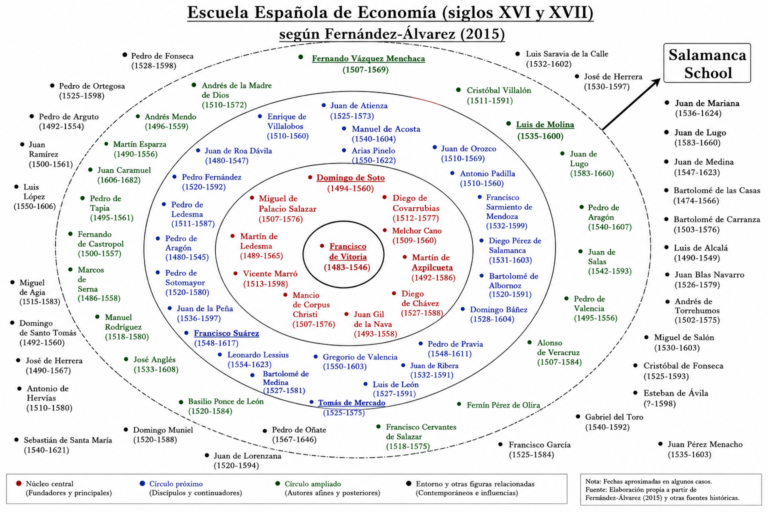
The School of Salamanca, with Francisco de Vitoria, Domingo de Soto, Luis de Molina and Francisco Suárez, probably represents the moment of maximum intellectual sophistication of Spanish scholasticism. These authors used the scholastic method to analyze completely new problems: the discovery of America, human rights, international trade, inflation, the legitimacy of political power or war.
Understanding the scholastic method is essential to understand not only medieval thought, but also the intellectual origins of international law, modern economics, and much of Western political philosophy.
What does “scholasticism” really mean?
The word “scholasticism” comes from the Latin term scholasticus, which referred to those who taught or studied in medieval schools and universities.
It does not designate a specific doctrine, but a method of thought and teaching.
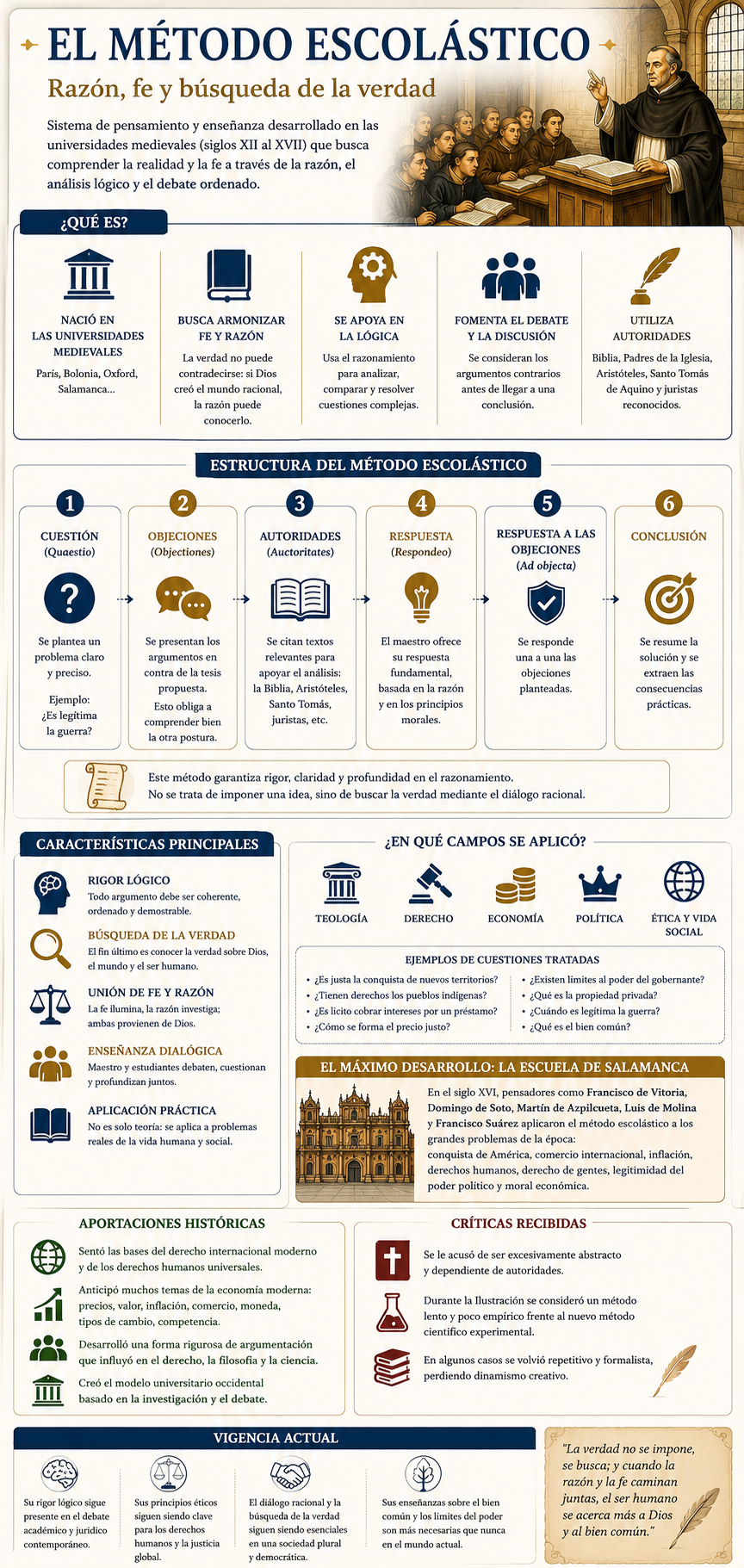
Scholasticism emerged in medieval European universities, especially in Paris, Bologna, Oxford and Salamanca. Its main objective was to harmonize faith with reason through a logical and systematic analysis.
The scholastics considered that the truth could not be contradicted. If God had created the world rationally, then the rational study of reality must ultimately lead to the truth.
For this reason, they developed an extraordinarily rigorous methodology based on:
- The logical analysis.
- The rational discussion.
- The comparison of arguments.
- The resolution of apparent contradictions.
- The systematic use of intellectual authorities.
The scholastic method was deeply influenced by Aristotle, whose work reached medieval Europe en masse through the Islamic and Byzantine world.
Saint Thomas Aquinas became the most representative figure of this intellectual tradition.
The scholastic method at the University of Salamanca
The structure of the scholastic method
The scholastic method followed a very precise and rigorous structure.
Everything began with a specific question or problem, called quaestio. This question had to be formulated clearly and precisely.
For example:
- Is a war legitimate?
- Can private property exist?
- Does political power have limits?
- Is it fair to charge interest?
- Do indigenous peoples have rights?
The objections followed. The teacher presented solid arguments against the main thesis. This is especially interesting because scholasticism required serious understanding of opposing positions before responding to them.
Then a relevant authority was introduced, usually the Bible, Aristotle, Saint Thomas or some recognized jurist.
Later, the central core of the reasoning arrived: I answer it. Here the author developed his own rational response to the problem posed.
Finally, each initial objection was responded to individually.
This structure had enormous intellectual advantages:
- It forced you to think precisely.
- It required logical coherence.
- He avoided superficial answers.
- It encouraged critical analysis.
- It allowed complex issues to be debated rationally.
In a way, the scholastic method anticipated elements of modern scientific reasoning and contemporary legal argumentation.
The importance of logic and reason
One of the biggest errors about scholasticism is to consider it irrational or purely dogmatic.
Validity of the scholastic method in modern philosophy
In reality, the scholastics gave enormous importance to reason.
Reason did not completely replace faith, but it was an essential tool to understand the world and analyze complex problems.
This explains why many scholastic debates reached an extraordinary level of sophistication.
The scholastics argued about:
- Nature of political power.
- Price formation.
- International trade.
- Individual rights.
- Private property.
- Currency and inflation.
- Contracts and obligations.
- Legitimacy of the laws.
- Economic ethics.
Many of these analyzes have a surprising modernity.
For example, the authors of the Salamanca School developed very advanced reflections on monetary inflation long before classical economics.
Martín de Azpilcueta formulated an early version of the quantity theory of money.
Luis de Molina analyzed competition and the functioning of markets.
Francisco de Vitoria developed fundamental principles of international law.
All this using the scholastic method.
The scholastic method at the University of Salamanca
The University of Salamanca was one of the great European scholastic centers.
During the 16th century it achieved enormous intellectual prestige thanks precisely to the development of the so-called School of Salamanca.
Francisco de Vitoria partially revolutionized traditional scholasticism by introducing a much more practical approach connected to real problems.
Instead of limiting himself to abstract questions, he began to apply the scholastic method to contemporary problems:
- The conquest of America.
- The rights of indigenous people.
- Global trade.
- Imperial expansion.
- The legitimacy of war.
- Economic morality.
This change was decisive.
Scholasticism ceased to be only an abstract theological reflection and became a tool of political, legal and economic analysis.
The people of Salamanca used an extremely rigorous methodology to study phenomena that were transforming the world.
In a way, they were pioneers of modern interdisciplinary analysis.
Francisco de Vitoria and applied scholasticism
Francisco de Vitoria probably represents the best example of scholasticism applied to real political problems.
His great innovation consisted of using scholastic reasoning to morally limit Spanish imperial power.
I always started with specific questions:
- Is the conquest legitimate?
- Do indigenous people have rights?
- Can religion be imposed by force?
- Are there universal norms valid for all nations?
From there he developed extremely structured reasoning.
- Analyzed objections.
- I studied precedents.
- I compared arguments.
- He applied general principles.
And finally he came to rational conclusions.
The result was revolutionary.
Vitoria maintained that all human beings possess dignity by nature and that no political power can legitimately act against it.
These ideas constitute some of the historical foundations of modern human rights.
Scholasticism and the birth of modern economics
Another extraordinarily important aspect of the scholastic method was its contribution to the early development of economics.
Many authors of the Salamanca School studied economic issues with surprising sophistication.
They analyzed:
- Price formation.
- Economic value.
- Inflation.
- International trade.
- Exchange rates.
- Private property.
- Financial interests.
- Competence.
And they did it centuries before Adam Smith.
The most interesting thing is that they combined economic analysis and ethical reflection.
For the scholastics, economics could never be completely separated from justice and human dignity.
Today, in a context often dominated by purely technocratic visions of the economy, this perspective once again acquires enormous interest.
Criticisms of the scholastic method
Despite its contributions, scholasticism also received significant criticism.
During the Enlightenment, many thinkers considered it to be excessively abstract, verbalistic, and dependent on traditional authorities.
Authors such as Descartes or Bacon defended more experimental and empirical methods.
The modern scientific revolution partially displaced scholasticism as the dominant system of thought.
However, many later critics unfairly simplified the intellectual complexity of the scholastic method.
Today, many historians recognize that scholasticism played a much more important role in the birth of modernity than previously thought.
Current validity of the scholastic method
Although the scholastic method no longer dominates modern universities, many of its elements are still fully alive.
The structure of contemporary legal reasoning retains clear scholastic influences.
Modern academic debate also maintains similar features:
- Presentation of objections.
- Critical discussion.
- Rational argument.
- Systematic response.
- Use of precedents and authorities.
Furthermore, the interdisciplinary approach of the Salamanca School is extraordinarily current.
The great contemporary problems—artificial intelligence, bioethics, globalization, sustainability or human rights—precisely require combining economics, ethics, politics, law and philosophy.
In this sense, scholasticism offers an important lesson: complex human problems cannot be solved solely from technical or utilitarian perspectives.
Conclusion
The scholastic method was much more than a medieval academic system. It constituted one of the great intellectual efforts of the West to rationally understand reality, power, economics and morality.
Its historical importance is enormous because it helped create the European university tradition and laid fundamental foundations for the subsequent development of law, political philosophy and economics.
The Salamanca School represented one of its culminating moments.
Francisco de Vitoria and his disciples demonstrated that the scholastic method could be used not only to discuss abstract questions, but also to analyze real problems of enormous political and social relevance.
Thanks to this, some fundamental ideas of modernity emerged: universal human rights, moral limits to power, international law and ethical reflection on the economy.
Five centuries later, many of those questions remain open. And perhaps that is why the intellectual legacy of scholasticism continues to be much more current than is usually imagined.