Dominicans and Jesuits in the School of Salamanca: two currents in dialogue and dispute
Introduction: why the Dominicans vs Jesuits debate matters today
The intellectual tension between Dominicans and Jesuits within the Salamanca School was not a simple academic confrontation. It was, in reality, a close-up dispute about how to think about law, economics, morality, and the relationship between religion and political power in an era of global expansion. Understanding that dialogue and its nuances helps us better read contemporary questions about international justice, human rights, economic regulation, and moral responsibility in multicultural contexts.
In this article I propose a reading that avoids caricatures. To speak of Dominicans and Jesuits is not to draw two monolithic blocks: there are convergences and tensions, doctrinal coincidences and strategic differences. I will say from the beginning that the distinction helps to order priorities and intellectual styles: the Dominicans tended to anchor their reflection in the Thomistic tradition and in concerns about natural law and public justice; The Jesuits, for their part, brought theological nuances and greater attention to human freedom and practical casuistry, embodied in debates about free will and grace.
The intention is twofold. First, offer students and trained readers a clear cartography of positions and authors: Vitoria, Domingo de Soto, Bartolomé de las Casas, Tomás de Mercado on the Dominican side; Luis de Molina, Francisco Suárez and Juan de Mariana among the Jesuits or close to them. Second, show the durability of these discussions: today they reappear in debates on sovereignty, international law, financial regulation and business ethics. The School of Salamanca is not a scholarly relic; It is a workshop of applicable ideas.
Historical context and common features of the Salamanca School
The School of Salamanca refers to a set of teachers and texts that emerged in the university city since the mid-16th century. It was a crossroads of canon law, Thomistic theology, Renaissance humanism and practical experience in the face of the dilemmas that produced American expansion. This confluence shaped a tradition concerned with regulating social coexistence with rational, legal and moral arguments. The unity of the school lies in trust in natural reason and in the intention to offer applied answers to concrete problems.
These thinkers shared certain principles: the legitimacy of the natural order as a source of norms, human dignity as a criterion of evaluation, and the use of philosophical tools to found practical solutions. At the same time, they took empirical observation seriously. The chronicles and news about America stimulated legal and theological reflections on the rights of the indigenous people, the legitimacy of the conquest and the justice of commercial dealings. This attention to the real case is one of the group’s hallmarks.
Crucially, the Salamanca School offers a proto-theory of international law and human rights: Francisco de Vitoria and others discussed the ownership of peoples over their own lands, the coherence of the law of nations, and the limits of royal power. In economics, authors such as Martín de Azpilcueta and Tomás de Mercado developed intuitions about value, price and currency that anticipated modern concepts. But within this plurality, methodological and doctrinal differences emerged that gave rise to recognizable currents: one more inclined to classical Thomism and another more open to modern scholastic nuances.
The Dominican current: features, authors and concerns
The Dominican current in Salamanca was characterized by a strong connection with the theology of Saint Thomas Aquinas and by a sensitivity towards natural law understood as the ethical-legal foundation of coexistence. The Dominicans provided normative clarity around justice and the legitimacy of political institutions. His method combined Aristotelian-Thomistic resources with attention to historical experience and practical prudence.
Among the most influential Dominicans, Francisco de Vitoria and Domingo de Soto stand out. Vitoria, through his lessons on the Indies and on the law of nations, articulated arguments about the ownership of peoples, the limitation of the power of conquerors, and the need for moral justification for war and conquest. Domingo de Soto, for his part, addressed questions of distributive and contractual justice with doctrinal rigor, transferring Thomistic categories to the analysis of markets and laws.
Another member of this sensibility was Bartolomé de las Casas, who brought Dominican ethics to the field of defense of indigenous people. Las Casas foregrounded the human dimension of the debate over conquest and denounced colonial violence as incompatible with natural law. In the economic field, Tomás de Mercado addressed the problem of price and currency from a perspective that linked justice in trade with the common good. The combination of moral reflection, attention to the concrete and public commitment defines the Dominican imprint.
Natural law and international justice: the legacy of Francisco de Vitoria
Francisco de Vitoria is a central figure because he raised questions that today are called international law and human rights. His lessons on the Indies questioned the legitimacy of domination and argued that the American peoples were holders of natural rights. Vitoria did not defend an abstract equality without distinctions, but he did maintain that natural reason establishes universal limits to violence and appropriation.
Vitoria prudently introduced the idea of ius gentium as a set of norms that regulate coexistence between peoples. From there he criticized claims of conquest that were not based on just causes, and, at the same time, he recognized the possibility of legitimate trade and non-forced evangelization. The ambition of his reflections was to systematize moral criteria applicable to an emerging global reality.
Today his legacy is evocative: Vitoria’s questions about sovereignty, people’s rights and limits of power are repeated in discussions about humanitarian intervention, indigenous autonomy and regulation of natural resources. It is no coincidence that the first Eurocritical articulations of the law of nations were born at this intersection between Thomistic morality and imperial practice.
Economy, price and currency: Tomás de Mercado and Martín de Azpilcueta
The Dominican current was not alien to economic reflection. Tomás de Mercado and Martín de Azpilcueta offered analyzes on fair price, usury, and currency that anticipated themes of modern economics. Mercado articulated value in relation to the moral law of exchange and highlighted how the abundance of precious metals from the Americas affected domestic prices and distributive justice.
Azpilcueta, also known as Navarrus, is famous for his observations on the causality of price and monetary variations. He clairvoyantly raised the relationship between the quantity of money and prices, and reflected on the role of the market and information in the formation of values. Their contributions show that the Salamanca School was not alien to practical economics and contributed to formulating problems that today we would define as macroeconomic and monetary.
The Dominican stance toward usury and credit combined a moral critique of predatory practices with a willingness to distinguish between perceived legitimate interests and unjust profits. That combination of ethics and economic analysis has been taken up by those seeking normative principles for contemporary financial regulation.
The Jesuit current: features, authors and concerns
The Jesuit presence in the Salamanca tradition introduced distinctive nuances. The Jesuits brought a casuistic sensitivity, interest in human freedom, and theological sophistication about grace and free will. This orientation did not always contradict the Dominicans, but it did offer different analytical horizons, with emphasis on individual agency and the assessment of concrete circumstances.
Luis de Molina is, probably, the emblematic figure of the Jesuit approach to philosophical-theological problems. With his work De libero arbitrio he sought to make divine providence compatible with human freedom through the theory of middle science. This concern for human freedom had collateral effects on legal and moral issues: how to attribute responsibility, how to value human acts, and what margin to leave for autonomy in the construction of norms.
Francisco Suárez and Juan de Mariana, although they show different affiliations, also represent a sensitivity close to the Jesuit school in that they provided theoretical complexity to the concepts of law, jurisdiction and sovereignty. Suárez, in particular, combined philosophical scholarship with practical applications that influenced international law and modern political theory. The Jesuit seal, in short, is that of a dense, technical reflection oriented to problems of agency and political legitimacy.
Freedom and grace: the Molinist contribution
Luis de Molina’s theory of middle science sought to save human freedom without relativizing divine sovereignty. From a practical point of view, this commitment implies greater confidence in the ability of agents to respond morally to norms and a conception of responsibility that influences legal casuistry. Attention to the specific circumstance and intention is a feature that modern jurists recognize in the Jesuit way of posing questions.
Molinism is not just a theological issue. Its derivations affect the theory of consent, the validity of contracts and the evaluation of the imputability of actions in complex contexts. In plural and globalized societies, questions about conditions of responsibility and limits of coercion once again become central, and here the Molinist legacy provides valuable conceptual resources.
In practice, the Jesuit position favored case-by-case solutions that sought equity in specific situations. This approach has been criticized by those who fear relativism, but also defended by those who value flexibility and the capacity for regulatory adaptation in the face of new and heterogeneous realities.
Law, sovereignty and political theory: Suárez and Mariana
Francisco Suárez contributed a rigorous theory of law and legislative power that influenced the subsequent configuration of international law and the modern theory of the State. For Suárez, the law is a rational organization aimed at the common good, and sovereignty has legal and moral limits. This articulation made it possible to criticize abuses and justify rights in the face of the arbitrariness of power.
Juan de Mariana added a critical dimension about the royal power and legitimacy of the ruler. His reflections, controversial in their time, resonated in debates about tyrannicide and political responsibility. From the Salamanca Jesuit perspective, these developments show a concern for subjecting power to rational and moral norms without renouncing the authority necessary for coexistence.
The richness of their analyzes is twofold: on the one hand, they offer theoretical tools to limit absolute sovereignty; On the other hand, they do not give up raising the need for strong institutions that guarantee the common good. This tension is current when we consider how to balance security, freedom and justice in contemporary States.
Points of convergence and conflict between both currents
Although the distinction between Dominicans and Jesuits clarifies styles and priorities, it is essential to recognize convergences. Both groups started from the same Christian moral horizon and confidence in natural reason. They agreed in the attempt to regulate the market, in the defense of human dignity and in the formulation of criteria to judge the legitimacy of the conquest. These coincidences explain why the debates were often nuanced and punctual.
However, the conflicts were real and operational. On the question of freedom and grace, for example, Molinist positions clashed with more Augustinian or Thomistic interpretations. In economic matters, methodological differences determined diverse responses on usury, fair price and monetary regulation. In politics, there was debate about the strength of royal authority and the conditions of its legitimate criticism.
An especially significant conflict was over casuistry and normative application: the Dominicans tended toward more normative and universal positions, while the Jesuits favored a case-by-case examination that allowed for prudential exceptions. This contrast is not irrelevant today: in contemporary legal systems the tension between general rules and criteria of proportionality or margin of discretion is reproduced.
Historical examples: colonization, justification of war and indigenous rights
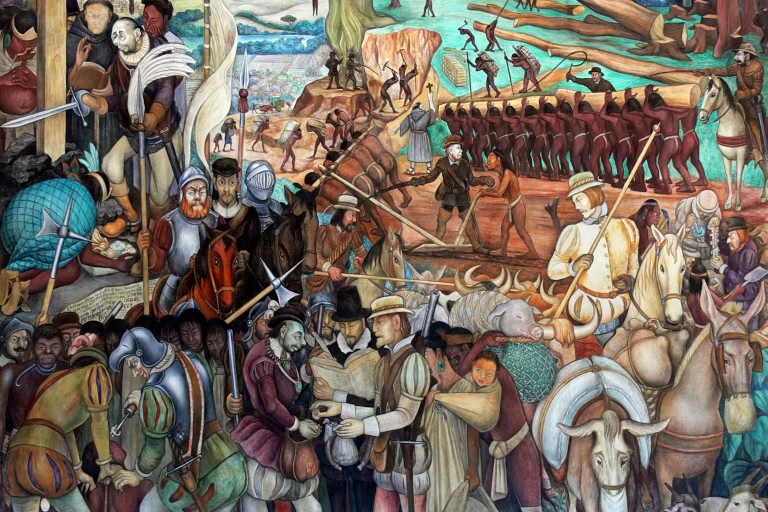
The debates about the Indies are the best-known scene where Dominicans and Jesuits deployed their arguments. Francisco de Vitoria and Bartolomé de las Casas represented the ethical criticism of excessive conquest and formulated legal limits on the appropriation of other people’s property. Their reasoning contributed to shaping a proto-doctrine of people’s rights, underlining indigenous ownership and the need for consent and legitimacy for any form of domination.
The Dominican argument relied on natural law to maintain that indiscriminate violence and slavery could not be legitimized for ecclesiastical or economic purposes. Las Casas personified moral denunciation, while Vitoria offered conceptual frameworks and legal criteria that later fed the tradition of international law. That combination of indignation and rational argument was powerful and lasting.
The Jesuits, for their part, participated in the mission and education of the indigenous people, and developed a pastoral and educational praxis that influenced colonial life. Although they shared criticism of the extremes of violence, their casuistic approach and attention to concrete circumstances generated more pragmatic responses about treatment and conversion. Both approaches left traces in colonial norms and practices, with complex consequences that require critical reading.
Contemporary projections: international law, economics and public ethics
Salamanca’s concerns are echoed in various current areas. In international law, the insistence on limits to violence and the ownership of peoples resonates in discussions about humanitarian intervention, self-determination, and indigenous rights. Questions about legitimacy of power and justice between nations do not remain in the past; They are today the subject of global courts and forums.
In economics, intuitions about price, currency, and usury are far from intellectual nostalgia. The reflection on the ethical responsibility of economic actors and the need for rules that place commercial activity in terms of the common good reappear in debates on financial regulation, taxation and corporate social responsibility. The Salamanca School provides vocabulary and arguments that can enrich contemporary discussion.
At the level of public ethics, the confrontation between rules applicable in the abstract and the casuistic assessment of circumstances continues. Public policies, judicial decisions, and administrative practices frequently oscillate between applying general rules and weighing specific consequences. The Dominican-Jesuit dialogue offers models for thinking about a balance that respects both principles and prudence.
Methodological lessons for researchers and teachers
For the historian and the teacher, the comparison between these currents teaches to avoid simplifications. Complex thinkers should not be reduced to homogeneous camps. More useful is to identify conceptual cores, argumentative instruments and practical priorities. This attention allows us to trace intellectual affiliations and understand how ideas are translated into public policies and legal decisions.
In research, the Salamancan approach invites us to combine conceptual analysis with study of contexts. The strength of Vitoria or Molina lies both in its theoretical coherence and in its ability to respond to concrete phenomena: conquest, inflation, contracts. Contemporary researchers can learn to keep one foot in theory and the other in empirical evidence.
In teaching, the dispute enables fruitful pedagogical exercises: case studies that confront Thomist and Molinist arguments, simulations of colonial courts or debates on economic regulation illustrate how ideas condition decisions. The history of thought thus becomes a tool for the formation of critical judgment.
Conclusion: synthesis and open questions
The opposition and dialogue between Dominicans and Jesuits in the School of Salamanca constitute fundamental chapters in the history of Hispanic thought. These are not just doctrinal differences, but different strategies for applying moral principles to new problems. The Dominicans brought a robust defense of natural law and a normative sensitivity that criticized the abuses of the conquest; The Jesuits introduced nuances about human freedom, casuistry and the complexity of moral responsibility.
Both currents contributed to the development of a legal and moral culture capable of interrogating European expansion, regulating markets and thinking about the common good. Today, faced with challenges such as the global regulation of markets, the protection of peoples and ecosystems, and the need for regulatory frameworks that respect cultural diversity, Salamanca’s lessons offer conceptual instruments and criteria for judgment. Its richness lies in the fruitful tension between norm and prudence, between universality and attention to the case.
There remain open questions that invite research: how to reinterpret classic concepts for contemporary environmental justice problems? What resources from Jesuit casuistry can help design flexible but fair public policies? How to translate the idea of natural law into pluralist political frameworks without incurring essentialism? The Salamanca School does not provide definitive answers, but it does provide an intellectual repertoire to confront these questions with rigor and responsibility.
References
Below I present a selection of primary works and reference works in APA format. They are starting points to delve deeper into the Dominican and Jesuit positions and the contemporary reception of the School of Salamanca.
• Vitoria, F. (1539). Relectio of Indis. Lessons on the law of nations and the situation of the Indies.
• Las Casas, B. de. (1552). Very brief account of the destruction of the Indies.
• Molina, L. de. (1588). Of free will. Treatise on human freedom and grace.
• Suárez, F. (1612). Tractatus de legibus ac deo legislatore. Studies on law, right and legislative power.
• Mariana, J. (1599). De rege et regis institutione. Reflections on political power and the responsibility of the ruler.
• Mercado, T. (1569). Of deals and contracts and currency. Analysis of price, currency and trade at the time.
• Azpilcueta, M. (16th century). Monetary and economic writings. Observations on price and quantity of money attributable to the author known as Navarrus.
• Noonan, J. T., Jr. (1957). The Scholastic Analysis of Usury. Cambridge, MA: Harvard University Press.
• Pagden, A. (1982). The Fall of Natural Man: The American Indian and the Origins of Comparative Ethnology. Cambridge: Cambridge University Press.
• Grice-Hutchinson, M. (1952). The School of Salamanca. Oxford: Clarendon Press. A classic reference on economic and legal tradition.
• Collective works and critical editions of the texts of the Salamanca School can be consulted in modern editions that include the aforementioned lessons and treatises, and in specialized academic bibliographies on natural law and early economics.