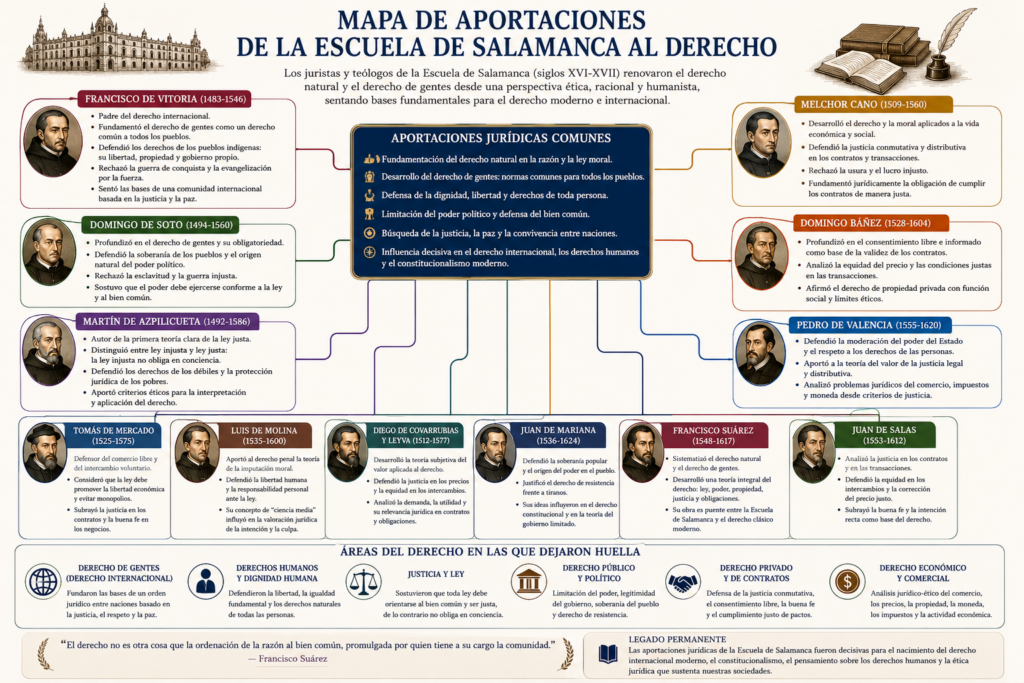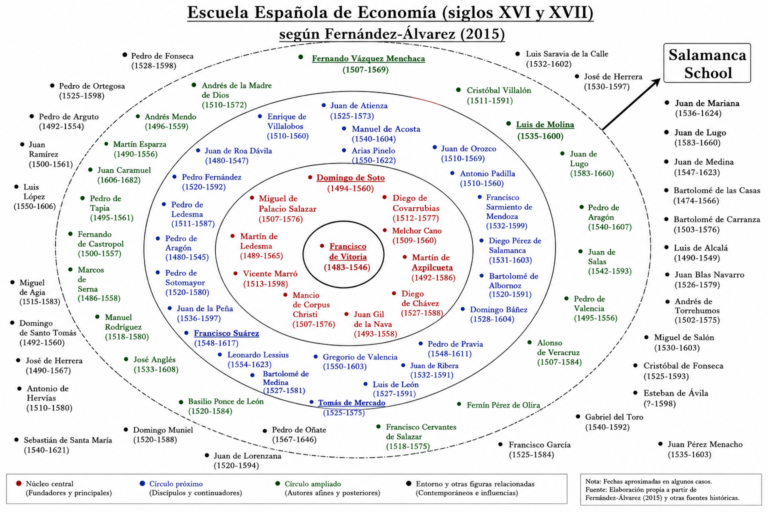
Map of relationships and legacy of the Salamanca School to economics and law.
The School of Salamanca represents one of the most influential intellectual movements in the history of Western thought. During the 16th and 17th centuries, an extraordinary network of theologians, jurists and philosophers developed from the University of Salamanca – and from other institutions such as Alcalá and Coimbra – fundamental ideas that laid the foundations of modern economics, international law and moral philosophy.
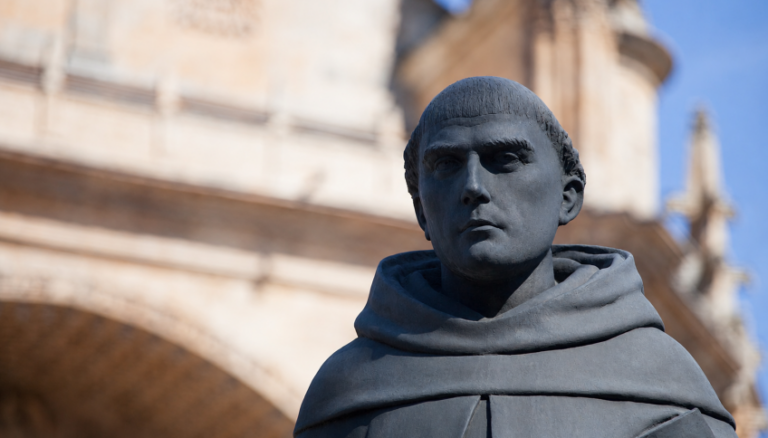
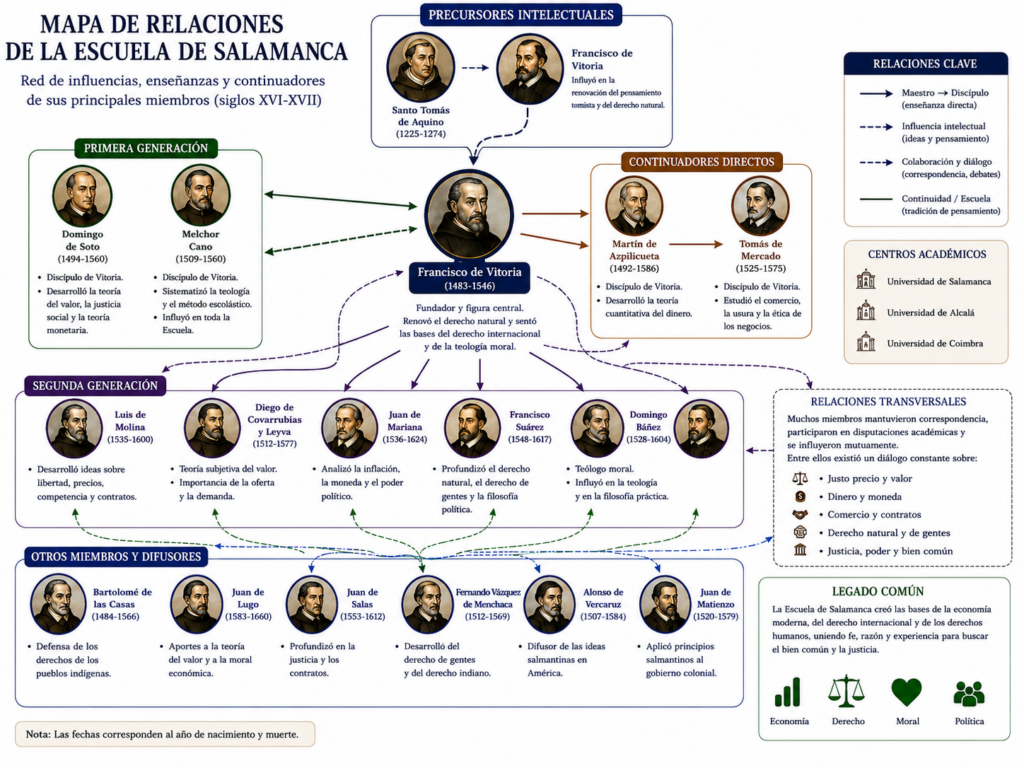
Francisco de Vitoria (1483-1546) is the central figure and founder of the School. A disciple of Thomistic thought, he renewed natural law and laid the foundations of modern international law and moral theology. His direct intellectual precursors were Saint Thomas Aquinas (1225-1274), whose scholastic philosophy inspired the entire school, and Francis of Vitoria the Elder, who influenced the renewal of Thomistic thought.
The intellectual map of the School of Salamanca
The first generation of direct disciples of Vitoria was headed by Domingo de Soto (1494-1560), who developed the theory of value, social justice and monetary theory, and Melchor Cano (1509-1560), who systematized theology and scholastic method, influencing the entire School. His most relevant direct followers were Martín de Azpilicueta (1492-1586), who developed the quantitative theory of money, and Tomás de Mercado (1525-1575), who studied commerce, usury and business ethics.
The economic legacy of the School of Salamanca
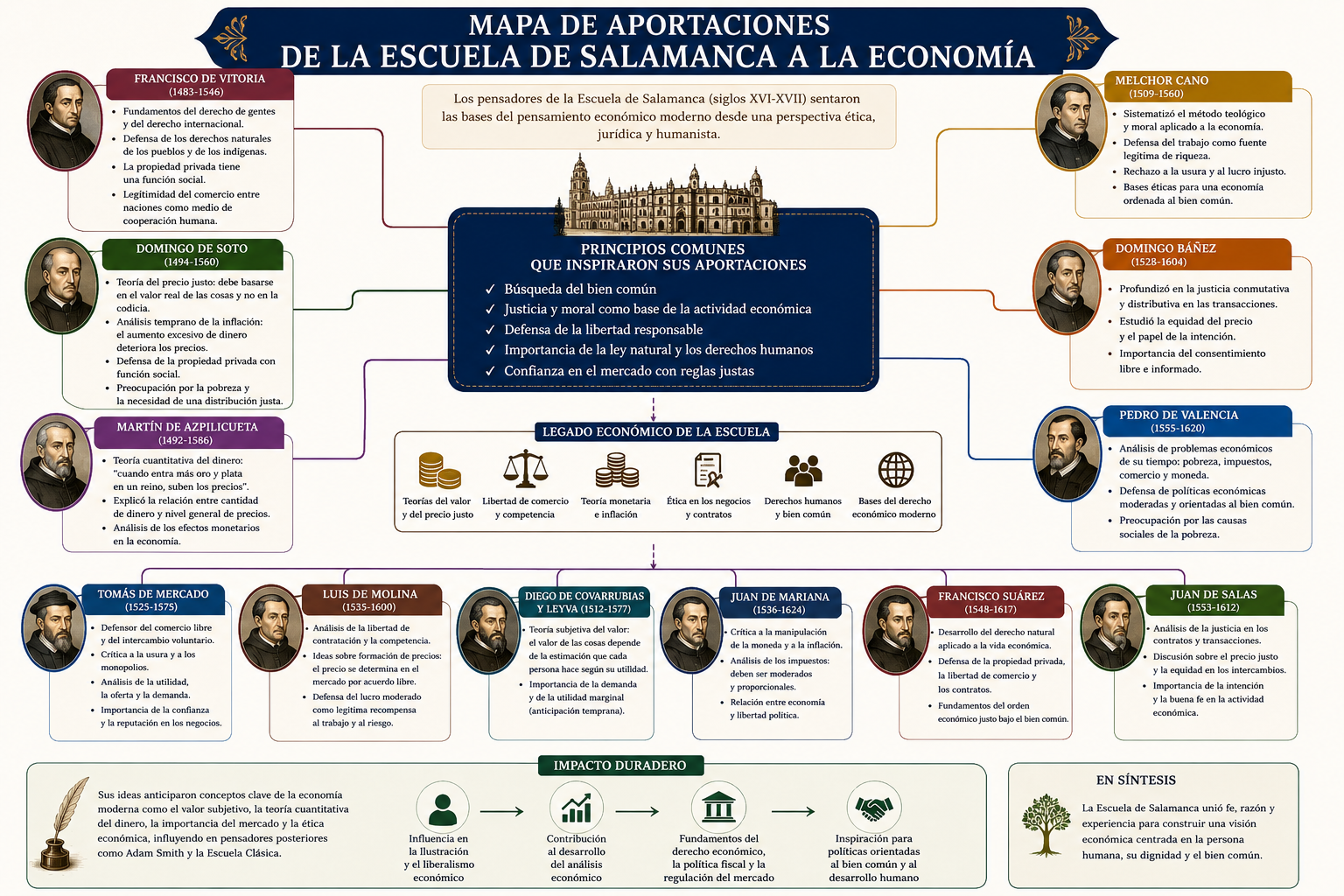
The most revolutionary contribution of the Salamanca School to economic thought was the development of a theory of subjective value. The Salamancan scholastics rejected the idea that the price of things was determined by their intrinsic nature or by the cost of production, and affirmed that value arises from the estimation that men make of goods based on their usefulness and scarcity. Tomás de Mercado, Diego de Covarrubias and Luis de Molina developed these principles with remarkable analytical precision for their time.
Martín de Azpilcueta also formulated a primitive version of the quantitative theory of money when he observed that the massive arrival of American precious metals had skyrocketed prices in Castile. This intuition, developed centuries later by David Hume and Milton Friedman, places the Salamanca School at the origin of modern macroeconomics. Luis de Molina, for his part, analyzed credit markets, the legitimacy of interest, and the nature of currency with a sophistication that anticipated the debates of the 18th century.
Joseph Schumpeter, in his monumental History of Economic Analysis (1954), recognized the Spanish scholastics as the founders of scientific economic analysis, stating that their contributions surpassed in rigor those of many later economists. This academic rehabilitation has placed the School of Salamanca as a fundamental link in the chain that goes from medieval scholasticism to Adam Smith and classical economics.
The legal legacy: international law and human rights
Francisco de Vitoria is universally recognized as one of the fathers of modern international law. In his Relectiones, and especially in the Relectio of Indis (1539), he developed the concept of ius gentium—law of nations—as a set of norms applicable to all nations and peoples, regardless of their religion or culture. Vitoria argued that the American Indians were subjects of natural rights, and that neither the pope nor the emperor could legitimately deprive them of their territories or subject them to servitude.
These principles, considered radical in their time, anticipated by more than four centuries the Universal Declaration of Human Rights of 1948. The Salamanca School established the philosophical foundation of legal equality between peoples, the limited legitimacy of war and the protection of non-combatants, principles that today form the core of international humanitarian law.
Francisco Suárez added to this legal edifice the doctrine of popular sovereignty and the right of resistance: political power emanates from the people, who delegate it to the rulers with conditions, and can revoke it if they abuse it. This theory directly influenced John Locke, 17th century English constitutionalism and, through them, the American Revolution and the French Revolution.
The influence of the Salamanca School on modern thought
The chain of influences that begins in the School of Salamanca spans four centuries of intellectual history. Hugo Grocio, considered the founder of modern international law, drank directly from Salamanca sources and recognized his debt to Vitoria and Suárez. Samuel Pufendorf and John Locke developed the natural law tradition that the scholastics had systematized. Adam Smith read the Spanish moral casuists through Francis Hutcheson and the Scottish moralists, incorporating into The Wealth of Nations notions about value, price and market justice that refer directly to the Salamanca debate.
In the 20th century, the Austrian School of Economics—Mises, Hayek, Rothbard—explicitly claimed the heritage of the Spanish scholastics, pointing out that the subjective theory of value and the analysis of the market process were already present in their works. Murray Rothbard wrote that the Salamanca School constituted “the first flowering of modern economic science.” This recovery has consolidated the place of Salamancan thinkers as unavoidable precursors of the liberal tradition in economics and political philosophy.
The current validity of Salamanca thought
In the 21st century, the legacy of the School of Salamanca is studied in faculties of law, theology, philosophy and economics around the world. Research centers in Spain, Germany, the United States and Latin America work on the critical edition of his texts and on the analysis of their influence. The debate on human rights, global justice, business ethics and the limits of political power continues to draw on the arguments that Vitoria, Soto, Azpilcueta and Suárez developed five centuries ago.
The School of Salamanca is not, therefore, a closed episode in the history of thought. It is a living tradition that continues to question the fundamental problems of human coexistence: what price is fair, what war is legitimate, what rights are inalienable, what limits there are to power. Its validity is the best proof of the intellectual height reached by that extraordinary group of thinkers from the classrooms of the University of Salamanca.