Popular sovereignty before Locke: the Spanish contribution
Introduction: why it is important to look at Salamanca before Locke
When discussing the history of sovereignty and modern political theory, the name of John Locke comes up easily and fairly. However, before 17th century England, there was a lively and fruitful debate in the Iberian Peninsula, in the universities of Salamanca and Alcalá, which conceptually worked on questions about the origin and legitimacy of political power. It is not about affirming a direct genealogy or displacing Locke, but rather about recovering an intellectual complexity that must be heard to better understand the European roots of modern political thought.
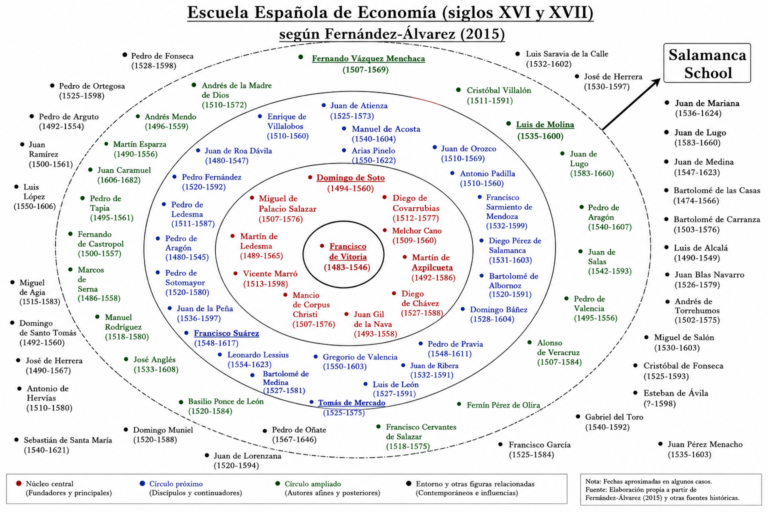
The School of Salamanca was not a monolithic school. It brought together theologians, jurists and moralists who, starting from the Thomist tradition and natural law, reflected on sovereignty, the limits of the prince, the right of resistance, international law and the condition of peoples. Names like Francisco de Vitoria, Domingo de Soto, Juan de Mariana, Luis de Molina and Francisco Suárez dialogued with real problems: war, conquest, the legitimacy of kings and the protection of people and property. This dialogue produced arguments about political will and the law that anticipate themes that will later be central to contractarianism and liberal theory.
In this piece we will carefully examine how the issue of popular sovereignty was dealt with in Salamanca. We will seek to identify key concepts, relevant authors and determining arguments, and finally we will show how these reflections reverberate in contemporary debates on democracy, legitimacy and international law. The purpose is didactic: to offer students, researchers and educated readers a clear reading connected to the present, without losing the complexity of these classic texts.
Popular sovereignty in Salamanca political theology
Historical and intellectual context of the School of Salamanca
The School of Salamanca emerged in a historical horizon marked by profound transformations: the discovery of America, imperial expansion, religious wars in Europe and the consolidation of modern States. The practical questions that these events raised forced jurists and theologians to reconsider traditional problems of natural law and political theology. The university ceased to be a mere workshop of abstract logic and became a forum where theory had to respond to concrete situations.
Intellectually, Salamanca is part of the Thomist tradition, but also incorporates resources from Roman law, canon law and late scholasticism. This crossing of sources allowed a systematic reflection on the legitimacy of power: what origin it has, what limits natural law imposes, and what instruments the community can use to ensure the common good. The practical orientation does not distort the theoretical depth; On the contrary, he feeds it with examples and cases.
It is important to emphasize methodological plurality. Not all Salamancan authors agree on conclusions or nuances. Some emphasize the sovereignty of the king within a hierarchical order; others highlight the primacy of natural law over positive power. This diversity turns the School of Salamanca into a space not of dogma but of critical dialogue, where the notion of sovereignty is modeled according to specific political, ethical and legal problems.
Key concepts: sovereignty, power and legitimacy in Salamanca
To approach sovereignty from Salamanca it is necessary to abandon anachronistic notions. It is not about seeking a univocal definition equivalent to Hobbesian absolute sovereignty or Lockean contractual sovereignty. In Salamanca the question breaks down: who has power, by virtue of what they exercise it and what are the purposes that legitimize their actions. The ultimate criterion is usually the common good understood in terms of natural law.
The term sovereignty appears implicit rather than explicit in many Salamancan texts. The authors speak of auctoritas, ius, potestas, and dominion, and carefully articulate the relationship between divine law, natural law, and human law. Political legitimacy cannot be understood as simple effectiveness or strength; requires compliance with justice. From this emerge limits to the prince’s power and justifications for resistance when power becomes a tool of oppression.
A recurring element is the social origin of power. Several theorists from Salamanca insist on the idea that the exercise of power is related to the consent of the community and the delegation of powers to protect and promote the common good. It is not an atomistic contract in the modern sense, but it is a conception by which authority is mediated by laws and purposes that the community recognizes as legitimate.
Key authors and their contributions
To understand how the notion of sovereignty was modeled in Salamanca, it is useful to stop at some authors whose works address, directly or indirectly, the legitimacy of power. This is not an exhaustive list, but rather a selection of figures that illustrate the breadth and diversity of the debate. I will now discuss Francisco de Vitoria, Domingo de Soto, Juan de Mariana, Francisco Suárez and Martín de Azpilcueta, among others.
Each of these authors approaches the relationship between natural law and political power from perspectives that complement each other and are sometimes tense. His texts discuss just war, the legitimacy of conquest, the right of resistance, and the nature of political consent. We will analyze his ideas with attention to his arguments and with a look toward contemporary implications.
It is necessary to read these works in their context: many of the concerns arose in the face of colonial expansion and the need to legally organize the relationship between kings, conquerors and indigenous communities. This practical urgency does not detract from the universality of his reasoning; On the contrary, it gives them a vigor that explains why their approaches continue to be discussed today.
The foundations of popular sovereignty according to the scholastics
Francisco de Vitoria: international order and limits of power
Francisco de Vitoria is probably the most emblematic figure when it comes to thinking about early lines of international law and questions about sovereignty. In his lessons on indigenous people and on war he develops arguments that put moral and legal limits on the action of States and kings. His notion of the law of nations grants human communities a certain normative universality that transcends mere royal will.
Vitoria maintains that the Indians are true owners of their lands and subjects of natural law. This thesis has direct consequences on the legitimacy of the conquest: a mere declaration of discovery is not enough to annul pre-existing rights. By underlining the dignity and legal status of peoples, Vitoria introduces an idea of political legitimacy that does not depend exclusively on the imperial decree but on justice that recognizes mutual rights and obligations.
Another relevant contribution of Vitoria is his treatment of war. It carefully differentiates between just and unjust causes and denies the possibility of any war that does not respect certain criteria. This reflection contains a powerful normative dimension: political authority cannot exercise violence indiscriminately without submitting to principles of justice that emanate from natural law and the common good.
Domingo de Soto and the function of positive law
Domingo de Soto provided a detailed legal and philosophical reflection on the relationship between positive law and natural law. From his perspective, the prince’s law is legitimate as long as it does not contradict natural law and seeks the common good. Soto insisted that political power is framed and limited by higher norms, which introduces moral and legal controls on sovereignty.
Soto also placed emphasis on prudence and the prudential nature of political decisions. For him, the legitimacy of power is measured by its conformity with practical reason that guides the well-being of the community. This vision connects with what today we would call public ethics: authority must be accountable to rational criteria of justice and social utility.
In short, Soto contributes to an image of sovereignty that is not absolute, but conditioned by the normative structure of natural law and by the teleological purpose of government. Authority exists to serve a higher purpose, not to impose whims.
Juan de Mariana and the criticism of tyranny
Juan de Mariana is a complex and controversial figure. Author of a work on the history and education of princes, he also devoted considerable efforts to discussing tyranny and the right of resistance. For Mariana, the monarch is not a being outside the law, and when he acts as a tyrant he loses his legitimacy and, with it, part of his political rights.
Mariana examined the conditions under which resistance can be justified, including the possibility of not only legal but also political actions to protect the community against oppression. His argument does not necessarily lead to a theory of regicide, although historiographical debate has emphasized the ambivalence of his position on the expulsion or punishment of tyrants.
Mariana’s contribution to the topic of popular sovereignty is twofold. On the one hand, it highlights moral limits to authority; On the other hand, its insistence on the instrumental nature of power—being an instrument of the common good—reinforces the idea that political legitimacy depends on conformity with higher goals shared by the community.
Francisco Suárez and the articulation of subjective law
Francisco Suárez represents a metaphysical and legal sophistication of the discussion about power. His reflection on law and natural law specifies categories such as power and subjective right, which allows for a finer articulation of how political obligations are constituted and how individuals can claim against injustices.
Popular sovereignty and modern constitutionalism
Suárez distinguishes between the origin of authority and the legitimate exercise of power, and shows greater concern for the systemic coherence of the legal order. For him, sovereignty must be interpreted in a normative framework in which human laws draw their force from natural law and from consensual and legal forms of delegation of power.
Suárez’s legal realism also provides a foundation for the protection of individual rights within a community vision. His reflections will be taken up by later theorists who will try to reconcile the existence of rights with the need for an effective government.
Martín de Azpilcueta and the economic and social implications
Martín de Azpilcueta, known as Dr. Navarrus, introduced economic and legal analyzes that enrich the understanding of sovereignty. His work on prices, currency and obligations shows how political decisions have tangible effects on the economic life of the community and, therefore, on the very legitimacy of the mandate.
Azpilcueta stated that the protection of property and the fair regulation of the market are essential functions of legitimate power. When politics systematically undermines the economy or favors unjustified privileges, it loses its moral foundation. That connection between economic justice and political legitimacy is an early contribution to a comprehensive understanding of sovereignty.
From this perspective, sovereignty is not just a matter of loyalty oaths or military control; It is also the ability to articulate norms that allow economic coexistence and fair social reproduction. Azpilcueta thus adds a practical dimension that feeds political criticism from moral economy.
Popular sovereignty and right of resistance: nuances and limits
One of the most relevant topics in Salamanca is the right to resist tyranny. The issue was raised intensely because the abuses of power were real and because jurists and theologians had to offer criteria for the legitimacy of the opposition. Salamanca teaching distinguishes between forms of legitimate resistance and acts of illegitimate violence based on passions or particular interests.
Resistance is understood as a last resort, justified when the ruler has seriously violated the laws of nature and law and when he has lost the purpose of the common good. Jurists are reluctant to face radical solutions and prefer procedural and collective mechanisms to restore justice. In many texts the idea appears that the organized community, or intermediate bodies, can claim or limit authority.
This emphasis on the organized community will connect with modern notions of popular sovereignty: political power does not arise from the arbitrary will of the sovereign but from a network of recognitions and delegations that, in extreme conditions, can be revoked. In Salamanca, then, we find a proto-theory of legitimacy that combines natural law, consent and institutional limits.
Salamanca and international law: sovereignty, peoples and global justice
Vitoria and other authors from Salamanca developed ideas that today we would recognize as the foundations of international law. The consideration of the rights of indigenous peoples, the regulation of war and the defense of a right of nations indicate an intellectual movement that goes beyond mere internal politics. It is about thinking about sovereignty in an intercommunity framework where there are norms that transcend domestic authority.
The notion of a law of people evokes the idea of reciprocal obligations between political communities. If nations are morally responsible towards each other, then sovereignty ceases to be a closed absolutism and becomes a competition regulated by principles of justice. This anticipates modern debates about humanitarian intervention, human rights and limits to state violence at the international level.
It is significant that these concerns were born in a colonial context. Disputes over the legitimacy of the conquest forced us to think about whether the sovereignty of a State could be imposed on peoples who had not consented to such subjection. The response from Salamanca was, in many cases, no: the violation of basic rights cannot be legitimized by appealing to mere transfers of power or force.
Connection with contemporary debates: democracy, rights and legitimacy
What do these texts contribute today to the debate on sovereignty and democracy? First, they offer an alternative to the narrative that identifies sovereignty with the absolute concentration of power in the State. La Salamanca remembers the normative function of natural law and the existence of ethical limits to power, useful lessons in an era of populism that demands extra-institutional powers.
Secondly, the insistence on legitimacy derived from serving the common good forces us to rethink debates about representativeness and effectiveness. The justification of a political authority cannot rely exclusively on formal procedures; It also requires evaluation of its effects on collective life and its conformity with principles of justice and equity.
Finally, the Salamanca School provides valuable perspectives for contemporary international law. The recognition of the dignity and rights of different peoples anticipates discussions on indigenous sovereignty, human rights and international responsibility. La Salamanca reminds us that sovereignty is a category that must dialogue with universal moral principles, not a shield for state impunity.
Historical examples and contemporary projection
To better understand the validity of Salamanca, it is worth considering specific examples. Discussions about the conquest of America show how legal and political categories serve to evaluate historical actions. When Vitoria and his contemporaries affirmed the legal status of the indigenous people, they were not only responding to an abstraction; They were creating a regulatory framework that could condition the behavior of monarchs and conquerors.
At present, issues such as sovereignty over natural resources, the recognition of collective rights and the protection of minorities refer to very similar problems. Salamanca’s arguments about human dignity and the right of people to their land resonate in contemporary litigation over indigenous territories, ecological rights, and redistributive justice.
Another example is the discussion on international interventions. The restrictions that Salamanca imposed on the war present a useful matrix for analyzing modern interventions, where humanitarian reasons must be weighed against risks, sovereignties, and the possibility of abuse. The practical lesson is to insist on clear criteria that legitimize any breakdown of the sovereign order in favor of higher principles of justice and protection of life.
Criticisms and limits of Salamanca interpretation
The School of Salamanca should not be idealized. Its thinkers lived in a hierarchical society and their texts contain tensions, contradictions and limitations. Not all debates were radical or led to liberal responses in the modern sense. In some cases, the theological foundation and hierarchy of the social order limit the extension of the notion of popular sovereignty.
Nor was the practical application of its principles uniform. Actual political decisions often ignored the legal and moral considerations of theorists. Furthermore, the insertion of Salamanca into ecclesiastical and monarchical structures conditioned the scope of its criticism. Interpreting their contributions requires, therefore, a critical reading that distinguishes between the theoretical ideal and historical praxis.
Despite these limitations, Salamanca gives us a valuable heritage: a set of arguments against tyranny, a concern for justice in international politics, and a notion of authority founded on shared purposes. They are resources that, when conveniently updated, can nourish current debates without pretending to be magic solutions or closed recipes.
Conclusion: lessons for the present
The rich intellectual tradition of the Salamanca School offers an early and nuanced contribution to the conception of sovereignty. Far from a monolithic theory of power, we find a network of arguments that articulate natural law, legitimacy, moral limits and public responsibility. It is a tradition that understands authority as service and that places the common good as the ultimate criterion of legitimacy.
Recovering this tradition is not an antiquarian exercise. Their questions and their answers remain valid: what limits should the law impose on those who govern? Under what conditions can the community claim or withdraw its trust? How to make national sovereignty compatible with supranational moral obligations? Salamanca provides perspectives that invite us to rebalance contemporary debates saturated by reductionisms and appeals to pure political will.
In the end, the central lesson is ethical and political: the legitimacy of power requires consonance with principles of justice, respect for human dignity and care for the common good. This teaching, formulated five centuries ago in Spanish universities, continues to be relevant in a world where theses about sovereignty are disputed in parliaments, courts and in global public opinion.
References
• Vitoria, F. (1991). Political Writings. Anthony Pagden (Ed.). Cambridge University Press.
• Grice-Hutchinson, M. (1952). The School of Salamanca: Readings in Spanish Monetary Theory 1544–1605. Clarendon Press.
• Noonan, J. T. (1957). The Scholastic Analysis of Usury. Harvard University Press.
• Mariana, J. de. (1599). De rege et regis institutione.
• Suárez, F. (1612). De legibus ac Deo Legislatore.
Category: Legacy
This article is part of the blog’s Legacy category, which seeks to explore the intellectual continuities between past and contemporary debates. The Salamanca School offers conceptual materials that continue to fuel reflection on democracy, international law and public ethics.
By placing these ideas in dialogue with current problems we aim to stimulate critical reflection in students and academics interested in the history of political thought and its practical application.
We invite readers to delve deeper into the cited works and consider how Salamancan resources can contribute to rebuilding more just and responsible public policies.