Adam Smith and his debt to the theologians of Salamanca: traces of a silent inheritance
Adam Smith and the Salamanca scholastic heritage
Introduction: Why does intellectual affiliation matter?
Talking about Adam Smith and the School of Salamanca in the same sentence may surprise those who associate the former with the Scottish Enlightenment and the latter with theology and law in Golden Age Spain. However, intellectual dialogue does not respect geographical boundaries or disciplines. Salamanca’s reflection on the fair price, the nature of money, the ethics of markets and the law of nations articulates a body of ideas that is, in the light of intellectual history, a relevant piece to understand how certain assumptions that reach classical political economy were configured.
This piece aims to offer a balanced and documented reading of what we could call Adam Smith’s intellectual “debt” to the Salamanca tradition. It is not proposed to force a direct and simple influence, as if Smith had compulsively read Vitoria or Azpilicueta. Nor does it intend to deny that the British Enlightenment had its own sources. The objective is to show conceptual affinities, indirect routes of transmission and coincidences in responses to similar problems: the formation of prices, the role of currency, the relationship between ethics and the market and the foundation of international law.
For a university and educated audience it is more useful to think in terms of complex intellectual genealogy. Ideas travel, recombine and transform. By relating the key works of the Salamanca School with Smith’s texts, we will see both convergences and distances. This comparison also allows us to rescue from oblivion thinkers who contributed to thinking about issues that seem central to us today: inequality, legitimacy of exchange, regulation and moral limits of the economy.
The influence of Salamanca on the modern economy
Historical and intellectual context of the School of Salamanca
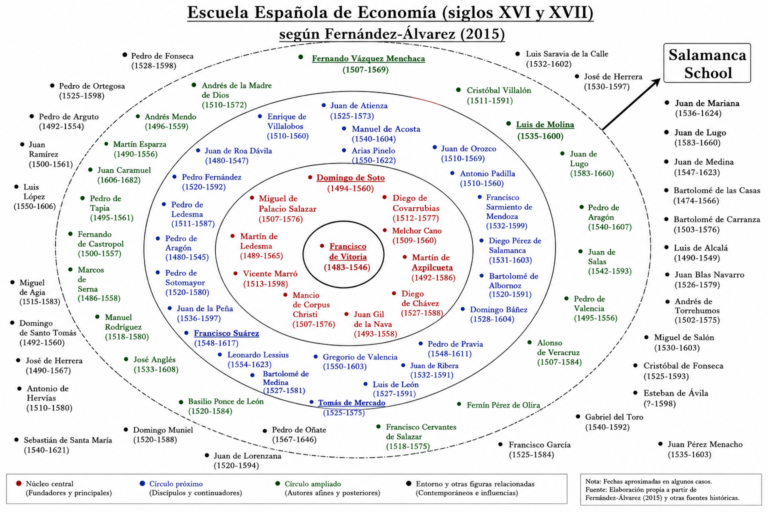
The School of Salamanca is not a school in the strict institutional sense, but rather a group of authors linked to the University of Salamanca between the late 15th and 17th centuries. Among them, figures such as Francisco de Vitoria, Domingo de Soto, Martín de Azpilcueta, Luis de Molina, Tomás de Mercado and Juan de Mariana stood out. His horizon combined Thomistic theology, natural law and a lively interest in the practical problems of an economy increasingly integrated into Atlantic trade.
The people of Salamanca responded to specific problems: the management of currency in a global empire, the circulation of precious metals, the regulation of credit, the treatment of indigenous peoples, the legitimacy of war and trade, and the relationship between morality and the market. His method alternated traditional scholasticism with an empirical attention to facts. This allowed them to develop arguments about the fair price, the nature of value and the function of the law that, beyond their theological language, contain contributions of economic interest.
A defining feature was his effort to reconcile moral consideration with the regularities of exchange. Rather than rejecting trade on ethical grounds, they sought to delineate when an exchange was genuinely fair and when it might involve exploitation. This tension between morality and the market will be a common thread to understand the eventual affinity with Smith, who also pondered ethics, especially in his Theory of Moral Sentiments.
Salamancan concepts relevant to the economy: fair price, value and currency
The treatment of the fair price by Salamancan authors is one of the points most cited by historians who study the economic contribution of the school. For Francisco de Vitoria and Domingo de Soto, price is not a purely natural fact, but a result of exchange. When two free and well-informed parties agree on a price, it is assumed that it reflects a fairness of the exchange. This conception moves away from the idea of a fixed natural price and introduces elements of subjectivity and information in the price formation process.
Martín de Azpilcueta and Tomás de Mercado delved into the relationship between currency and price. Azpilcueta, in his analyzes of the circulation of precious metals and exchange rate parity, anticipated intuitions that would later appear in modern discussions of money supply and prices. Tomás de Mercado, in his reflections on trade and prices, offered an analysis of the forces that adjust international markets, including the observation on how the abundance of precious metals can favor inflation in the internal prices of goods.
The notion of value in the Salamanca school was treated in a plural way. Some authors distinguished between use value and exchange value, while others emphasized the importance of marginal utility and scarcity in the valuation of goods. Although they do not articulate the marginalist theory in mathematical terms, intuitions about subjective valuation and comparative advantage for exchange appear. These elements are crucial for drawing bridges to some of Smith’s intuitions about value and price formation.
From Salamanca to Scotland: transmission routes and nuances
There is no conclusive evidence that Adam Smith read the Salamancans directly. However, the transmission of ideas is not always linear or explicit. Several plausible channels connect the Iberian world with the Atlantic and with European universities: translations, natural law manuals, debates on currency and commerce in the faculties of law and theology, and the circulation of merchants and commercial treaties that amalgamated practices and theories.
Furthermore, the natural law tradition and late scholasticism influenced continental thinkers who were read by the British. The works on natural law and the law of nations, disseminated by European publishers, created a common intellectual substrate. In that sense, the Salamancan influence could reach Smith indirectly, mediated by European texts and debates on justice, trade and international law that circulated at his time.
It is also relevant to consider the practical exchange. Debates about prices, currency and trade were fueled by merchant correspondence and reports on the colonial experience. The people of Salamanca often wrote in response to specific problems of administration and commerce. It is plausible that these responses contributed to a body of ideas available in Europe, which Smith and his contemporaries filtered and reworked according to their own empirical and intellectual sensibilities.
Conceptual parallels between Smith and the people of Salamanca
At several key points we find parallels that invite us to consider a kind of intellectual kinship. First, the primacy of freedom of exchange if the conditions are fair. The people of Salamanca defended that a free contract between informed parties produces a fair price. Smith, for his part, maintained that the market, when it operates with information and competition, tends to allocate resources efficiently. Both recognize that contractual freedom is a condition for legitimate exchange.
Second, the ethical consideration of the market. Although Smith is often read as an advocate of an amoral economy governed by the invisible hand, his Theory of Moral Sentiments shows that economic conduct is inseparable from moral considerations and social sympathy. The people of Salamanca, from moral theology, also insisted that the economy must be subordinated to the common good. The convergences here are not trivial coincidences; Both traditions make the legitimacy of the market depend on moral norms shared by the community.
Third, attention to the currency and international prices. Azpilcueta and Mercado’s observations on the effects of the arrival of precious metals and the dynamics of changes anticipate discussions that Smith will take up from another perspective. Smith analyzes the role of currency, the effects of industry on the wealth of nations, and the distribution of income. Although their analytical tools and vocabulary differ, some concrete problems are the same.
Differences and limits of intellectual debt
We should not fall into the temptation to completely equate Smith with the people of Salamanca. There are notable methodological and teleological differences. The School of Salamanca is based on theological premises and a moral project linked to natural law. Its conclusions are articulated through scholastic reasoning and practical cases. Smith, on the other hand, articulates his work from a secularized and empirical position, with a marked interest in the aggregate effects of the division of labor and institutions.
Another difference is the way of conceiving the role of the State. The people of Salamanca accepted an active role of law and authority to guarantee justice in exchanges and to correct abuses. Smith defends state intervention in certain essential areas, but warns of the dangers of protectionism and interventionism that curbs competition. The divergences arise both from different priorities and historical contexts.
Finally, the theoretical elaboration differs: Smith deploys a more systematic analysis of production, the labor market and productive specialization. The people of Salamanca, although they made relevant contributions, did not develop a general theory of economics in the Smithian sense. His interest was more specific and oriented to the moral and legal regulation of exchange.
Contemporary projection: regulation, ethics and markets
Looking at the relationship between Smith and the Salamanca School is not a merely historiographical exercise. It has implications for current debates about regulation, distributive justice, and the role of ethics in economics. The tension between market freedom and moral regulation, which ran through both doctrinal bodies, is still alive in discussions about financial markets, their regulation and the legitimacy of certain commercial practices.
The people of Salamanca offer a useful reminder: markets do not exist in a moral vacuum. Law and institutions are called to correct asymmetries and abuses. Smith, for his part, shows how institutions and the division of labor can produce material prosperity. The synthesis of both perspectives suggests that economic efficiency and social justice are complementary concerns, not opposites.
In the 21st century, when we discuss monetary policies, financial regulation or limits on market power, it is worth rescuing this double lesson. A wise economic policy must recognize the virtues of the market while being attentive to flaws, biases and inequities. In this sense, the Salamancan heritage and Smithian reflection can be mutually illuminating to guide more humane and effective regulatory frameworks.
Conclusion: shared inheritance and prudent distances
The hypothesis of a direct debt of Adam Smith to the theologians of Salamanca must be handled with caution. There is no documentary evidence that allows us to affirm a simple and direct affiliation. However, the comparative analysis shows important conceptual affinities. Salamanca’s intuitions about the fair price, the nature of money and the relationship between morality and the market anticipate questions that Smith addresses from another theoretical matrix.
Beyond claiming patents of authorship, what matters is recognizing the complexity of the origin of economic ideas. Smith is part of a broader European tradition in which late scholasticism played a nonnegligible role. Thinking about the history of economic thought as a web of multiple influences helps to enrich our understanding and recover voices that can still illuminate current debates.
In short, admitting an intellectual debt is not reducing Smith to an epigone of Salamanca. It is recognizing that questions about justice, value and money were formulated by different actors and that, at the intersection of these formulations, there are valuable resources for thinking about today’s economy. Recovering this legacy allows us to articulate a normative reflection on markets that combines efficiency with moral responsibility.
Reading of interest:
- Final Degree Project: Degree in Economics, School of Salamanca and Adam Smith: Economy and rationality Presented by: Diego Toribio Rodríguez Tutored by: Juan Carlos Rodríguez Caballero
References
- Smith, A. (1759). The Theory of Moral Sentiments. London: A. Millar.
- Smith, A. (1776). An Inquiry into the Nature and Causes of the Wealth of Nations. London: W. Strahan and T. Cadell.
- Vitoria, F. de. (1532). Relectio of Indis. Salamanca: classes and rereadings published in later editions.
- Soto, D. de. (1556). De iustitia et iure. Salamanca: collected theological and legal writings.
- Azpilcueta, M. (16th century). Writings on currency and morals. Navarra: historical compilations.
- Mercado, T. (1571). Deals and contracts. Seville: treatise on trade and prices.
- Molina, L. de. (1588). Concordia liberi arbitrii cum gratiae donis. Lisbon: theological work on free will and grace, with ethical repercussions.
- Noonan, J. T. Jr. (1957). The Scholastic Analysis of Usury. Cambridge: Harvard University Press.
- Hanke, L. (1949). The Spanish Struggle for Justice in the Conquest of America. Philadelphia: University of Pennsylvania Press.
- Pagden, A. (1982). The Fall of Natural Man: The American Indian and the Origins of Comparative Ethnology. Cambridge: Cambridge University Press.
- Elliott, J.H. (2006). Empires of the Atlantic World: Britain and Spain in America 1492-1830. New Haven: Yale University Press.