Salamancan natural law: what it is and why it matters today
At a time when debates on human rights, sovereignty, globalization and economic ethics reappear with intensity, it is appropriate to recover historical voices that offered theoretical frameworks capable of dialogue with contemporary problems. The natural law developed by the School of Salamanca in the 16th and 17th centuries is not mere academic erudition. It is a repertoire of normative concepts and critical criteria that articulate reason, human nature and legal practice.
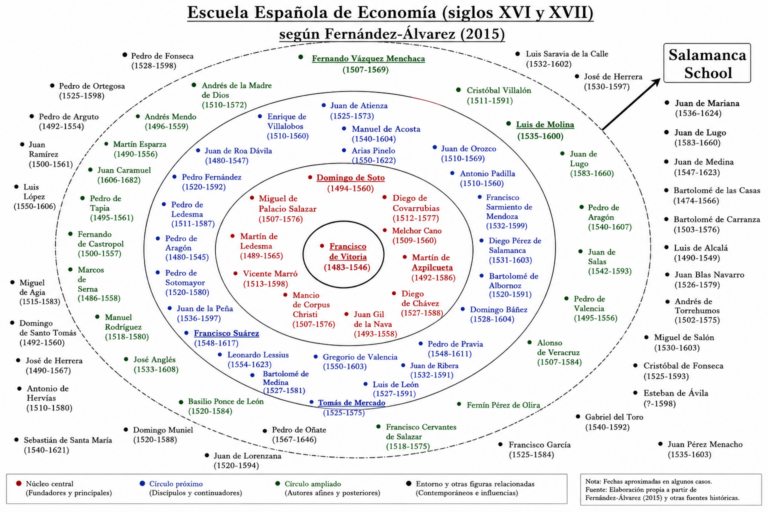
The Salamanca School produced relevant reflections on the legitimacy of power, the rights of indigenous peoples, the nature of the law of nations, justice in economic transactions and the relationship between morality and positive law. Authors such as Francisco de Vitoria, Francisco Suárez, Domingo de Soto, Luis de Molina and Martín de Azpilcueta rigorously discussed problems that today occupy international forums, courts and parliaments.
This introduction proposes three coordinates to read Salamancan natural law: first, its commitment to a legal order founded on nature and human dignity; second, its critical approach to abusive political and economic power; third, its ability to assemble theory and praxis on concrete issues such as trade, currency and war. From there, we will see why these reflections remain fully relevant.
Natural law in the School of Salamanca
Conceptual framework: What do we understand by Salamanca natural law?
The term natural law designates, in general terms, the doctrine that supports the existence of objective legal principles linked to human nature and knowable by reason. In Salamanca, this idea was developed with its own features: an emphasis on practical moral rationality, a moderate theological reading that did not annul the autonomy of practical reason and an articulation between natural law, human law and emerging international law.
Salamanca thinkers started from the conviction that natural law precedes and conditions positive law. However, this is neither rigid naturalism nor metaphysical absolutism. The natural norm is a guide for judging the justice of specific laws and for guiding political and economic action. Hence his interest in specific cases: contracts, usury, fair price, property and relations between States.
A distinctive feature is the attention to the plurality of sources: practical reason, Christian tradition and legal reflection. Authors such as Francisco de Vitoria or Francisco Suárez did not retreat their thinking towards theoretical abstraction; On the contrary: they started from real problems—conquest, trade, currency—to develop general principles. Thus, Salamancan natural law is both theoretical and pragmatic.
Foundations and validity of Salamancan natural law
Francisco de Vitoria and the law of nations
Francisco de Vitoria is perhaps the best-known figure of the Salamanca School for his influence on the formation of international law. His lessons on the “conquest” of America and the law of nations constitute a turning point. Vitoria rejected the idea that indigenous peoples lacked rights and defended moral limits on sovereignty and war.
In the well-known Relectio on the Indians, Vitoria analyzes whether the kings of Spain had the right to dominate the natives by mere superiority of faith or by the mercy of discovery. His answer is blunt: legitimate possession and sovereignty require valid legal foundations; The dignity and rational condition of the indigenous people confer on them inalienable rights. This argument links to our current discussion on indigenous rights and self-determination.
Vitoria also developed early notions of ius gentium that anticipate principles of modern international law: the idea of common interests of humanity, limits on war, and mechanisms for peaceful coexistence between peoples. His approach shows how natural law can be a source of normative criticism of the political and economic practices of his time and the present.
Francisco Suárez: law, community and legal order
Francisco Suárez developed a complex legal theory that integrated metaphysics, theology and philosophy of law. In works such as De legibus, Suárez develops a conception of natural law that emphasizes human sociability and the orientation of the individual towards the common good. For Suárez, human laws are authentic to the extent that they seek just order and respect practical reason.
Suárez also offered reflections on legitimate political authority. Against the idea of absolute power without limits, he maintained that authority is justified by its service to the common good and by its conformity with natural law. This perspective contributes to the theoretical foundation of the critique of tyrannical power and to the legitimacy of resistance when the order violates essential rights.
At the international level, Suárez recognized the relative autonomy of political communities and the possibility of obligations and rights among them, anticipating instruments that would later structure the idea of the law of nations. His legacy is useful today to rethink the tension between sovereignty and supranational obligations, as occurs in matters of human rights or environmental protection.
Domingo de Soto and the theory of justice in exchange
Domingo de Soto focused much of his reflection on the justice of transactions and the definition of the fair price. For Soto, justice in the market is not a purely theoretical construct: it requires attention to the specific conditions of the sale, the information available and the absence of coercion. He condemned practices that took advantage of ignorance or extreme need.
His analysis offers a moral proto-economy that dialogues with current problems: asymmetric contracts, predatory commercial practices and market regulation to correct failures that generate injustice. The Salamanca proposal here is neither statist nor strict individualist; seeks a balance between contractual autonomy and principles of equity that protect the dignity of the contracting party.
Furthermore, Domingo de Soto helped clarify the distinction between value and price and explain how market variations influence moral perceptions about what is fair. Their considerations are a conceptual wealth for thinking about contemporary regulations on competition, consumer protection and social policies.
Luis de Molina and moral freedom in the legal order
Luis de Molina is known for his contribution to the debate on free will and grace, but his influence also reaches areas of law and moral economy. Its central concern is how to reconcile human freedom with the legal and social coordination necessary for a just order.
Molina defended a conception of human action as rational and deliberative, which implies that legal norms must respect and guide freedom based on the common good. This has practical implications: laws that impose arbitrary ends or deny conditions for human autonomy are unjust from the Molinist perspective.
In the economic field, Molina and his school examined individual responsibility in transactions and the nature of consent in contracts. Its emphasis on rational deliberation connects with contemporary debates on choice, commercial manipulation, and the ethics of freedom in complex markets.
Martín de Azpilcueta: currency, prices and a modern intuition
Martín de Azpilcueta, known as Doctor Navarrus, contributed a surprisingly modern intuition about currency to economic reflection. He observed that the abundance of precious metals in Castile, derived from transatlantic flows, contributed to rising prices; With this he anticipated a primitive form of the quantitative theory of money.
Azpilcueta did not develop a mathematical model, but he did propose that the amount of currency in circulation influences prices and economic well-being. His observation is very pertinent to current debates on monetary policy, inflation and financial globalization: it demonstrates that Salamancan thinkers applied ethical reflection to specific economic phenomena.
In addition, Azpilcueta addressed practical issues such as currency exchange, usury and the regulation of exchange markets. Their contributions show the capacity of the Salamancan tradition to combine conceptual analysis and political recommendations informed by economic reality.
Recurring principles and their translation to the present
When reviewing Salamancan authors, recurring principles emerge: the primacy of human dignity, the requirement of the common good to legitimize norms and authorities, the possibility of international norms derived from reason and justice, and attention to equity in economic transactions. These principles can be translated to contemporary problems directly.
In human rights, the idea from Salamanca that humanity shares a series of rights due to its rational nature reinforces current arguments about universal fundamental rights. In international law, the notion of moral limits to intervention and obligations between States contributes to founding multilateral institutions.
In economics and public ethics, Salamanca teaching invites us not to divorce efficiency from justice. The discussion on financial regulation, redistributive policies or corporate responsibility can be enriched with the idea that the economy is a regulatory field where law and ethics must come together to protect dignity and the common good.
Contemporary applications: international law and sovereignty
One of the most palpable legacies is the influence on the genesis of international law. Vitoria’s notions about ius gentium and limits to war anticipate principles that are today found in treaties and international jurisprudence. The notion of subjects of rights beyond the State, although still incipient in Salamanca, helps us think about the transnational protection of people.
In a world of States and supranational organizations, the tension between sovereignty and global obligations persists. The Salamancan reflection—which recognizes rights and duties common to the international community—provides a framework to justify supranational commitments in matters of human rights, migration, public health or the environment.
When it is debated whether the international community can impose limits on the actions of a State under the excuse of preserving the common good, it is worth reviewing the Salamancan criteria on legitimacy: authority is legitimized when it favors the common good and respects the dignity of people. This perspective can be a critical repertoire for political and judicial decisions.
Economy, justice and regulation: a Salamanca voice for globalization
Salamanca’s reflections on fair price, contract and usury offer tools to evaluate global markets. These were not economic technicalities unrelated to ethics; They were practical analyzes of how exchange should respect equity and avoid exploitation.
Today, when globalization produces power asymmetries between economic agents and when value chains hide unjust practices, Salamancan natural law suggests criteria for regulation: transparency, protection of vulnerable parties, equity in the distribution of benefits and sanctions for predatory practices.
Likewise, Azpilcueta’s monetary intuition reminds us that monetary policy and decisions on currency circulation have real distributive effects. Ethical deliberation must accompany technical decisions on inflation, interest rates and capital control.
Climate justice and intergenerational responsibility
Although the climate was not an issue in Salamanca, natural law principles offer an ethical basis for thinking about responsibility between generations. The idea of a shared common good and moral obligations between human communities can be transferred to resource management and the preservation of the environment for future generations.
If we accept that certain goods—breathable air, healthy ecosystems—require protection on moral grounds, then public and private institutions have duties that exceed the mere maximization of present benefit. Salamancan natural law invites us to conceive environmental law as part of intertemporal justice.
This approach helps justify climate mitigation and adaptation policies that incorporate distributional criteria: who pays, how damage is repaired, and how the most vulnerable populations are protected. Thus, the Salamancan tradition can contribute to contemporary debates on reparation, compensation and ecological sovereignty.
Indigenous rights and historical memory
The treatment of the native peoples by the Crown and the ideological justifications for the conquest are issues that still raise debates about historical reparation. Vitoria’s audacity in recognizing the dignity and rights of indigenous people is key to any ethical and legal reflection that addresses memory and restorative justice.
Recognizing that, in the 16th century, there were voices that defended universal rights does not eliminate the injustices committed, but it offers a normative resource to support contemporary demands. Salamancan natural law can support the protection of territorial, cultural and political rights of indigenous communities in the present.
Likewise, the tension between the economic interests of conquest and the rights of the original peoples illuminates modern debates about extractivism, prior and informed consent, and benefit sharing. The Salamancan tradition provides criteria to evaluate when an economic activity transgresses basic norms of justice.
Criticism and limits of Salamancan natural law
Not everything in Salamanca is a model to follow without criticism. The natural law perspective can be used in a conservative way, justifying certain existing orders, or it can fall short in the face of the demands for recognition of plural identities. Furthermore, some Salamancan authors shared theological and cultural assumptions that today we must critically review.
It is necessary to distinguish between valuable normative principles—human dignity, common good, criteria of justice in exchange—and the contextual limitations of the authors: Eurocentric visions or limitations in the understanding of cultural plurality. Reading Salamanca requires critical hermeneutics, aware of his time, but attentive to what he contributes today.
Finally, natural law does not offer technical answers to all contemporary problems. It must dialogue with disciplines such as political economy, environmental science and positive law. Its contribution lies in providing normative foundations and evaluative criteria, not in replacing modern technical work.
Methodology to apply Salamanca ideas today
Applying the Salamancan tradition requires a certain method: first, identifying the relevant normative principle; second, translate it into operational legal and political criteria; third, subject the proposed solutions to empirical tests and plural discussion. This procedure allows us to take advantage of conceptual depth without falling into ahistoricism.
For example, faced with a fiscal policy that favors capital over labor, the Salamanca reading would ask about its conformity with the common good and its effects on the dignity of the most vulnerable groups. From there, reforms are designed that respect contractual freedom, but correct structural inequalities.
In the international arena, the Salamancan criterion can be used to evaluate treaties: do they promote the universal common good? Do they respect the dignity of the peoples involved? These questions, although old in form, are operative to design more just global institutions.
Conclusion: main ideas and living legacy
The natural lawism of the Salamanca School is not an academic relic, but rather an intellectual resource with the capacity to illuminate contemporary debates in law, public ethics and economics. Its authors offered normative foundations for human dignity, the common good, political legitimacy, and justice in transactions that remain relevant.
His legacy consists of a way of thinking that unites theory and praxis, that is not afraid to address specific problems and that conceives law as a service to the person and the community. Recovering this heritage is useful for thinking about economic regulation, international justice, people’s rights and intergenerational responsibility.
When doing so, it is necessary to maintain a critical and contextualized reading: appreciate the contributions without ignoring the limitations. Only in this way can the Salamanca tradition contribute fruitfully to the construction of legal and ethical frameworks that respond to the challenges of the 21st century.
References
• Vitoria, F. (1539). Relectio de Indis et de iure belli. Edition of the lessons on Indians and the law of nations.
• Suárez, F. (1612). De legibus ac Deo legislatore. Treatise on laws and legislative authority.
• Domingo de Soto, D. (1556). De iustitia et iure. Reflections on justice and law in transactions.
• Molina, L. (1593). De iustitia et iure. Contributions on morality and law, especially on matters of responsibility and contract.
• Azpilcueta, M. (Doctor Navarrus) (16th century). Writings on currency and exchange. Early observations on the relationship between the quantity of money and prices.
• Noonan, J. T. Jr. (1957). The Scholastic Analysis of Usury. Cambridge: Harvard University Press.
• Pagden, A. (1982). The Fall of Natural Man: The American Indian and the Origins of Comparative Ethnography. Cambridge: Cambridge University Press.
Category: Disciplines