Francisco de Vitoria: founder of modern International Law
Francisco de Vitoria, Dominican and professor at the University of Salamanca in the 16th century, is not just a historical figure confined to manuals. Its lessons on the limits of power, the legitimacy of war and the moral condition of colonized peoples constitute a direct and surprisingly modern antecedent of International Law. Understanding his work helps us situate contemporary debates about sovereignty, human rights, the responsibility to protect, and global justice within a clear and demanding genealogy.
Today, when public opinion and international courts confront questions about humanitarian interventions, exploitation of common resources, and recognition of the rights of indigenous peoples, Francisco de Vitoria’s reflection offers conceptual tools that are not only historical but normatively provocative. His insistence on human dignity, on the ius gentium as a legal order that transcends borders, and on clear limits to the right of conquest, raises questions that remain valid.
This entry seeks to explore in a didactic manner the intellectual life of Francisco de Vitoria, characterize his central doctrine and show his projections on current problems. This is not about hagiography: we will also examine limits and criticisms. But we start from the premise that Francisco de Vitoria inaugurated a way of thinking about the international community that deserves to be read carefully by students of Law, philosophy, history and economics.
Francisco de Vitoria: founder of international law
Historical and intellectual context: Salamanca in the 16th century
The University of Salamanca, in the first half of the 16th century, was a crossroads of intellectual practices: scholastic theology, canon law, biblical commentary and moral debates applied to practical problems. The massive arrival of news about America and colonial practice raised unprecedented questions: what rights did the indigenous populations have? By virtue of what authority could encomiendas be founded or war declared? What limits did natural law impose?
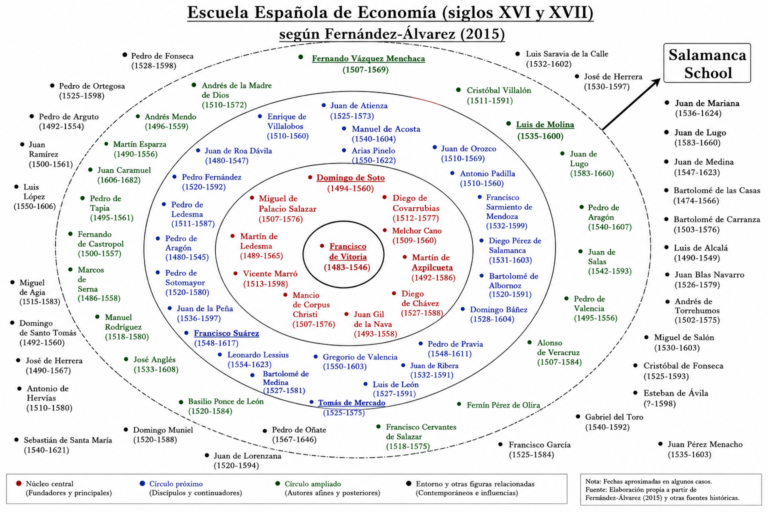
In this context, the so-called School of Salamanca was not a formal institution, but a constellation of teachers and students who worked with scholastic tools to address specific social and political problems. Along with Francisco de Vitoria, figures such as Domingo de Soto, Martín de Azpilcueta and, later, Francisco Suárez and Luis de Molina stood out. The strength of the method was the application of natural law and Roman and canon law to new realities.
This dialogue between tradition and novelty explains the originality of Vitoria. He did not start from a liberal tabula rasa or a closed positivism. He started from universal principles—natural law, human dignity, legitimate political communities—and used them to judge historical practices. The result was a legal and moral critique of colonization that, in many points, anticipated concepts of modern International Law.
The doctrine on just war and the rights of peoples
Vitoria’s intellectual biography: life and essential works
Francisco de Vitoria was born around 1483 in Burgos and died in Salamanca in 1546. He was a Dominican friar and professor of theology in Salamanca. His lectures were not originally written as systematic treatises, but as rereadings and academic sermons collected in what we know today as his Relectiones or Rereadings. From this teaching dedication come the fundamental texts: the so-called Readings on the Indians and on the war between Christians and non-Christians.
The most cited works are the Relectiones from the decade of 1530-1540, which address, among other issues, the legitimacy of the encomienda, the legal status of the American Indians, and the just causes of war. Some of that material was later edited and translated; An influential modern edition is Political Writings, edited and translated by Anthony Pagden and Jeremy Lawrence in 1991. That volume has brought a rigorous interpretation of its arguments to an Anglo-Saxon audience.
Vitoria did not write a single treatise on international law, but his collected lessons make up a coherent corpus in which concepts such as ius gentium, natural law, community of law, and limits on papal and royal power in temporal matters constantly appear. Reading his Relectiones requires patience: they are pedagogical texts that discuss case by case, but this form gives his thinking a practical and applicable character.
Central principles: natural law, ius gentium and human community
A central axis in Vitoria is the distinction and simultaneity between natural law and ius gentium. For him, natural law founds universal moral rights; The ius gentium is the set of norms that regulate coexistence between peoples and that, although they manifest themselves in diverse customs, have a common founding reason. This ius gentium becomes the matrix of an emerging international law, neither arbitrary nor merely customary, but anchored in reason and human dignity.
The human community, in Vitoria’s vision, precedes and limits particular powers. This is not an abstract cosmopolitanism, but rather the idea that there is a common legal space in which certain prerogatives and restrictions are recognized. This vision allowed him to support arguments in favor of supranational rights: to navigation, commerce, personal integrity and the political autonomy of peoples.
With such premises, Vitoria developed a critical discourse against more expansive doctrines of papal or royal power over new lands. He did not deny the authority of the Crown or the Church, but he affirmed that neither the papal bull nor the simple act of discovery conferred absolute rights to dominate and expropriate entire peoples. Justice demanded more.
The Relectio on the Indians: right, dignity and limits to the conquest
The famous Relectio of 1539, known as De Indis, is perhaps the nucleus that has made Vitoria indispensable for the history of International Law. In it he confronts colonial praxis and arguments that justified the conquest for religious reasons or for simple discovery. Vitoria starts from the radical premise for its time: indigenous people are full subjects of law and legitimate holders of their lands and laws.
Vitoria rejects the thesis that mere discovery or supposed cultural inferiority grants title to appropriation. He also discusses the supposed right of Christian kings to subdue infidel peoples by papal command. In his analysis he distinguishes between potestas spiritualis and potestas temporalis: the pope can judge ecclesial matters, but he does not confer the right to exterminate or enslave entire people in the name of faith.
From that basis, Vitoria admits only limited causes that could justify intervention: for example, the exercise of a police right to punish those who commit serious crimes or defense against attacks. But that use is not equivalent to a general right of appropriation. Its conclusion is clear: colonization could not be based on legal principles that denied the ownership and dignity of indigenous peoples.
Justice of war and ethical limits: the doctrine of ius belli
The question of war and its legitimacy occupies another essential part of Vitorian reflection. Following the Thomist tradition, Vitoria proposes rigorous criteria to determine when a war can be considered just. Among them are legitimate defense, restitution of rights and right intention. War for greed or purely utilitarian reasons is not permissible.
Furthermore, Vitoria applies these criteria to the colonial scenario with profound criticism. He points out that many of the actions committed in America do not meet the requirements of just war. The massification of violence, slavery and the systematic appropriation of resources do not conform to the practical reason that should govern Christian states.
His theory of ius belli, therefore, poses a moral and legal brake on expansionism. Even though it allows for limited exceptions, its spirit is restrictive: the emerging international community must be governed by norms that reduce barbarism and protect the innocent. That spirit connects directly with modern debates on humanitarian law and limits on war.
Economy, property and people’s rights: contributions to a normative economy
Although Vitoria was not an economist in the modern sense, his reflections imply important economic consequences. By recognizing the property and sovereignty of indigenous peoples, it denied the legal justification for the systematic expropriation of resources. Furthermore, he understood trade as a natural right of people, not as a privilege granted by metropolises.
At this point his position serves as an early criticism of forms of accumulation based on plunder. If the inhabitants of the newly contacted islands and continents had the right to trade freely and own their goods, then exclusionary or monopolistic policies were unjust. Vitoria thus proposed an ethical framework for the international economy that anticipates contemporary concerns about economic sovereignty and distributive justice.
His notions about legitimate resource use and limits to dominance are also relevant to environmental debates. The idea that the human community shares a heritage that must be administered fairly links to the current discussion about common goods, rights of nature and intergenerational responsibility.
Influence and reception: from Salamanca to Grotius
The importance of Vitoria is not limited to the University of Salamanca. His ideas circulated in Europe and fueled subsequent discussions on the law of nations. Authors such as Alberico Gentili, Hugo Grocio and, later, Francisco Suárez and the late scholastics, dialogued with the categories that Vitoria had clarified. There is no simple line of influence, but there is a transmission of concepts: ius gentium, limits of sovereignty and the centrality of practical reason in international affairs.
Grotius, for example, consolidated in De jure belli ac pacis a theory of international law that collected and transformed previous intuitions. Although Grotius led the debate to a more systematic and secularized language, the normativist and humanist seed found in Salamanca was part of that process. Vitoria thus figures as a precursor whose impact is visible in the evolution of the discipline.
In Spain and Latin America, his legacy had a complex reception. On the one hand, he was vindicated as an intellectual who criticized colonial abuses. On the other hand, its reading was sometimes instrumentalized by policies that did not always respect its moral limits. Critically interpreting this reception is part of an intellectual history that connects with memory and the construction of national narratives.
Vitoria and human rights: an early bridge
Can Vitoria be considered a precursor of human rights? The answer requires nuances. He did not write a Universal Declaration nor defend an explicit catalog of positive rights. However, its recognition of the dignity and natural rights of individuals and peoples constitutes a conceptual root of the tradition that would lead, centuries later, to the modern idea of human rights.
His insistence that certain rights are inalienable and that political communities cannot be treated as mere objects of conquest anticipates contemporary concepts of autonomy and self-determination. In that sense, Vitoria offers resources to legitimize legal and moral claims against state oppression and structural violence.
The bridge between his thought and human rights is neither direct nor teleological. But recognizing this affiliation allows us to read the emergence of supranational norms—such as the principle of non-discrimination, the prohibition of slavery, and the idea of responsibility to protect—as part of an intellectual plot that has a significant thread in Salamanca.
Contemporary applications: sovereignty, interventions and indigenous peoples
Current controversies about humanitarian intervention, sovereignty and the rights of indigenous peoples can benefit from Vitorian precision. For example, his distinction between legitimate causes of intervention and pretexts for domination is useful in evaluating contemporary international military operations. Vitoria would demand rigorous verification of motives and proportionality in the response.
Regarding indigenous peoples, their arguments about land ownership and the political capacity of communities provide a philosophical basis for contemporary demands for restitution, consultation and autonomy. Although the current context includes modern international instruments, the justifying core—dignity, sovereignty and the right to property—finds an echo in Vitoria.
Also in the global economy, Vitoria’s reflection suggests limits to extractive practices that ignore local rights. The idea that trade and navigation are natural rights, not granted favors, raises criteria for judging international agreements and unequal contracts. His thinking provides an ethical framework to think about fair economic cooperation between nations.
Criticism and limits: what Vitoria did not resolve
It is important to be critical: Vitoria did not solve all the problems nor was it consistent in all its applications. His arguments, although radical on some points, still operate within Eurocentric and theological frameworks. His use of natural law categories and his teleological vision of history may be insufficient for contemporary interlocutors who propose very different assumptions.
Furthermore, historical practice did not necessarily follow its recommendations. Colonial institutions and political nautical institutions showed an inertia that scholastic reason could not stop. This reminds us that institutional and economic power often neutralizes well-founded moral arguments.
Finally, reading Vitoria requires hermeneutical care. His texts are lessons and not systematic treatises; therefore, his position at a given point may seem contradictory to another in a different passage. Historical interpretation must avoid both the idealization and the cancellation of its thought.
Methodological lessons for the present
A key lesson from Vitoria is the importance of applying universal ethical principles to concrete problems. An abstract moralism does not work, nor does a technocracy detached from justice. The scholastic method, with its emphasis on practical reason, allows for case-by-case discussion without losing sight of firm principles.
Another lesson is the combination of internal criticism and institutional fidelity. Vitoria was a friar and teacher; However, he did not give up criticizing practices of his time. This tension between belonging and criticism is instructive for today’s academics and professionals, who must balance institutional commitment and moral demand.
Furthermore, its interdisciplinary approach—theology, law, economics, and philosophy—offers a model for addressing complex problems in the 21st century. Global policies require frameworks that integrate ethical, legal and economic dimensions; Salamanca tradition shows how to do it rigorously.
Conclusion: the validity of critical and normative thinking
Francisco de Vitoria is not an author for intellectual museums. His Relectiones constitute a living source that challenges modern disciplines: Law, political philosophy, history and economics. His defense of human dignity, his criticism of conquest and his affirmation of a ius gentium founded on reason provide valuable tools for thinking about the international community.
Although his language and assumptions differ from the contemporary context, the normative core of his thought—the demand for rational justification for violence, the recognition of the sovereignty of others, and the protection of the vulnerable—continues to resonate. To read Vitoria today is to receive an invitation to reconstruct an International Law that puts justice and shared responsibility at the center.
As historians and citizens we must sustain this critical invitation: to receive from tradition not dogmatic slogans, but demanding questions. In times of deregulated globalization and ecological crisis, Vitoria reminds us that practical reason and moral responsibility are requirements for any legitimate international order.
References
- Vitoria, F. (1991). Political Writings. Edited and translated by Anthony Pagden and Jeremy Lawrence. Cambridge: Cambridge University Press.
- Pagden, A. (1982). The Fall of Natural Man: The American Indian and the Origins of Comparative Ethnology. Cambridge: Cambridge University Press.
- Grotius, H. (1625). De jure belli ac pacis. Leiden: Elzevir (traditional ed.).
- Suárez, F. (1612). Tractatus de legibus ac Deo legislatore. Salamanca: (original ed.).
- Noonan, J. T., Jr. (1957). The Scholastic Analysis of Usury. Cambridge, MA: Harvard University Press.