International conferences on the School of Salamanca: memory, debate and public projection
Introduction
The international conferences dedicated to the School of Salamanca have been, since their appearance in the 20th century, spaces where intellectual history, law, morality and political economy converge. These meetings not only commemorate figures such as Francisco de Vitoria, Domingo de Soto, Francisco Suárez or Martín de Azpilcueta; They also activate a live dialogue with contemporary problems: human rights, economic justice, global governance and the challenges of legal pluralism. Studying how these conferences have been organized and what topics they have privileged allows us to understand both the evolution of academic interest in the Salamancan tradition and its ability to influence current public debates.
In this article I reflect on the history and evolution of international conferences on the School of Salamanca, their recurring thematic lines, their methodologies and audiences, and the projections they open for the present. My intention is to offer a critical and practical reading: it is not just an inventory of presentations, but rather considering how these meetings produce knowledge, build research agendas and mediate between the past and the urgent problems of the globalized world. Throughout the text I will cite works and canonical authors of the Salamanca school when appropriate and relate their thinking to contemporary issues.
The audience I am addressing is university students, researchers and professionals involved in humanities, law, economics and social sciences. For this reason, I will seek a rigorous but accessible tone, avoiding unnecessary technicalities and favoring conceptual connections that allow conferences to be used as a research and teaching tool. I will also put forward practical suggestions for the organization of future meetings, with an eye toward interdisciplinarity and public responsibility for historical knowledge.
Historical context and genesis of the congresses on Salamanca
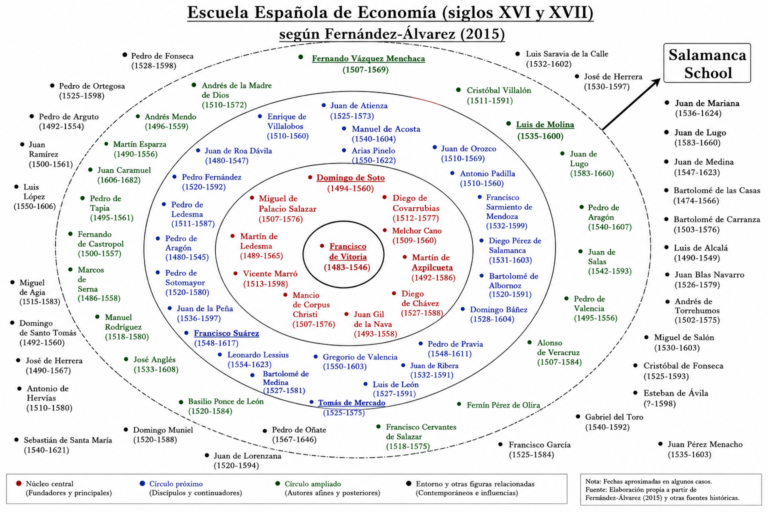
The so-called School of Salamanca was not a school with a strict physical headquarters, but rather an intellectual constellation that emerged in the 16th century around the University of Salamanca and the figure of theologians and jurists who explored problems of natural law, moral economy and international law. Its modern revaluation began in the 20th century, partly due to the interest of legal and economic historians in identifying European antecedents to modern regulatory systems. The first international conferences on the Salamanca School emerged in this context of historiographical recovery and, over time, were consolidated as transnational forums where sources are reexamined and the contemporary relevance of their ideas is discussed.
The first international academic meetings had an eminently historiographical character: critical editions of texts, philological studies and academic biographies. However, thematic axes linked to public ethics and international law were soon added. Figures like Francisco de Vitoria, with his lessons on Native Americans and just war, became nodes connecting intellectual history with issues of colonization, sovereignty, and human rights. This tension between textual scholarship and the public dimension has marked the nature of many subsequent conferences.
When analyzing the genesis of these conferences it is important to also consider the institutional context: universities, research centers and cultural foundations have sponsored events that vary in scale and scope. Some have been highly specialized and academic in nature; others have sought the participation of a broader public, incorporating outreach panels, interdisciplinary round tables, and cultural activities. This institutional diversity is one of the reasons why today the conferences on the School of Salamanca are useful platforms for articulating historical memory and contemporary relevance.
International conferences: origin, evolution and formats
The format of the conferences has evolved over time. The first academic sessions followed the classic model of strictly specialized presentations and debates. Over the decades we have seen a methodological expansion: plenary sessions, thematic panels, interdisciplinary round tables and public activities. This transformation reflects an explicit desire to connect historical research with diverse audiences, and to situate the Salamanca School in broader conversations about political ethics, economics, and international law.
The internationalization of these congresses involved two simultaneous processes: the translation and circulation of Salamancan texts outside the Hispanic sphere, and the incorporation of comparative perspectives from other legal and philosophical traditions. Researchers from different latitudes have contributed to rethinking interpretations, for example, contrasting Vitoria’s proposals with those of Italian or French jurists of the same time. This comparative view has enriched the academic treatment and has allowed us to identify original contributions in the field of international law and moral economy.
Regarding practical organization, digitalization and academic networks have introduced new modalities: hybrid conferences, virtual seminars and online publications associated with the meetings. These formulas have expanded accessibility and have allowed a greater diversity of participants. However, they also pose challenges: the quality of the debate, the selection of presentations and the continuity of collaborative projects after the event continue to be central challenges for the organizers.
Recurring themes in conferences on the School of Salamanca
International law, sovereignty and human rights
One of the most persistent axes in international congresses is the interest in early international law and in reflections on sovereignty and indigenous population, largely inherited from Francisco de Vitoria. His Relections on the Indians and the Law of Nations raise debates about the legitimacy of the conquest, political authority and the protection of fundamental rights. At the conferences, both the historical contextualization of these reflections and their ability to formulate universal principles applicable today are discussed.
Sessions dedicated to international law usually bring together legal historians, political philosophers and contemporary jurists. The comparison between Salamancan concepts, such as the idea of ius gentium, and the modern development of human rights is a recurring issue. Debates usually focus on the limitations and contributions of the Salamanca perspective: on the one hand, Salamancans admit natural rights and certain valid norms among peoples; On the other hand, its frameworks were immersed in a theological and political universe that forces an anachronistic reading to be qualified.
At present, these debates are echoed in practical issues: the protection of minorities, the legitimacy of international interventions, the rights of migrants and the responsibility of states in the face of mass violations. Conferences thus act as spaces where it is explored whether and how ideas from the 16th and 17th centuries can illuminate solutions to current problems without forcing inappropriate analogies.
Moral economy, just price and monetary theory
The Salamanca School is frequently cited for its early contributions to economic theory, including discussions of fair price, interest, and currency. Tomás de Mercado and Martín de Azpilcueta, among others, reflected on commerce, usury and value, laying the foundations for debates that reappear in the economic sessions of the congresses. These meetings usually analyze both the theoretical writings and the commercial practices of the time.
The conferences discuss, for example, the notion of fair price understood as a result of multiple social and moral factors, and not merely as an objective price determined by the market. Likewise, arguments from Salamanca about the quantity of money and its relationship with prices are examined, anticipating intuitions that today we associate with monetary theory. These historical discussions are linked to contemporary issues: inflation, financial regulation and business ethics.
The conferences encourage dialogue between historians of economic thought and current economists. This interaction allows us to evaluate to what extent Salamanca concepts retain analytical and normative relevance. At the same time, it highlights the need to place these contributions in their historical context to avoid teleological readings that anachronistically project modern solutions onto ancient debates.
Ethical decision making, conscience and intra-ecclesiastical law
Another persistent theme is the study of moral theology and its relationship to public decision-making. The Salamanca School developed an applied ethic, aimed at solving specific dilemmas of government, commerce and war. Figures such as Domingo de Soto or Francisco Suárez addressed practical problems that continue to be relevant today in bioethics, business ethics and public ethics.
The conferences address these issues from a double perspective: as a history of casuistic morality and as a source of principles applicable in secular contexts. Here, Salamanca’s ability to articulate general principles with casuistic judgments stands out, which is useful for thinking about public policies that integrate ethical and legal criteria. The discussion usually includes the tension between universal principles and contemporary moral pluralism.
In relation to intra-church law, the academic meetings also explore how religious institutions managed moral and legal conflicts and what lessons can be drawn for the modern governance of organizations with public missions. This combination of institutional history and normative reflection contributes to enriching the research agenda of the conferences.
Methodologies, sources and historiographical challenges
The quality of a conference depends largely on the methodologies it promotes. In the meetings on the Salamanca School, philological studies, critical editions, philosophical-conceptual analysis and comparative approaches are combined. The methodological challenge is to integrate these approaches without losing rigor: editing texts and working with manuscripts require documentary precision that must dialogue with broad theoretical interpretations.
A recurring problem is disciplinary fragmentation. Legal historians, theologians, economic historians and philosophers often work with different terminological frameworks. The most fruitful conferences schedule sessions explicitly designed for interdisciplinary dialogue, with presentations that start from a common premise and panels that seek to synthesize findings. The structure of the conferences plays an important role: round tables with speakers from different disciplines facilitate the integration of approaches.
Another challenge is the dissemination of results. Many conferences produce specialized proceedings of a high academic level, but making these results reach non-specialized audiences requires other strategies: vernacular language editions, popular books and public activities. The problem of accessibility has been transformed with digital tools, but the translation of scientific knowledge into useful formats for public administration and education remains a pending task.
Interdisciplinarity and audiences: who participates and why it matters
The international conferences on the Salamanca School have diversified their audiences. Along with specialized academics, the presence of practicing jurists, public officials, human rights activists and secondary school teachers interested in incorporating historical perspectives into teaching has expanded. This plurality enriches the debate, but imposes the need to design mediation activities: introductory sessions, synthesis panels and teaching materials.
Interdisciplinarity is not just a sum of disciplines; requires methodologies that allow conceptual translatability and clarity in communication. In practice, successful conferences bring together speakers who usually make an effort to explain their assumptions and contextualize their proposals. These good practices make it easier for a contemporary jurist to take advantage of a reading of Vitoria, or for a modern economist to find points of contact with Azpilcueta or Tomás de Mercado.
The expansion of audiences also raises a question of social responsibility: conferences can and should offer useful reflections for the public sphere. This does not imply instrumentalizing history, but rather producing critical and contextualized reading that contributes to debates on public policies. Collaboration between universities, administrations and civil organizations can enhance this purpose and make conferences spaces for knowledge transfer.
Connections with contemporary issues
When looking at the recent programs of international conferences on the School of Salamanca, one can see an explicit desire to confront Salamanca’s thought with current problems. Topics such as indigenous community rights and colonial legacy, economic regulation and distributive justice, ethics of international intervention and global governance are common. This update imposes interpretive caution: it is not about converting Vitoria or Suárez into defenders of modern solutions, but rather about evaluating what conceptual resources they contribute to contemporary debates.
In terms of human rights, for example, the recovery of the Salamanca debate on the dignity and rights of indigenous peoples offers insights to review historical narratives and to think about models of legal recognition that integrate cultural pluralism. Similarly, Salamanca’s reflections on fair price and usury constitute a conceptually fertile starting point for discussing policies on financial regulation and corporate responsibility in the 21st century. Congresses serve, therefore, as forums where the validity and limits of such contributions are tested.
Another relevant area is the ethics of war and international intervention. Vitoria and his successors developed criteria to evaluate the legitimacy of war and sovereignty. At the congresses, these criteria are re-examined in the light of contemporary conflicts, humanitarian law and the role of international organizations. There emerges a critical task: distinguishing between useful heuristic analogies and anachronistic readings that distort classical thought.
Academic, educational and public impact of the conferences
International conferences contribute to specialized bibliographic production: proceedings, monographs, articles and critical editions. This impact is tangible in the bibliographic renewal on the School of Salamanca, which in turn influences university study plans and emerging lines of research. In addition, the meetings generate academic networks that facilitate transnational collaborative projects, research stays and joint publications.
In the educational field, the results of the conferences feed teaching materials and subject modules, especially in areas such as history of law, history of economic thought and public ethics. The possibility of incorporating primary sources and historiographic debates in teaching is especially valuable in developing students with a critical understanding of the intellectual past and its reception.
At the public level, conferences that open spaces for dissemination help democratize knowledge. Open conferences, debate cycles and the publication of accessible summaries allow the non-specialized public to get closer to the complexity of the Salamancan tradition. This communication effort is essential to prevent intellectual history from being confined to academic niches without social impact.
Ethical and political challenges in the organization of conferences
Organizing international conferences on a tradition that is linked to episodes of colonization raises ethical responsibilities. It is necessary to critically recognize the historical context and avoid uncritical celebrations. Programs must incorporate postcolonial perspectives and voices of communities affected by the colonial past. Including researchers from Latin America and representatives of indigenous communities enriches the debate and legitimizes the academic project.
Likewise, issues of academic equity must be addressed: financing, mobility and digital access are factors that determine participation. Organizers must design scholarship policies and hybrid modalities that reduce barriers to participation. This is part of an organizational ethic that seeks to expand plurality and inclusion in the production of historical knowledge.
Finally, political responsibility implies transparency in the relationship with sponsors and a clear stance against instrumentalization. Conferences must preserve academic autonomy and guarantee that research and debate are not subordinated to particular interests. Maintaining a balance between institutional openness and critical rigor is a constant challenge for academic organizations.
Practical proposals for future conferences
I propose several concrete measures to strengthen international conferences on the Salamanca School. First, organize thematic sessions that integrate legal historians, economists and philosophers in working groups with clear objectives: produce interdisciplinary statements, updated bibliographies or joint editorial projects. Second, encourage the publication of minutes in open access and in different languages to improve visibility and accessibility.
Third, incorporate training activities, such as summer schools and methodological workshops on text editing and source analysis, aimed at young researchers. These spaces allow the transfer of skills and ensure research continuity. Fourth, establish lines of collaboration with public institutions to translate historical findings into public policy recommendations, particularly in areas such as historical memory, community rights and economic regulation.
Fifth, design inclusion policies: travel scholarships, hybrid modalities and simultaneous translation to facilitate the participation of researchers from less represented regions. Sixth, incorporate post-congress evaluations that allow measuring the academic and social impact of the conference and guide future planning based on tangible results.
Conclusion
International conferences on the Salamanca School constitute fundamental spaces for the critical rereading of a tradition that continues to offer conceptual and normative resources for contemporary problems. Its value lies not only in reconstructing the past, but in activating an interdisciplinary dialogue that allows the contributions of Salamanca to be valued with rigor and prudence. Through interdisciplinary tables, critical editions and public activities, these meetings can contribute to debates on human rights, economic ethics and global governance.
It is essential, however, that the organization of conferences addresses issues of inclusion, historical responsibility and transfer of knowledge. Including postcolonial perspectives, promoting accessibility and orienting results towards public audiences are actions that must be integrated into planning. Only in this way will the congresses not remain closed scholarly exercises, but rather articulate memory and social relevance.
Looking forward, the School of Salamanca will continue to be fertile ground for academic and civic reflection if the conferences that celebrate it maintain a combination of historical rigor, interdisciplinary openness and public commitment. Organizers and participants have the opportunity to renew the Salamanca tradition as a critical tool to address moral and political problems of the present, without giving up complexity and respect for the historical context.
References
– Vitoria, F. (1532). Relectiones on the Indians and De Indis et de Ivre Belli Relectiones. Contemporary editions and studies consulted at international conferences.
– Suárez, F. (1597). Disputationes Metaphysicae. Fundamental texts to understand metaphysics and the theory of law in the School of Salamanca.
– Soto, D. (1565). De iustitia et iure. Works that address issues of justice and law applied to problems of their time.
– Mercado, T. (1571). Summary of deals and contracts. Important for discussions about fair pricing and business practices.
– Azpilcueta, M. (16th century). Writings on currency and price. Early contributions to monetary theory and moral economics.
– Mariana, J. (17th century). De monetae mutatione. Reflections on currency and economic policy relevant to contemporary monetary debates.
– Las Casas, B. (16th century). Very brief account of the destruction of the Indies. Critical source for historiography on colonization and rights of indigenous peoples.
– Studies and minutes of international conferences on the School of Salamanca. Collections of minutes and publications derived from academic meetings that document the thematic and methodological evolution of these forums.