Juan de Mariana: the thinker who challenged power more than 400 years ago
When we talk about economic freedom, limits on political power or inflation caused by currency manipulation, we usually think of very current debates. However, many of these ideas were already developed at the end of the 16th century by Juan de Mariana.
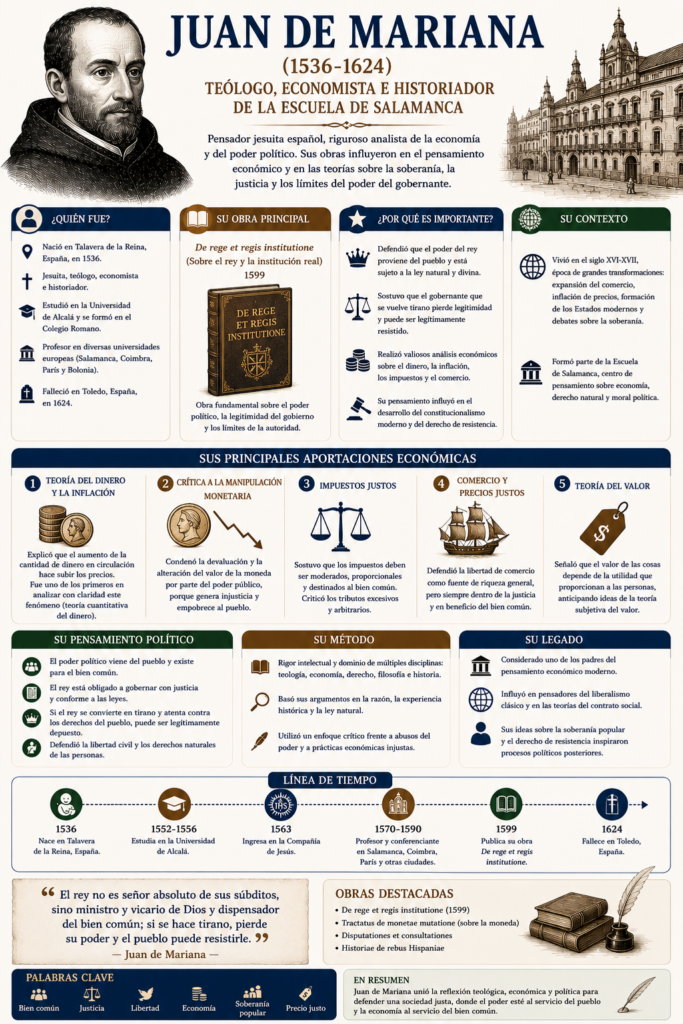
A prominent member of the Salamanca School, Mariana defended that the power of the State should be limited by natural law, justice and respect for private property.
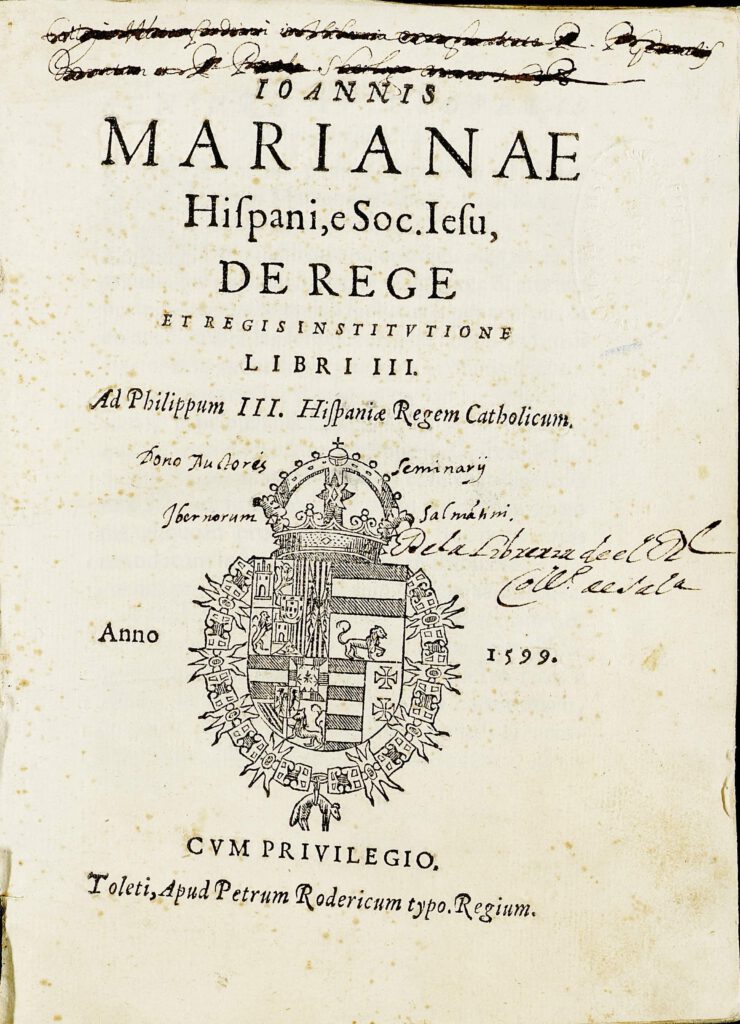
His best-known work, De rege et regis institutione, raised a revolutionary question for its time: what happens when a ruler abuses his power?
Juan de Mariana maintained that political authority is not absolute and that rulers must act in the service of the common good. His reflections laid the foundations for concepts that today we associate with constitutionalism, the separation of powers and accountability.
But perhaps one of his most surprising contributions was his criticism of monetary manipulation. In his work De monetae mutatione he denounced the reduction of the metallic content of coins by governments to finance public spending.
According to Mariana, altering the value of the currency was equivalent to a hidden tax that impoverished the population. An idea that, centuries later, continues to fuel debates about inflation, monetary policy and loss of purchasing power.
Five lessons from Juan de Mariana that are still valid
- Political power must be limited by norms and institutions.
- Private property is a pillar of prosperity.
- Monetary manipulation has economic and social consequences.
- Excessive taxes can slow economic development.
- Individual freedom requires constant vigilance against abuses of power.
Let’s delve a little deeper into it.
Legacy of Juan de Mariana
More than four centuries later, Juan de Mariana’s ideas continue to inspire economists, jurists, and defenders of freedom around the world. Juan de Mariana’s legacy transcends theology and history to become a fundamental reference in economics, political philosophy, monetary theory and limitation of state power. Its main contributions can be grouped into five large areas:
1. Political theory and limitation of power: In his most influential work, De rege et regis institutione, he defended that political authority is not absolute, but derives from the people and is limited by natural law. He argued that:
- The ruler must seek the common good.
- Political power is subject to moral and legal limits.
- A king who becomes a tyrant loses his legitimacy.
- Citizens retain a right to resist tyranny.
These ideas anticipated central elements of modern constitutionalism, the separation between rulers and the State and the theory of the social contract.
2. Criticism of monetary manipulation: His work De Monetae Mutatione constitutes one of the earliest and most forceful criticisms of monetary intervention by governments.
Mariana denounced that the reduction of the metallic content of the coins was equivalent to a hidden tax and a form of plundering of citizens. He argued that:
- Artificially increasing the quantity of money reduces its value.
- Inflation especially harms the poorest.
- Monetary manipulation generates mistrust and economic instability.
- The sovereign cannot appropriate the assets of his subjects through devaluation.
His approaches anticipated the quantity theory of money and current debates on inflation, monetary policy and expansion of the money supply.
3. Defense of economic freedom: Juan de Mariana defended:
- Private property as a natural institution.
- Freedom of trade.
- Fiscal moderation.
- Legal security.
- Monetary stability.
He considered that prosperity arises from individual initiative and voluntary exchanges subject to fair rules.
These ideas later influenced liberal currents and authors of the Austrian School of Economics.
4. Influence on later economists and thinkers: His thinking influenced, directly or indirectly, authors such as:
- Hugo Grotius.
- John Locke.
- Friedrich Hayek.
- Murray Rothbard.
Especially in the 20th century, several authors recovered Mariana as a precursor of classical liberalism and criticism of state interventionism.
5. Historical and intellectual legacy: Juan de Mariana represents one of the greatest exponents of the Salamanca School, a tradition that integrated economics, law, ethics and politics. His main legacy can be summarized in four ideas:
- The economy must be subordinated to justice.
- Political power has moral limits.
- The currency should not be manipulated by the State.
- Individual freedom and the common good are compatible.
His work demonstrates that many contemporary issues – inflation, public debt, abuse of power, political legitimacy or economic freedom – were already analyzed with remarkable depth more than four centuries ago.