
The Relectio of Indis by Francisco de Vitoria: justice, natural law and international law
The Relectio of Indis and indigenous rights
Introduction
Francisco de Vitoria’s Relectio de Indis occupies a unique place in the history of political and legal thought. It is not only a pioneering document on the American question; It is a complex reflection that articulates notions of natural law, ius gentium and human dignity that continue to dialogue with the problems of our time. The lesson of Vitoria opens fundamental questions that have not lost relevance: what rights do people have in the face of imperial expansion? What limits does justice impose on war and conquest? How to reconcile the defense of sovereignty with universal norms of coexistence?
For students and professionals interested in law, philosophy and political economy, the Relectio is a text that demands to be read in its double dimension: as a product of a specific discussion in the 16th century and as a precedent for principles that today claim a place in international discourse. In this article I propose a contextualized and rigorous reading that seeks to make the contemporary relevance of Vitoria’s theses emerge without reducing them to anachronistic slogans.
The intention is didactic and critical at the same time. Throughout the text I will connect Vitoria’s arguments with current debates on collective rights, sovereignty, international responsibility and moral economy. I will avoid gratuitous technicalities and will ensure that the university reader finds useful material for historical analysis and for contemporary normative reflection. We will begin by placing the Relectio in its intellectual and political context.
The legal impact of the Relectio of Indis
Historical context and intellectual correlate
Vitoria’s lessons on the Indians appear at a time of intellectual and political upheaval. At the beginning of the 16th century, the crown of Castile faced the challenge of integrating overseas territories, managing resources and justifying a presence that was often sustained by force. At the same time, the scholastic tradition renews its philosophical and legal instruments, incorporating an emerging international discourse that is no longer limited to the framework of Roman law or canon law. Vitoria belongs to the so-called Salamanca School, an intellectual nucleus that combined Thomistic erudition, humanist sensitivity and legal pragmatism to think about the problems of its time.
In the Reelections, delivered in 1539 at the University of Salamanca, Vitoria faces specific questions: the legitimacy of the wars of conquest in America, the legal status of the indigenous peoples and the domain titles that the conquerors claimed. Although the text responds to practical concerns, its conceptual scope is broad. Vitoria uses the notion of natural law and the ius gentium to articulate moral and legal limits applicable to all nations, whether Christian or not. This universality is the key that allows his work to be read as a precedent for modern international law.
We should not forget the backdrop of the Valladolid debate in the 1550s, where figures such as Bartolomé de las Casas and Juan Ginés de Sepúlveda discussed, with public and moral intensity, the status of the indigenous people. Vitoria precedes and enriches that debate. Their arguments are not simple political objections: they are directed at the roots of the right to war, human dignity and the legitimacy of power. Understanding this context is essential to assess the novelty and limitations of your proposal.
Doctrinal core of the Relectio of Indis
The doctrinal core of the Relectio can be summarized in three interrelated axes: the defense of a community of rights founded on natural law, the criticism of dominion titles based solely on force or supposed cultural inferiority, and the formulation of restrictions on war and forced evangelization. Vitoria maintains that natural law confers rights on all men, regardless of their religion or civilization. From this point of view, indigenous people are not foreigners devoid of rights, but rather subjects full of moral dignity.
Vitoria rejects arguments that based the conquest on cultural substitution or the supposed barbarism of the natives. It does not deny the existence of cultural disparities; What it challenges is the normative conclusion that such disparities authorize expropriation, slavery or the annulment of their autonomy. In legal terms, it affirms the existence of a ius gentium valid for all peoples, which restricts the prerogatives of the conquerors and opens avenues for trade, peaceful coexistence and diplomacy.
Another central aspect is the distinction between legitimate property title and usurpation. Vitoria examines the assumptions under which the crown or individuals could claim rights over other people’s lands and concludes that mere violent occupation or technological superiority are not enough. Legitimacy requires consent, purchase or clearly proven causes of justice. This criterion introduces a notion of legality that precedes modern systems of international law and that foregrounds the idea of moral limits to political expansion.
law of nations, sovereignty and limits of jurisdiction
One of Vitoria’s most enduring contributions is his reflection on the ius gentium, the branch of law that regulates relations between peoples. For Vitoria, the ius gentium is not a neutral instrument of domination; It functions as a framework of reciprocal obligations that articulates coexistence between nations. This perspective contributes to the genesis of an idea of an international community in which natural law and practical reason determine minimum duties.
The notion of sovereignty in Vitoria does not equate to omnipotence. The king or the crown has power over his subjects, but that power is limited by natural law and the law of nations. In the American context this means that jurisdiction over indigenous people is not automatically imposed by the mere fact of discovery. Sovereignty becomes legitimate when it acts in accordance with principles of justice and when it respects the rights of the subjects over whom it intends to exercise it. This vision introduces a normative counterweight to the idea of absolute right of the conqueror.
From a contemporary perspective, these approaches anticipate debates on humanitarian intervention, international responsibility and recognition of self-determination. It is not an exaggeration to say that Vitoria and his contemporaries balance the tension between respect for sovereignty and the demand for minimum standards of treatment. Its conception does not offer closed formulas, but it does offer useful conceptual resources for thinking about ethical limits in international politics.
Indigenous rights and criticism of colonization
A notable aspect of Relectio is the tangible defense of the rights of indigenous people. Vitoria maintains that the American peoples have forms of property, institutions and customs that deserve respect. This does not imply idealization of indigenous societies, but it does imply legal recognition that prevents their reduction to mere beasts or instruments of exploitation. Such recognition is radical for its time and requires rethinking administrative and economic practices that had become normalized in the Indies.
Vitoria openly criticizes abuses that today we would classify as human rights violations. It denounces arbitrary violence, illegal enslavement and mechanisms of dispossession that do not respect any legitimate title. In his arguments lies a moral sensitivity that seeks to subordinate power to justice. Such sensitivity is inscribed in the Christian tradition, but its normative force is presented as universal: the obligations that derive from natural law affect all political agents.
Vitoria’s criticism of colonization is also articulated with practical proposals. It is not limited to condemning; It proposes solutions: honest purchase of land, treaties based on consent, compensation and the prohibition of forced evangelization under penalty of moral nullity. These recommendations show an effort to combine theory and praxis, and remember that law has a normative dimension that must be translated into institutions and procedures.
Moral economy: property, trade and prices
The Relectio is not only a legal and political treatise; It also has economic implications. Within the School of Salamanca, the ethics of commerce, the legitimacy of property and the nature of fair price were discussed in depth. Vitoria participates in this discussion by considering, for example, the conditions under which exchange between Europeans and Americans can be fair. Legitimate buying and selling appear as ways to recognize indigenous property and incorporate moral economy into international law.
At a time when the global economy raises questions about inequality, resource appropriation and corporate responsibility, Vitoria’s reflections on trade and property remain of interest. Vitoria understands that the market is legitimate if it is governed by justice. Rejects practices of deception and imposition of leonine prices. From this perspective, the moral economy of the Salamanca School offers conceptual tools to think about regulations that protect weak subjects from more powerful actors.
The issue of fair prices and credit also appears in broader Salamancan debates. Although these issues are not the focus of the Relectio, their mention is pertinent. Concern for fairness in transactions and condemnation of abusive benefits dialogue with current concerns about financial ethics, responsibility in investment and sustainable business practices.
Contemporary projection: collective rights, responsibility and historical memory
Vitoria’s reading offers instruments to address contemporary problems: recognition of collective rights, historical reparation, and international responsibility for massive violations. Its insistence on the dignity and universal nature of certain rights opens the possibility of demanding limits on state policies that violate basic standards. In this way, Vitoria becomes an unexpected interlocutor for debates on transitional justice and international human rights law.
Likewise, Vitoria’s criticism of colonial violence provides elements for historical memory. It is not about instrumentalizing the classics for current political purposes, but rather about understanding how protection norms emerged and how they can inspire processes of recognition and reparation. The Relectio allows us to trace a genealogy of arguments that today support claims for restitution, intercultural dialogue and indigenous autonomy policies.
In the field of contemporary international law, some ideas from Vitoria resonate in notions such as the responsibility to protect and in the discussion about rights that transcend borders. Although modern formulations are different, the basic intuition that there are obligations that bind all political agents is echoed in current legal instruments. Turning these intuitions into concrete policies requires, however, delicate institutional translations that respect plurality and self-determination.
Method and limits of the Relectio: criticism and self-correction
It is essential to approach Vitoria with a critical method. His contribution is enormous, but it is also a product of his time and his theological and cultural assumptions. Some of its positions could be insufficient from a contemporary perspective, for example in its treatment of cultural plurality or in the valuation of certain indigenous practices through European categories. Recognizing these limitations should not lead to a total disqualification, but rather to a nuanced reading that values what is innovative and at the same time detects inevitable biases.
A useful exercise is to distinguish between principles and concrete applications. The Vitorian principles—universality of certain rights, a norm of justice that limits war, legal recognition of cultural subjects—have a force that can be vindicated today. Particular applications may require review. This critical and self-corrective attitude connects with the very spirit of the Salamanca School, which valued practical reason and reasoned discussion as tools to improve political praxis.
In methodological terms, Relectio invites us to combine conceptual history and normative analysis. It is not enough to describe the text as a historical document; It is necessary to evaluate its budgets, its logical coherence and its ability to illuminate current problems. This double movement—historical and normative—is especially valuable for students who wish to apply classical theory to contemporary issues.
Conclusion
Francisco de Vitoria’s Relectio de Indis continues to be a necessary text. His contribution lies in having raised, in legal and moral terms, the possibility of a community of nations regulated by universal principles of justice. Vitoria not only defended rights for indigenous peoples; it articulated limits on political power and offered conceptual resources that anticipate modern international law. Reading it today allows us to understand how arguments about dignity, sovereignty and responsibility were born that are still valid.
At the same time, it is necessary to avoid teleological readings that anachronistically project our categories onto the 16th century. The task of the university reader is complex: recognize Vitoria’s originality, identify its limits and, above all, know what elements can be recovered to enrich current debates on global justice, historical reparation and economic regulation. The Relectio offers more questions than closed answers, which is one of its greatest intellectual virtues.
I invite the reader to approach the text with critical curiosity. Vitoria’s lessons can inspire fairer policies and deeper reflections on the relationship between law, morality and power. His legacy is not a petrified doctrine, but a set of resources for thinking about justice in contexts of inequality and plurality. Revisiting the Relectio is, ultimately, asking ourselves again how we can organize human coexistence with respect and rationality.
Category: Works and texts
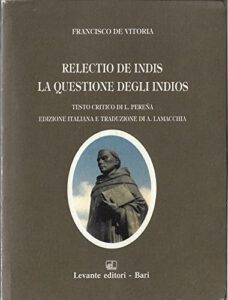
Reading the book
References and bibliography
- Vitoria, F. (1539). Relectio of Indis. Lessons about Indians and the law of nations. Manuscript of lessons given at the University of Salamanca.
- Las Casas, B. de (16th century). History of the Indies. Testimonies and complaints about colonization and the treatment of American peoples.
- Sepúlveda, J. G. (16th century). Democrats Alter. Arguments in favor of war of conquest and lordization; relevant text to contextualize the Valladolid debate.
- Hanke, L. (1974). All Mankind Is One: A Study of the Disputation Between Bartolome de Las Casas and Juan Ginés de Sepúlveda. Harvard University Press.
- Pagden, A. (1982). The Fall of Natural Man: The American Indian and the Origins of Comparative Ethnology. Cambridge University Press.
- Noonan, J. T. Jr. (1957). The Scholastic Analysis of Usury. Harvard University Press. Representative text of economic debates in the scholastic tradition and its relationship with market ethics.
- Suárez, F. (1609). De legibus ac Deo legislatore. Treatise that develops the relationship between natural law, positive law and political authority in the late scholastic tradition.
- – Critical works and editions on the School of Salamanca and classical international law that can be consulted for further expansion: modern editions of the Relectiones de Vitoria and anthologies on political-Renaissance thought.