Martín de Azpilcueta and the quantitative theory of money: Salamanca prefiguration of a key economic explanation
Introduction: why a 16th century Navarrese friar matters today
The figure of Martín de Azpilcueta (often known as Doctor Navarrus) may seem strange to those who look for answers about inflation in press articles or in central bank analysis. However, his reflection on money and prices in the 16th century anticipates essential elements of what we today call the quantitative theory of money. Understanding Azpilcueta’s contribution is not a scholarly exercise without current implications: it allows us to see how rational intuitions about the relationship between monetary quantities and price levels emerged in a specific historical context, and how those ideas can illuminate contemporary debates about liquidity, money supply, and the redistributive effects of inflation.
This introduction proposes a bridge between two worlds: on the one hand, the intellectual wealth of the Salamanca School, its interdisciplinary approach that combined ethics, natural law and practical economics; on the other, the challenges of today: imported inflation, exchange rates, unconventional monetary policies and the legitimacy of certain fiscal measures. We will start from a careful reading of Azpilcueta’s observations on the increase in prices after the arrival of precious metals from America, to move towards a critical reflection on the limits and scope of his explanation in relation to modern economic theory.
The goal of this article is twofold. Firstly, to offer a clear and rigorous, but accessible, exposition of Azpilcueta’s ideas that make him a precursor of quantitative theory. Secondly, connect that heritage with contemporary issues: what can 16th-century Salamanca tell us about inflation derived from modern monetary expansions? Where is the analogy right and where does it fall short? I intend that in the end the reader not only admires the historical acuity, but also takes away conceptual tools to dialogue with current economic problems from a long-standing Spanish intellectual tradition.
Martín de Azpilcueta and the quantitative theory of money
A methodological warning
It is important to remember that Azpilcueta wrote from a disciplinary matrix different from modern economics. Their arguments are articulated in moral and legal terms, and they use practical examples to guide political and confessional action. However, this practical orientation does not prevent the emergence of robust analytical conclusions. Reading Azpilcueta requires translating his language into contemporary categories without distorting his original intention. That is why this article avoids presenting the Navarrese as a modern economist fully aligned with quantitative theory; rather, it shows him as a thinker who, observing the monetary reality of his time, formulated an interpretation that contains the germs of said theory.
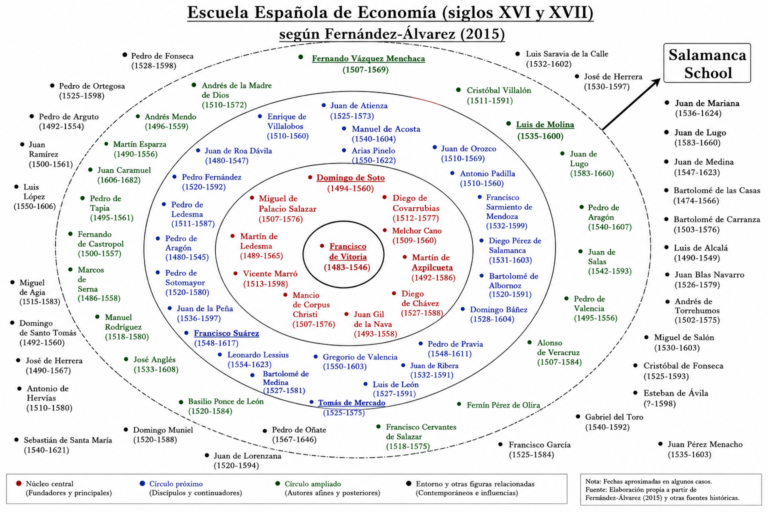
Finally, it should be noted that the Salamanca School was plural. Azpilcueta lived in the same intellectual environment with Tomás de Mercado, Juan de Mariana, Francisco de Vitoria and others, and the discussions on currency, usury and maritime trade developed in constant dialogue. However, Azpilcueta’s uniqueness lies in his attention to the link between the quantity of precious metals and prices, articulated with a practical sensitivity to the distributive and ethical effects of these fluctuations.
Martín de Azpilcueta: brief intellectual biography
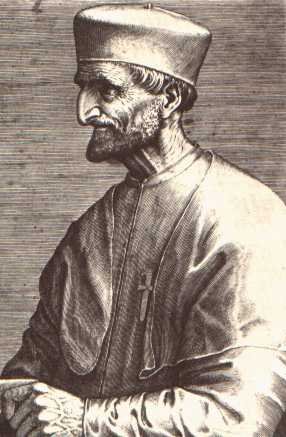
Born in 1492 in Barásoain (Navarra), Martín de Azpilcueta studied in Toulouse and worked as a professor of theology and canon law before working as a theologian at the University of Salamanca. His life is located at the crossroads of a profound intellectual renewal and an Atlantic expansion that transformed European economies. Azpilcueta was, furthermore, a jurisconsult with pastoral sensitivity; His institutional and confessional work sought to guide courtiers, confessors, and administrators in practical and moral matters.
His training allowed him to address complex problems from an interdisciplinary perspective. He did not limit himself to discussing the morality of usury, but carefully observed monetary phenomena: variations in the value of currency, changes in the relationship between money and goods, and the economic consequences of the massive arrival of American silver. That mixture of legal rigor, pastoral care and empirical observation is what allowed him to recognize patterns that today we associate with quantitative explanations of money.
In the Salamanca of his time, practical concerns abounded: the Crown dealt with debts, the financing of military campaigns and the management of remittances from America. The friars and Dominicans argued about the legitimacy of certain contracts and the protection of indigenous communities. In this context, Azpilcueta’s observations on the prices and abundance of metals did not remain as mere abstract theory: they offered a key to understanding fiscal, distributive and moral problems of the first magnitude.
Training and methodology
Azpilcueta combined canonical legal training with scholastic readings of Aristotle and natural law, without giving up empirical observation. His method was typical of practical scholasticism: starting from concrete cases, analyzing moral and legal principles, and offering useful guidelines for government and confession. This methodology allowed him to move naturally from the discussion of usury to reflections on the nature of money and its relationship with prices.
Unlike the writers who limited themselves to theoretical speculation, Azpilcueta relied on available evidence: the increase in prices that could be observed in the markets, the exchange variations between different monetary circulations and the daily experience of merchants and consumers. That combination of theory and empiricism is one of the reasons why his observations retain value to this day.
His style, therefore, is explanatory and normative at the same time. It does not seek to construct mathematical models, but it does provide causal connections that can be translated, carefully, into the analytical categories of modern economics. This translation is what allows us to affirm that Azpilcueta anticipates elements of the quantitative theory of money, although placing them in his own conceptual matrix.
Azpilcueta and the quantitative theory of money: exposition of the idea
The central intuition associated with Azpilcueta is simple and powerful: a notable increase in the amount of precious metals in circulation tends to raise the prices of goods. When large quantities of silver and gold arrived in Europe from American mines in the 16th century, he observed that the prices of everyday products, wages and income rose steadily. For Azpilcueta, the explanation did not rest only on temporary factors; It was a consequence of a systematic relationship between the amount of money available and the relative value of goods.
The monetary contributions of Martín de Azpilcueta
This relationship—in modern terms—approaches the thesis that, other factors held constant, an increase in the supply of money leads to a proportional increase in the general price level. Azpilcueta did not formulate the equation that would later be popularized by the classical school, but he did identify the causal mechanism: more money available means that the same quantity of goods is valued with more monetary unit, raising prices and altering purchasing power.
Azpilcueta also distinguished between counterfeiting or mixing of coins and simple increases in the amount of pure currency. It recognized that deliberate devaluation by authorities (through mixing or recointing) could affect prices in different ways. Not every increase in prices was due to adulteration; The massive import of metals was a real phenomenon that explained the so-called ‘price revolution’ of its time.
Key elements of your explanation
First, Azpilcueta insisted that monetary circulation is a quantitative phenomenon: the relative abundance of precious metals in an economy influences their value. Second, he highlighted the observable relationship between entry of metals from abroad and internal price changes, which today we could consider an early formulation of money supply effects on prices. Third, he linked these variations to distributional effects: the rise in prices harmed those who lived on fixed incomes and benefited debtors over creditors, which had moral and political implications.
Furthermore, Azpilcueta recognized operational limits: the changes were not instantaneous or uniform in all assets. There were rigidities and delays, and the intensity of the adjustment varied according to markets and regions. Consequently, his explanation was not intended to be a universal law of a mechanical nature, but rather an empirical generalization with contextual nuances. This methodological caution brings his discourse closer to the modern approach that distinguishes between short- and long-term effects and between different speeds of adjustment in relative prices.
Finally, his diagnosis included practical recommendations: those who managed real and monetary resources should take into account the effects on prices to design prudent fiscal and monetary policies. Although in his time there were no central banks as we understand them today, the idea that currency management could have macroeconomic consequences was a clear and relevant conclusion.
Historical examples and evidence: American silver and the ‘price revolution’
The massive arrival of metal from America during the 16th and 17th centuries is the essential backdrop to understand Azpilcueta’s observation. Mines such as Potosí and Zacatecas supplied quantities of silver never seen before in Europe. This flow of metals altered trade balances, financed government companies and fueled a process of wealth redistribution in different economic sectors.
Contemporary chroniclers and municipal accounts document price increases in a series of consumer goods and in the cost of services. Azpilcueta took that evidence and used it as an empirical basis for his analysis. Its merit consisted in connecting the phenomenon with a coherent monetary explanation, which ruled out exclusively climatic or productive causes to explain the generalized phenomenon of price increases.
It is important to distinguish between the idea of inflation as a complex phenomenon and Azpilcueta’s predominantly monetary explanation. Current economic historians recognize that the price revolution is multicausal: demographic changes, trade expansions, technological evolution, and variations in productivity all played roles. However, Salamanca’s contribution was to place the abundance of precious metals at the center of the discussion, which contributed to a more complete understanding of the phenomenon.
Comparison with other thinkers from Salamanca
Tomás de Mercado, in his Sum of Deals and Contracts, offered analysis on the relationship between precious metals and prices similar to those of Azpilcueta. Mercado emphasized the commercial experience and the impact of American silver. Juan de Mariana, for his part, when addressing the issue of currency and its adulteration, expanded the field by including criticism of sovereign intervention in currency. Francisco de Vitoria provided an ethical and legal framework that placed transactions in a matrix of justice and natural law.
These convergences show that it was not an isolated voice, but rather an intellectual environment concerned about currency in a broad sense. However, Azpilcueta’s uniqueness is his clarity in the quantitative connection: he observed the correlation between monetary magnitudes and price levels with a clarity that anticipates the core of quantitative theory.
The influence of Martín de Azpilcueta on modern economics
Recognizing this internal dialogue at the Salamanca School helps to value the collective nature of intellectual advance: quantitative theory does not spring from an isolated mind, but from an environment where law, ethics and economics practiced a productive conversation about the real problems of power and the market.
Contemporary projection: useful lessons and limits of analogy
What concrete lessons can Azpilcueta offer us in the 21st century? Firstly, the importance of integrating empirical observations into theoretical reflection. His attention to the available evidence is a reminder that theories about money and prices must be tested against historical and contemporary data before policy recommendations are derived.
Secondly, Salamanca reminds us that the distributional consequences of inflation are central. Azpilcueta understood that the effects of monetary expansion are not neutral: they harm rentiers and benefit debtors, modifying incentives and social interests. That perspective is useful for evaluating modern policies such as quantitative easing or monetary deficit financing, whose redistributive effects often go unnoticed in technical debates.
Third, his approach suggests caution in the face of the temptation of simple solutions. Recognizing that the money supply affects prices does not mean ignoring other factors. Effective policies require multifactorial diagnosis and institutional sensitivity. Salamanca teaches us to combine normativity with empiricism.
Limits for direct application
However, we must be cautious. Azpilcueta worked in a pre-industrial economy with less integrated markets, the absence of complex financial instruments and a different relationship between the State and credit. Monetary transmissions and expectations play roles today that did not exist to the same extent in the 16th century. The existence of central banks, modern banking systems and capital markets introduces new transmission channels and amplifies others.
Furthermore, modern quantity theory distinguishes between different monetary aggregates, speed of circulation, and currency velocity effects. Azpilcueta did not have those analytical tools at his disposal. His argument is, therefore, a deeply valuable conceptual outline, but incomplete with respect to sophisticated contemporary theories.
Finally, contemporary globalization causes capital flows and asset mobility to alter the domestic impact of monetary expansions. While American silver had relatively direct effects on prices in Europe, today a monetary expansion in an economy can be transmitted internationally in complex ways and with unpredictable results. The analogy is fertile, but requires nuances.
Practical applications and current debates
Let’s examine three current debates where Salamanca’s reading provides clarity: post-pandemic inflation, monetary deficit financing and cryptocurrency as money.
In the case of recent inflation in many economies, the combination of expansionary fiscal policy, supply bottlenecks, and monetary expansions has generated price pressures. From Azpilcueta’s point of view, it is essential not to reduce the explanation to a single cause. However, its emphasis on the quantity of money energized by real factors leads us to seriously consider the role of increased liquidity in the system and its distributional effects.
Regarding the monetary financing of the deficit, Salamanca raises moral and practical questions: is the direct issuance of money to cover public spending legitimate? Azpilcueta would remember the effects on prices and equity. It raises prudential limits and the need for mechanisms that protect the most vulnerable against the loss of purchasing power.
Cryptocurrencies and definitions of money
The debate on cryptocurrencies revives Salamanca questions about the essence of money. For Azpilcueta, money has value due to its social acceptance and its ability to facilitate exchange and measure value. Cryptocurrency raises questions about widespread acceptance, stability of value, and function as a store of value. From Salamanca, the legitimacy and usefulness of any form of money is judged both by its economic effectiveness and by its effects on distributive justice.
In short, the lesson from Salamanca is twofold: reflection on money must be empirical and normative. Azpilcueta urges us to ask not only whether a policy increases liquidity, but how it affects prices, contracts and social justice.
Conclusion: historical continuity and contemporary relevance
Martín de Azpilcueta was not an economist in the modern sense, but his observation and analysis of the relationship between the abundance of precious metals and prices provided a direct antecedent to the quantitative theory of money. Its advantage was the combination of empirical attention, ethical sensitivity and legal pragmatism. This fusion allowed him to identify a causal mechanism that remains central in macroeconomic analysis: the connection between the quantity of money and the general price level, with its distributional and political implications.
When transferring his ideas to the present we must be cautious: the contemporary world adds channels, instruments and expectations that make monetary transmission more complex. However, Salamanca’s intuition retains heuristic and normative value. It reminds us that policies that alter the quantity of money have real effects on prices and income distribution, and that these effects deserve to be evaluated from technical and ethical perspectives.
The School of Salamanca, with Azpilcueta among its most insightful representatives, offers a methodological lesson: the importance of combining observation, conceptual rigor and moral reflection. That approach is useful today, when monetary decisions affect millions of lives and demand both evidence and prudence. Recovering and dialoguing with that tradition is not nostalgia: it is enriching the contemporary debate with intellectual tools that have demonstrated their fruitfulness over the centuries.
References (selection in APA format)
• Azpilcueta, M. (16th century). Observations and writings on currency and prices. Historical editions compiled and studied by historians of monedology. (It is recommended to consult critical editions in specialized libraries for the original versions).
• Mercado, T. (1571). Sum of deals and contracts and doctrines of the law of nature and nations. Historical edition available in collections on economics and law of the time.
• Mariana, J. (1609). De monetae mutatione. Treatise on currency and its alterations. Complete works in modern editions on Spanish economic history.
• Vitoria, F. (1539). Relectio de Indis et de iure belli. Works and lessons on natural law and indigenous communities. Contemporary critical editions offer historical and legal context.
• Schumpeter, J. A. (1954). History of Economic Analysis. Oxford University Press. Classic reference that collects the evolution of economic thought and includes discussions of the first writers and quantitative theory.
• Pagden, A. (1982). The Fall of Natural Man: The American Indian and the Origins of Comparative Ethnology. Cambridge University Press. Work that situates the intellectual context of Salamanca and its relationship with the new world.
• Research and critical editions on the Salamanca School and the history of economic thought: it is suggested to consult academic compilations and specialized university editions that bring together Salamanca writings with contemporary annotations to delve deeper into the primary sources.
Category: Thinkers