Inflation and gold in America: lesson from the 16th century from the School of Salamanca
Introduction: why it matters to look at the 16th century
The massive arrival of gold and silver from America to Europe in the 16th century was not only a historical event; It was an intellectual crucible that forced thinkers, jurists and theologians to rethink basic concepts about money, price and economic justice. The Salamanca School reacted to this material shock with arguments that continue to be useful for understanding contemporary dilemmas about inflation, natural resources, and monetary policy.
This article proposes reading those texts with historical and philosophical attention. It is not about looking for mechanical parallels between two very different eras, but rather about extracting conceptual lessons. The central question is simple: what explanation did the people of Salamanca give for the price increase and what proposals did they offer to moderate it? And, more importantly today, what lessons can we carry over to modern debates about fiat money, capital flows and the so-called resource curse?
The intention is didactic but rigorous. I will cite Salamancan authors when appropriate, place their arguments in the political and fiscal context of the Hispanic monarchy, and draw connections with current problems. The tone will be accessible to those with university training, but with the conceptual density that the topic demands. At the end, I offer a conclusion and references for further study.
Inflation and the thought of the School of Salamanca
The historical context of the 16th century
Since 1492, the Atlantic expansion transformed the economic ecology of the known world. The flow of precious metals from the Americas altered Western Europe’s money supply to an unprecedented magnitude. The mines of Potosí and the maritime routes that connected Seville with America introduced increasing quantities of silver and, to a lesser extent, gold in a matter of decades.
The Hispanic monarchy combined fiscal imperatives with an expansionist policy that demanded resources. American metals were used to finance armies, pay the Crown’s debt and support the imperial administration. But those same resources also interacted with local markets, prices, and wages in complex ways.
In that breeding ground, an intellectual anxiety arose: why do prices rise when so much precious metal arrives? Is it a mere matter of greed, or are there observable economic laws? The authors of the Salamanca School addressed these questions from their classic concerns: natural law, the morality of exchange and the interpretation of market signals.
Inflation, price and currency: essential vocabulary
Before entering into specific authors, it is worth clarifying the vocabulary. Today we talk about inflation as a generalized and sustained increase in prices. In the 16th century, analogous notions were used, although the language and categories were different. The people of Salamanca distinguished between price increases, currency devaluation and changes in purchasing power.
For them, currency had a double nature: material and conventional. The precious metal provides an intrinsic quality due to its rarity and coined use. But the social value of currency is built in the practice of exchange. From this arises a theoretical tension: does the abundance of metals automatically reduce their value in relative terms, raising prices, or do other causes intervene on demand and the speed of circulation?
Responding to this tension required analyzing phenomena that today we would call money supply, demand for goods, and speed of circulation. The people of Salamanca did not use these terms, but they described equivalent mechanisms in legal-theological language and in empirical observations on the exchange and price markets.
The School of Salamanca: approaches and protagonists
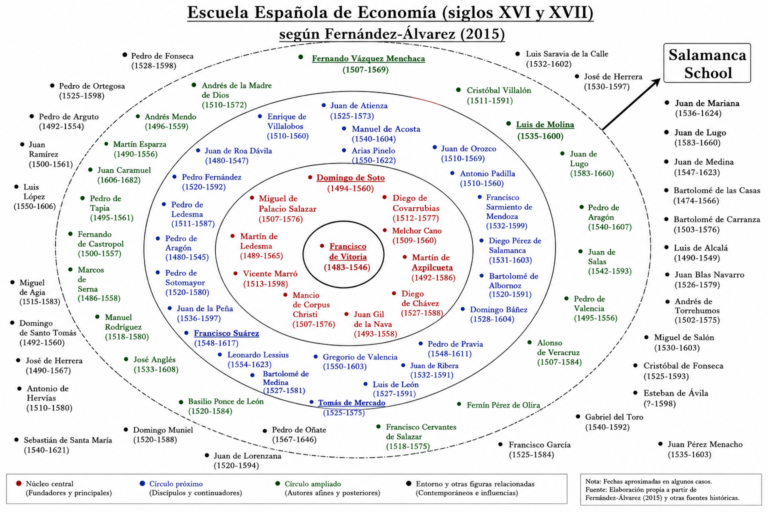
The School of Salamanca was not a monolithic institution, but a group of thinkers who worked around the University of Salamanca and other Spanish chairs. His interests spanned natural law, moral theology, international law, and practical economics. Faced with the phenomena of the 16th century, some names stand out: Francisco de Vitoria, Martín de Azpilcueta (Doctor Navarrus), Tomás de Mercado, Domingo de Soto, Luis de Molina and Bartolomé de las Casas, among others.
These authors shared a conceptual disposition: the economy was a morally regulated sphere. They did not reject the market, but they considered that exchanges must respond to criteria of justice and equity. That perspective allowed them to approach inflation with concerns about fair pricing, excessive profit, and the legitimacy of get-rich-quick.
At the same time, they practiced an empirical observation of the facts. They were not limited to theological deductions; many observed markets, changes and tariffs. This combination of normative reflection and empirical attention makes the School a stimulating reference for those who today seek frameworks to think about the economy without losing their ethical compass.
The causes of inflation according to the Salamancan scholastics
Martín de Azpilcueta and the theory of change
Martín de Azpilcueta, known as Doctor Navarrus, is a key figure for his reflection on change and currency. Although his writing adopts the scholastic register, his observations are surprisingly modern. Azpilcueta directly linked the abundance of precious metals to the general rise in prices and explained how the international exchange of currencies influenced exchange rates and local economies.
For Azpilcueta, the price of goods responds in part to the amount of currency in circulation. If a lot of silver arrives, the purchasing power of the currency decreases and prices rise. He also observed that the ease of exchange and the speed with which metals circulated between markets accelerated this process. This intuition is an early antecedent of what would later be formalized as the quantity theory of money.
Furthermore, Azpilcueta distinguished between a moral appreciation of price and a causal explanation. The price increase was not always due to fault or fraud; could be the effect of changes in the money supply. This distinction made it possible to develop less punitive political responses and more aimed at stabilizing monetary circulation and equity in contracts.
Tomás de Mercado: prices, salaries and economic metaphors
Tomás de Mercado is another author who explicitly addressed the relationship between the entry of metals and the rise in prices. In his work, he sought to describe how American silver had increased the monetary supply in Castile and, therefore, raised the prices of basic products. Market also links price variations with the growing demand for luxury products and with the expansion of credit.
A relevant point in Mercado is its attention to the social consequences: employees and consumers suffer from price increases, while those linked to the international circulation of metals can benefit. This observation about winners and losers anticipates modern analyzes on the distribution of income associated with external shocks.
Likewise, Mercado reflects on practical solutions: controlling the outflow of metals, regulating the exchange rate and moderating speculative exchange practices. His proposals were not dogmatic; He understood that the imperial economy required a combination of regulation and adaptation of prices and wages.
Francisco de Vitoria and justice in transatlantic trade
Francisco de Vitoria offered a more legal and moral reading of trade with the Indies. His reinterpretations of the rights of indigenous peoples and the legitimacy of trade reveal a concern for fair conditions of exchange. If trade becomes a tool of plunder or dispossession, it loses moral legitimacy.
In relation to inflation, Vitoria is not limited to technical factors. It asks about the fairness of contracts, about the implications of exchange practices and about the public function of currency. For him, political authorities have the responsibility of guaranteeing an economic order that does not violate equity between subjects.
This leads to an important thesis: fighting inflation is not only a technical problem but also an ethical one. Monetary and fiscal policies must be guided by criteria of the common good. In the practice of the 16th century that meant debates about collecting metals, regulating exchanges and prohibiting usurious or fraudulent practices.
Combining theoretical explanation and empirical observation
A distinctive feature of the Salamanca School was its willingness to integrate conceptual reflection and empirical data. Authors such as Azpilcueta and Mercado collected evidence on metal flows, exchange rates and price variations in specific markets. This documentary work allowed them to distinguish proximate causes and remote causes of inflation.
The analysis of inflation in the 16th century and its validity
For example, they observed that not all prices rose in the same way or with the same speed. Some imported and luxury goods registered increases other than those of basic foods. This heterogeneity shows that the transmission of the monetary increase to prices depends on the productive structure, consumption habits and market integration.
That is, the entry of metals was a crucial factor, but not the only one. The speed with which the currency circulated, expectations about future prices, the fiscal policies of the Crown and local productive capacity formed a framework that modulated the final result.
Economic and fiscal consequences for the Hispanic monarchy
From the Crown’s perspective, American metals were both a blessing and a challenge. They made it possible to finance large-scale military and diplomatic enterprises, but they also fueled inflationary tensions that complicated tax collection and internal economic sustainability.
A paradox is that the abundance of metals did not solve productivity problems. Spain spent large sums on rental income and military services that, in the long run, did not increase urban and rural productive capacity. Inflation thus eroded purchasing power and, in some cases, weakened the real fiscal base of the Castilian economy.
Salamanca thinkers understood this relationship between fiscal policy and prices. They did not interpret the entry of metals as a miraculous and inexhaustible resource. They recommended prudence in public spending, control of the outflow of metals and regulation of exchange trading to protect the internal economy.
Lessons for contemporary debates on inflation and resources
The experience of the 16th century suggests several useful lessons for the present. First, a money supply shock—whether to precious metals or credit expansion—can generate price pressures if there is no correspondence with real production. Today this reflection applies both to monetary printing policies and to massive capital flows that alter local markets.
Second, the distribution of benefits is crucial. Extraordinary income from natural resources or capital flows tends to be concentrated and produce redistributive effects. Understanding who wins and who loses helps us design compensatory mechanisms and redistributive policies that mitigate social tensions.
Third, institutionality matters. The Salamanca School emphasized the role of public authority to regulate exchange and protect the common good. In the contemporary era, this is equivalent to strengthening monetary institutions, regulating financial markets and designing fiscal rules that cushion volatilities.
American gold and the ‘resource curse’
The history of American metals clearly advances the so-called resource curse. The abundance of a valuable resource does not guarantee sustained development; It often induces dependency, distortions in relative prices and loss of competitiveness in productive sectors. The people of Salamanca, without using that term, observed analogous effects.
For example, the constant arrival of silver could discourage investments in local manufacturing, by generating incentives to import goods and finance immediate consumption. Likewise, the ease of entry of wealth could have contained incentives for productive tax reform or for investments in long-term infrastructure.
Here ethical reflection becomes practical. It is not enough to exploit resources; Management is required that converts these flows into human capital, infrastructure and economic sovereignty. That responsibility fell to the Crown in the 16th century and falls today to the States and international agreements.
Monetary policy, regulation and control of the exchange rate
Salamanca’s proposals to mitigate inflation combined control measures with institutional recommendations. They thought about limiting the outflow of metals, regulating the exchange market and intervening to correct speculative practices. These solutions may be imperfect, but they foreshadow modern debates about capital controls and prudent monetary policy.
A point that stands out is the need for coherence between monetary and fiscal policy. If the State spends without a productive counterpart, inflation sets in with greater force. Therefore, the School demanded public discipline and transparency in the administration of extraordinary resources.
In contemporary terms, this suggests that currency issuance, resource royalty management, and exchange rate policy must be coordinated with development objectives. The lesson from Salamanca invites us to design clear rules that limit discretion and favor macroeconomic stability.
Implications for economic ethics and the theory of value
The Salamanca School links the causal explanation of inflation with reflections on the justice of price. In his approach, the fair price is not an abstract figure, but the result of equitable conditions of exchange. If the increase in prices responds to structural causes, the moral response is not to demonize the agents, but to correct the conditions that generate imbalances.
This raises a relevant contemporary debate: how to balance individual responsibility in the market and the collective obligation to build institutions that protect the common good. The people of Salamanca remind us that economic and technical morality are not watertight compartments; Well-understood Economic Policy incorporates both dimensions.
Finally, his view of value as something that is formed in social and contractual interaction resonates with modern approaches that combine subjective value theory and institutional mechanisms. It is no coincidence that many discussions about prices and justice today follow the lines they outlined in the 16th century.
Conclusion: synthesis and questions for the present
The main lesson of the experience of the 16th century and of Salamanca’s analysis is twofold. On the one hand, monetary abundance can cause inflation if it is not matched by a proportional increase in goods and services. On the other hand, the response to inflation must combine technical measures with criteria of justice and governance. The Salamanca School offers precisely that hybrid framework.
Applied to the present, this means that debates about monetary expansion, capital flows or income from natural resources cannot be reduced to technocratic models without considering distribution, institutions and public ethics. History shows consequences not foreseen by individual agents when shocks are systemic and institutions are fragile.
As historians and citizens, we must draw from that century a double humility: humility in the face of the complexity of economic phenomena and humility to recognize that solutions require technical instruments and moral agreements. The Salamanca School did not provide definitive answers, but it left a conceptual legacy that continues to illuminate crucial questions about inflation, wealth, and justice.
References
• Vitoria, F. (1539). Relectio de Indis and writings on international law and morals. Historical editions and later studies compile these lessons on war, commerce, and law.
• Las Casas, B. de (1552). Very brief account of the destruction of the Indies. Key testimony about the human impact of American expansion.
• Molina, L. de (1588). Concordia liberi arbitrii cum gratiae donis. Work in which he displays his theological and philosophical thinking, with implications on freedom and responsibility in economic action.
• Mariana, J. (1599). De rege et regis institutione. Reflections on the political authority and economy of the State that help understand the political vision of the time.
• Azpilcueta, M. (16th century). Writings and comments on exchange and currency. His observations on the circulation of metals and the effects on prices are fundamental to early monetary theory.
• Mercado, T. (16th century). Treaties and economic observations on prices and trade. His empirical analyzes of American silver and the rise in prices are a classic reference.
• Noonan, J. T. (1957). The Scholastic Analysis of Usury. Harvard University Press. Modern study of how scholasticism dealt with monetary and usury issues.