Leo XIV in the Congress of Deputies: a call to human dignity and the recovery of the legacy of the School of Salamanca
The intervention of Pope Leo XIV before the Congress of Deputies of Spain on June 8, 2026 represents a historical event of extraordinary institutional relevance. It was the first occasion on which a pontiff addressed the representatives of Spanish national sovereignty from the parliamentary tribune.
Leo XIV articulated a speech focused on the dignity of the human person, the common good, the moral responsibility of political power, the defense of life, the protection of migrants, religious freedom and the need for democratic coexistence based on mutual respect.
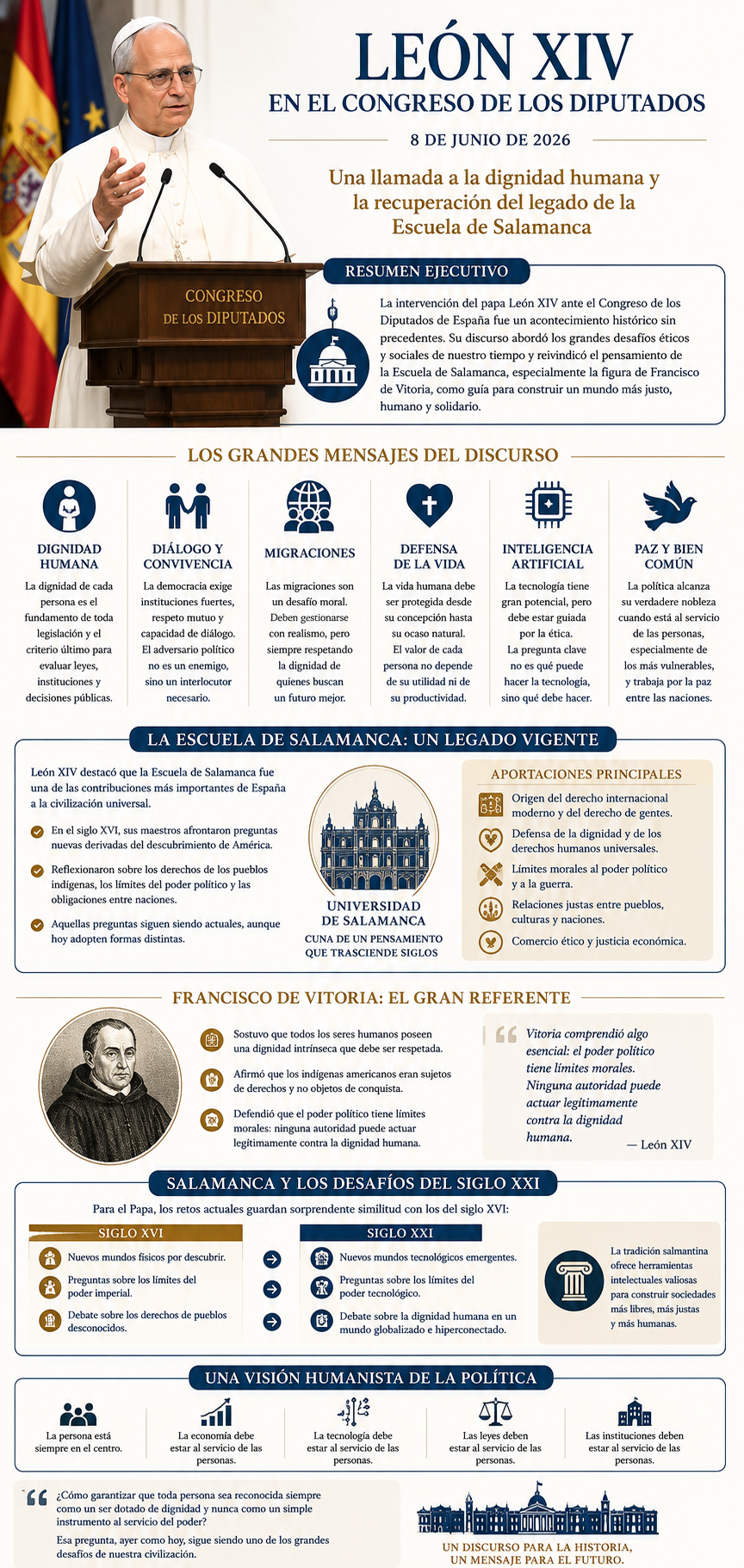
Among all the elements of his intervention, the vindication of the School of Salamanca stood out especially, whose intellectual contribution was presented by the pontiff as one of Spain’s most important contributions to universal civilization. The Pope pointed out that the reflections developed by Francisco de Vitoria and other Salamancan teachers five centuries ago continue to be extraordinarily current to face the challenges of globalization, migrations, human rights and artificial intelligence.
The School of Salamanca and human dignity
His message can be interpreted as an invitation to recover a humanist vision of politics and the economy, where the dignity of the person constitutes the ultimate criterion for evaluating laws, institutions and public decisions.
A historic moment for Spain
Leo XIV’s visit to Spain was already full of symbolism before arriving at the Congress of Deputies. However, his appearance before deputies and senators elevated the institutional relevance of the trip to a historical dimension.
The pontiff appeared not only as the spiritual leader of more than one billion Catholics, but also as head of State of Vatican City. From this double condition he wanted to address those who have the responsibility of legislating and legally ordering social coexistence.
For approximately thirty minutes he developed an intervention characterized by a serene, reflective and deeply intellectual tone. It was not a partisan speech nor an intervention intended to influence specific debates in Spanish politics. Its purpose was broader: to remember the ethical principles that should guide all public action.
Leo XIV insisted that politics acquires its true nobility when it is at the service of people and especially those who are in vulnerable situations.
Human dignity as the foundation of all legislation
The central idea of the entire speech can be summarized in one expression: human dignity.
According to Leo XIV, no democracy can be sustained solely on procedures, norms or parliamentary majorities. Any institutional architecture needs to be supported by an adequate understanding of the human being.
For this reason, he reminded the Spanish parliamentarians that the mission of the legislator is to protect and promote the dignity of all people, regardless of their origin, economic condition, religion or social situation.
From this perspective, the Pope addressed some particularly sensitive issues in the contemporary debate:
The legacy of the Salamanca School in the 21st century
- The defense of human life.
- Attention to the most vulnerable.
- The protection of migrants.
- Religious freedom.
- Social justice.
- International peace.
- The ethical challenges of artificial intelligence.
In all these matters he insisted on the same idea: the human being can never become a means to achieve political, economic or technological objectives.
Criticism of political polarization
One of the messages that had the most impact was its reference to the growing polarization that affects numerous Western democracies.
Leo XIV recognized that disagreement is part of democratic life and constitutes a legitimate manifestation of political pluralism. However, he warned against transforming a political adversary into an enemy.
According to the Pope, a healthy democracy requires strong institutions, mutual respect and the capacity for dialogue.
Firmness in convictions should not lead to contempt for those who think differently.
This reflection was especially significant in a political context characterized by high ideological confrontation both in Spain and in much of Europe and America.
Migrations and human dignity
Another of the central axes of the speech was the immigration issue.
Leo XIV described contemporary migrations as one of the great moral challenges of our time.
The pontiff asked legislators to contemplate this phenomenon from a human perspective and not exclusively economic or security.
He recognized the right of States to manage their borders, but recalled that any migration policy must respect the dignity of those who are forced to leave their homes due to wars, persecution, extreme poverty or climate crises.
His approach combined political realism with ethical demands.
The defense of life
In coherence with Catholic doctrine, Leo XIV reiterated the need to protect human life in all its stages.
He expressly referred to the defense of life “from its conception to its natural decline”, emphasizing that the value of a person does not depend on their economic usefulness, productivity or degree of autonomy.
Beyond the specific legal debate, he presented this issue as a fundamental anthropological problem: how a society understands the value of each human being.
Artificial intelligence and ethical limits
One of the most innovative aspects of the intervention was its reference to artificial intelligence.
Leo XIV recognized the enormous potential of new technologies to improve people’s quality of life.
However, he warned about the risk of developing increasingly powerful tools without adequate ethical reflection.
The fundamental question is not only what technology can do, but what it should do.
At this point he linked directly with the intellectual tradition of the School of Salamanca, presenting it as a source of inspiration to confront contemporary ethical dilemmas.
The Salamanca School at the center of the discourse
Perhaps the most intellectually relevant element of the entire intervention was the importance given to the Salamanca School.
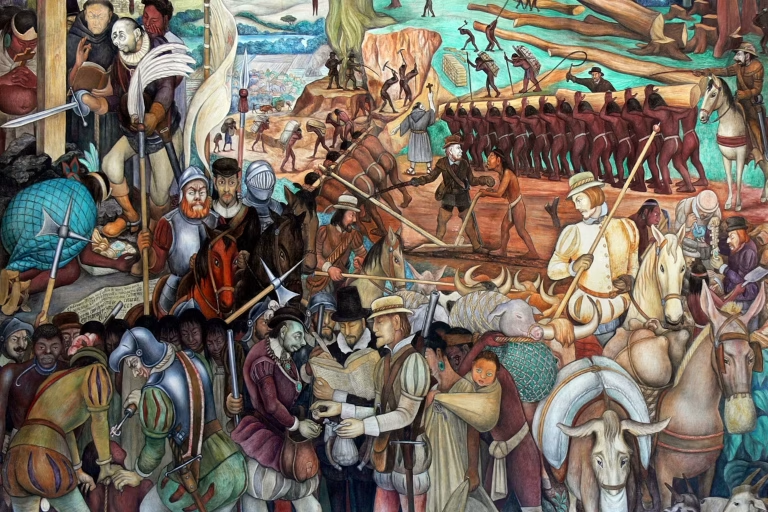
Leo XIV mentioned Salamanca and the intellectual tradition that emerged at its university during the 16th century on several occasions. He stressed that talking about the human person today inevitably leads to that historical moment when Spain had to face completely new challenges derived from the discovery of America. (USAL Communication)
The Pope recalled that the Salamanca teachers assumed with extraordinary lucidity the task of reflecting on unprecedented questions:
- Did indigenous peoples have rights?
- Were there moral limits to political power?
- Could any conquest be justified?
- What obligations did nations have toward each other?
Those questions are still relevant, although today they take different forms.
Francisco de Vitoria: the great intellectual protagonist
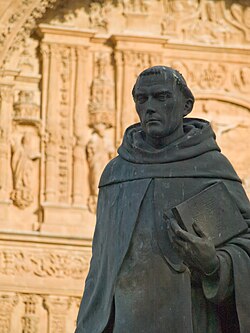
Within the School of Salamanca, Leo XIV especially highlighted the figure of Francisco de Vitoria.
Vitoria developed a revolutionary reflection for his time.
Against those who justified the absolute dominion of conquered peoples, he maintained that all human beings have an intrinsic dignity that must be respected.
He defended that the American Indians were subjects of rights and not simple objects of conquest.
This statement constitutes one of the historical foundations of modern human rights.
The Pope stressed that Vitoria understood something essential: political power has moral limits.
No authority can legitimately act against human dignity.
The contribution of the School of Salamanca to international law
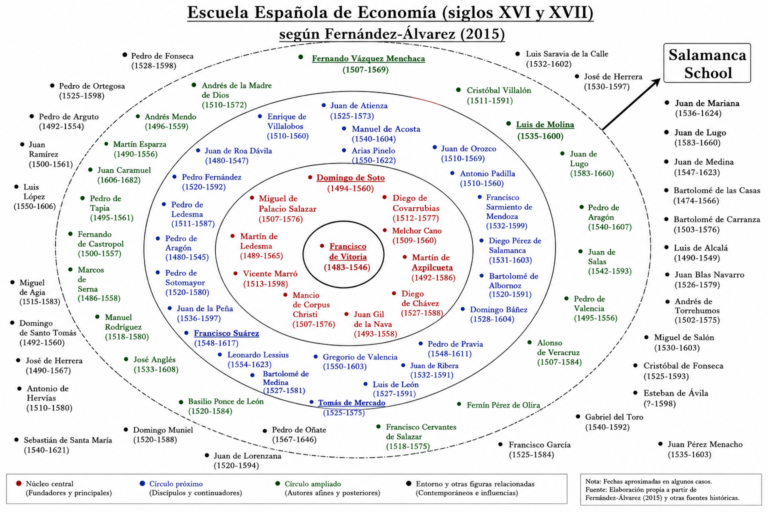
The School of Salamanca is considered by numerous historians as one of the cradles of modern international law.
Salamancan thinkers developed concepts that would later influence:
- The right of people.
- The sovereignty of the States.
- Human rights.
- The theory of just war.
- International trade.
- Relations between peoples and cultures.
Leo XIV recalled that this intellectual tradition was born precisely in Spain and constitutes one of the most valuable Spanish contributions to universal thought.
Salamanca and the challenges of the 21st century
One of the most original aspects of the speech was the connection between the Salamanca School and current problems.
For Leo XIV, contemporary challenges bear a surprising similarity to those of the 16th century.
Then new physical worlds appeared. Today new technological worlds appear.
Questions then arose about the limits of imperial power. Today questions arise about the limits of technological power.
Then the rights of unknown peoples were debated. Today there is debate about the protection of human dignity in a globalized and hyperconnected context.
For this reason, he considered that the Salamancan tradition continues to offer extraordinarily valuable intellectual tools.
Spain as a bridge between tradition and modernity
Another important message was the positive assessment of Spain as a nation capable of contributing to the construction of a fairer international coexistence.
Leo XIV presented Spanish history not as a simple succession of events, but as a source of teachings for the present.
The reference to Cervantes, the School of Salamanca and other figures of the Spanish cultural tradition pursued precisely this objective.
Spain has a historical experience that can help face the challenges of globalization from a deeply humanist perspective.
A humanist vision of politics
The speech can be interpreted as a defense of integral humanism.
Faced with technocratic, ideological or utilitarian tendencies, Leo XIV claimed a policy centered on the person.
The economy must be at the service of the people.
Technology must be at the service of people.
Laws must be at the service of the people.
Institutions must be at the service of people.
This vision constitutes the common thread of his entire intervention.
Conclusions
The intervention of Leo
His message went far beyond religious issues. It constituted a reflection on the nature of democracy, the responsibility of power and the centrality of human dignity.
Especially relevant was the recovery of the Salamanca School as an intellectual reference to face the great contemporary challenges. In vindicating Francisco de Vitoria and the Salamanca masters, Leo XIV recalled that Spain played a decisive role in the birth of ideas that we consider fundamental today: human rights, the limits of power and the universality of human dignity.
Five centuries later, the Pope suggested that those intuitions continue to be indispensable for building freer, more just and more humane societies.
In an era marked by political polarization, mass migrations, the technological revolution and geopolitical uncertainty, Leo XIV proposed returning to an essential question formulated by the School of Salamanca: how to guarantee that every person is always recognized as a being endowed with dignity and never as a simple instrument at the service of power?
The answer to that question, yesterday as today, continues to be one of the great challenges of our civilization.
Main sources: official speech of the Pope before the Spanish Parliament, published by the Vatican, and press reports and academic analyzes on the reference to the School of Salamanca. (Vatican)