Domingo de Soto and the discovery of free fall: the Salamanca that anticipated Galileo
Introduction
At a time when modern science is often associated with names like Galileo or Newton, it is revealing to look back at the Salamanca School and discover that some of its teachers posed problems and solutions that anticipate decisive debates about the nature of movement. Domingo de Soto, Dominican, theologian and professor in Alcalá and Salamanca, is a central figure of this intellectual transition. His treatment of the problem of free fall constitutes a key piece to understand how the mundo scholasticus was not simply an obstacle for modern science, but also a nursery for methodological questions and conceptual solutions.
This article offers a broad and critical reading of Domingo de Soto’s contribution to the problem of free fall. It starts from his intellectual biography and the context of the School of Salamanca, analyzes his confrontation with Aristotelian physics, reconstructs his technical and methodological arguments, and explores the contemporary reception and projection of his ideas. The objective is to show that the history of thought is not a succession of sharp ruptures but rather a plot where continuity and change converge.
The current relevance is not temporary. Today, as we debate the relationship between theory and practice, the role of institutions, and the construction of scientific evidence, Domingo de Soto’s experience offers useful lessons. His work requires combining conceptual rigor with empirical attention, and the Salamanca School reminds us of the importance of a plural reflection that links science with ethics and law.
Domingo de Soto and the study of free fall
Life and brief work of Domingo de Soto
Domingo de Soto was born in Segovia in 1494 and died in 1560. He entered the Order of Preachers and developed an academic career that led him to teach at the University of Salamanca and the University of Alcalá. He was at the same time a theologian, jurist and philosopher, and his scholastic training allowed him to move with ease between metaphysical, moral and physical questions. This disciplinary breadth explains why his reflections on movement are not limited to technical problems, but are linked to concerns about reason, experience and the natural order.
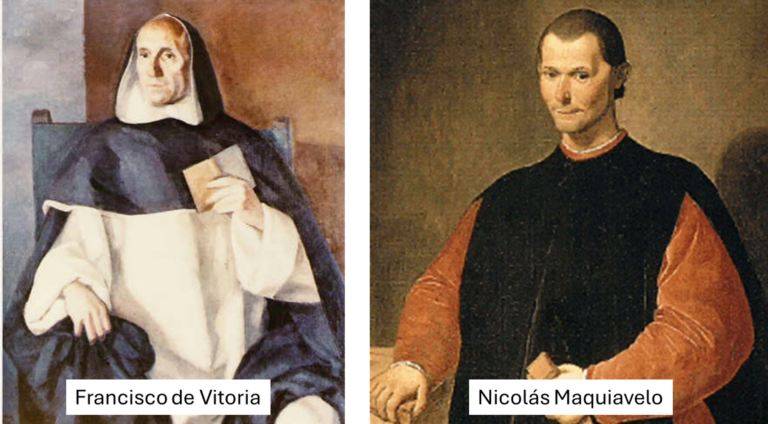
His best-known works include treatises and commentaries covering moral theology and natural law, such as De iustitia et iure, and commentaries on the works of Aristotle. He was an influential voice in the chorus of Spanish Catholic humanism, alongside figures such as Francisco de Vitoria and Martín de Azpilcueta. His method combines the Aristotelian and Thomistic tradition with a critical sensitivity that does not shy away from contrasting hypotheses with observation, an attitude that today we would describe as proto-empirical.
It is important to emphasize that Domingo de Soto did not write in the vacuum of a hermetic academy. He participated in public and ecclesiastical debates, and his work circulated in Latin editions and in university teaching. This dissemination contributed to his arguments about the movement having an impact in later times, and made it easier for historians of science to identify in their corpus prefigurations of concepts that would later be formalized in the 17th century.
The problem of free fall in the Aristotelian tradition
To understand the originality of Domingo de Soto, it is necessary to review the Aristotelian framework that dominated medieval physics. Aristotle maintained that natural bodies seek their natural place and that the falling movement is not uniform: the speed would be proportional to the weight and the difference between the object and the medium. This conception implied a direct relationship between qualities of the body and speed, so that different bodies fall with different speeds if their weight and relative density differ with respect to the surrounding medium.
Medieval physics inherited that framework, but not without tensions. Throughout the Late Middle Ages, criticism and qualifications arose. Authors such as the philosophers of the School of Merton and later thinkers proposed notions that pointed to temporal and quantitative regularities in movement. However, the lack of a mathematical apparatus and systematic experimental procedures made it difficult to formulate precise laws. In this context, the question of free fall—whether the speed was constant or varied in a certain way—acquired growing interest because it touched the heart of the naturalistic method: how to move from observations to general and quantitative statements.
The problem was complicated by the interaction between physics and metaphysics. For many scholastics, accepting a rigorous mathematical law could seem like a betrayal of the qualitative understanding of the natural world inherited from Aristotle. That is why Domingo de Soto’s contribution is so significant: he knew how to formulate arguments that allow a quantification of movement without denying a deep philosophical reflection on causality and nature.
Domingo de Soto and the law of uniform fall
The core of Domingo de Soto’s contribution to the problem of free fall is his proposal that the speed of falling bodies increases in a regular and measurable way with time. In current terms we could say that he anticipated the idea that acceleration is constant and that, therefore, the distance traveled grows with the square of time. Stated with historical caution: his formulations are not equivalent in mathematical precision to those presented by Galileo or later scientists, but they do point to the notion of a regular and quantifiable temporal relationship between time and space traveled in accelerated uniform motion.
Domingo de Soto worked on problems that seemed exclusively theoretical, but he introduced considerations that forced measurement and comparison. He proposed arguments that dismantled certain Aristotelian assumptions about the proportionality between weight and speed, and maintained that variations in speed obey a rule that can be expressed with geometric and arithmetic reasoning. Thus, his contribution is not an experimental law in the modern sense, but rather a conceptual operation that prepares the ground for a more rigorous formulation.
The interest of this position lies in its intermediate character: Domingo de Soto showed that physics could incorporate quantitative regularities without abandoning metaphysical reflection on causes. His proposal was an invitation to think about measurement as a legitimate tool for natural physics, and he left a seed that would bear fruit in the 17th century when mathematics and experimentation took center stage.
The scientific contribution of Domingo de Soto
Methods and arguments: experimentation, mathematics and philosophy
A notable feature of Domingo de Soto’s reflection is his combination of tools. In his comments a mixture of logical argumentation, geometric resources and references to sensible experience appear. He did not amplify systematic experimentation as an exclusive method, but he promoted the idea of contrasting hypotheses with observations and using mathematics as a language of precision. This position places him among those who prepared the transition towards an experimental and mathematical science.
Another virtue of his method was conceptual clarity. Domingo de Soto carefully distinguished notions that seem basic to us today: speed, instantaneous speed, acceleration and the relationship between time and space traveled. He did not always use terms identical to modern ones, but the conceptual distinction was present and operational for his analysis. This clarity allowed his approaches to be taken up and reinterpreted by later generations.
Finally, his philosophical reflection was not an obstacle to scientific progress but rather a support. By attending to causality and the conditions of possibility of natural knowledge, Domingo de Soto helped create an epistemological framework where quantification made sense. It was not a mere technicality, but a philosophy of nature that legitimized the search for universal laws through reason and experience.
Historical examples and reconstruction of arguments
Reconstructing Domingo de Soto’s specific arguments requires avoiding anachronisms, but also recognizing their originality. In his comments on Aristotelian physics, he proposed thought experiments and observations about bodies falling from different heights and how to measure increases in speed. He used geometric devices to illustrate that the distance traveled is not a simple sum of equal increments of speed, but rather follows a progression that can be represented by geometric areas. This combination of visual intuition and elementary calculation anticipates the graphic procedures that would be common in 17th century mechanical science.
An instructive example is his discussion of the perception of speed in objects of different weight. Domingo de Soto criticized the idea that two bodies of different weights always fall with speeds directly proportional to their weights. He pointed out situations in which the resistance of the environment and the continuity of movement lead to behaviors that must be explained in terms of variation over time and not exclusively as a function of weight. This shift toward a temporal variable such as explanans makes an important conceptual difference.
In addition to theoretical arguments, Domingo de Soto appealed to comparative procedures. He suggested observing trajectories and comparing descent times, establishing relationships between initial height and acquired speed, and using reason as an instrument to formalize those relationships. He did not formulate an algebraic law in our terms, but he outlined the contours of what would be a rigorous mathematical formulation.
Contemporary reception and relationship with Galileo
The reception of Domingo de Soto’s ideas was not immediate or monolithic. In the scholasticus context there were resistances and nuances. Some contemporaries valued its clarity, others were suspicious of any novelty that seemed to contradict Aristotle. In any case, his texts circulated in the university environment and contributed to an intellectual climate where the question about movement was discussed with new resources.
The extent to which Galileo ignored or inherited ideas from earlier thinkers has been debated in the history of science. It is not plausible to claim that Domingo de Soto invented the law of free fall in modern terms, but he did offer a conceptual and methodological premise that facilitated the emergence of mathematical physics. Galileo benefited from an intellectual framework where there were already voices that legitimized the quantification of movement and attention to experimentation.
On the other hand, remembering the contribution from Salamanca is a wake-up call against teleological readings. History is not a straight line in which a single figure produces revolution and everything before it is darkness. Domingo de Soto’s work demonstrates that the transition towards modern science was plural and that universities and religious orders actively participated in it.
Philosophical implications: causality, laws and scientific explanation
Beyond the concrete result about the fall, Domingo de Soto’s reflection raises lasting philosophical questions. What does science understand by law of nature? Are laws mere descriptions of observed regularities or explanations of first causes? Domingo de Soto held a hybrid conception: natural laws reveal regularities deeply linked to the nature of things, but their knowledge requires both philosophical intuition and empirical validation. This position avoids extremes that separate philosophy from scientific practice or that reduce science to a mere instrumental technique.
Domingo de Soto and the experimental method
Another relevant aspect is its treatment of causality. For him, the explanation of movement cannot be limited to stating a quantitative relationship without considering the formal and final causes that, according to tradition, make up the complete explanation. This integration between causality and quantification offers a model of approach to science that remains relevant today when we face problems that require both theory and values.
In epistemological terms, Domingo de Soto anticipates contemporary reflections about the complementarity between models and observations. His writings invite us to think of scientific laws as constructions that mediate experience and turn it into universalizable knowledge, without losing sight of the philosophical background that makes that universality intelligible.
Connections with natural law and moral economy
The breadth of the Salamanca School forces us to consider how a concern for physics can dialogue with law and economics. Domingo de Soto also wrote about justice and law, and it is interesting to observe how his rigor in the description of the natural world finds a parallel in his conception of the social order. The search for regularities in nature coexists with a search for principles that guide human action in complex societies.
In 16th century Salamanca, science, philosophy and law were not isolated. Reflections on property, fair price or the recognition of rights in the New World were supported by a method of argument that valued coherence, evidence and moral consideration. The attention to measurement and the rule in physics has analogies with the concern for just rules in economics and law.
That is why recovering Domingo de Soto is not only an exercise in the history of science. It is also an invitation to think about how different areas of thought can cooperate. Today, when public problems require interdisciplinary approaches, the School of Salamanca offers a fruitful example of dialogue between knowledge.
Contemporary projection: science, ethics and public policies
The lessons that emerge from Domingo de Soto’s study are applicable to current debates. First, they show the importance of knowledge based on the articulation between theory and evidence. In times of post-truth and big data, the epistemological prudence promoted by the School of Salamanca—that is, testing hypotheses, carefully measuring, and reflecting on assumptions—is a valuable guide.
Second, his example highlights the social responsibility of academic and ecclesiastical institutions in the production of knowledge. Domingo de Soto taught at universities and participated in commissions that debated public issues. Today, the relationship between technical knowledge and political decisions requires a similar sensitivity: researchers who not only master techniques, but who reflect on the applicability and social effects of their discoveries.
Finally, the interconnection between science and ethics in Salamanca’s work reminds us that contemporary problems, from artificial intelligence to the climate crisis, require responses that combine scientific rigor and normative reflection. History shows that this combination is not a historical anomaly but a tradition with useful conceptual resources.
Conclusion
Domingo de Soto was not the isolated inventor of a physical law in the modern sense, but his contribution to the problem of free fall is decisive as a conceptual background. His work demonstrates that the School of Salamanca was a place of critical reflection where questions were formulated that enabled the emergence of quantitative physics. By combining conceptual clarity, attention to experience, and philosophical sensitivity, Domingo de Soto prepared terrain that would be exploited by subsequent generations.
The history of science is enriched when we recognize the plurality of its roots. Recovering Domingo de Soto implies correcting simplified visions and valuing the complexity of intellectual processes. It also forces us to recognize that dialogue between different disciplines can be fruitful and that intellectual responsibility requires both conceptual precision and ethical sense.
Ultimately, studying Domingo de Soto offers a lesson in humility and hope. Humility, because it shows that great advances usually depend on shared and cumulative trajectories. Hope, because his work indicates that reason, experience and moral reflection can be articulated to produce valuable and socially responsible knowledge.
References
• De Soto, D. (1551). Commentary in books Physicorum Aristotelis. Historical editions and manuscripts preserve his comments on Aristotelian physics.
• De Soto, D. (1579). De iustitia et iure. Treatise on justice and natural law with later editions that spread his legal thinking.
• Galileo Galilei (1638). Discorsi e dimostrazioni matematiche, intorno a due nuove scienze. Foundational work on the dynamics and fall of bodies.
• Heilbron, J. L. (2010). Galileo. Oxford University Press. Modern study on Galileo’s scientific and cultural career.
• Drake, S. (1957). Discoveries and Opinions of Galileo. Doubleday. Anthology and comments on Galileo’s scientific innovations.
• Suárez, F. (1597). Disputationes metaphysicae. Text relevant to understanding natural philosophy and later scholastic methodology.
• Vitoria, F. de (1539). Relectio of Indis. Reflections that illustrate the breadth of interests of the Salamanca School and its involvement in moral and political debates.